

Thick Snake Soup 蛇羹
Thick Snake Soup is featured among the local specialties of Hong Kong.
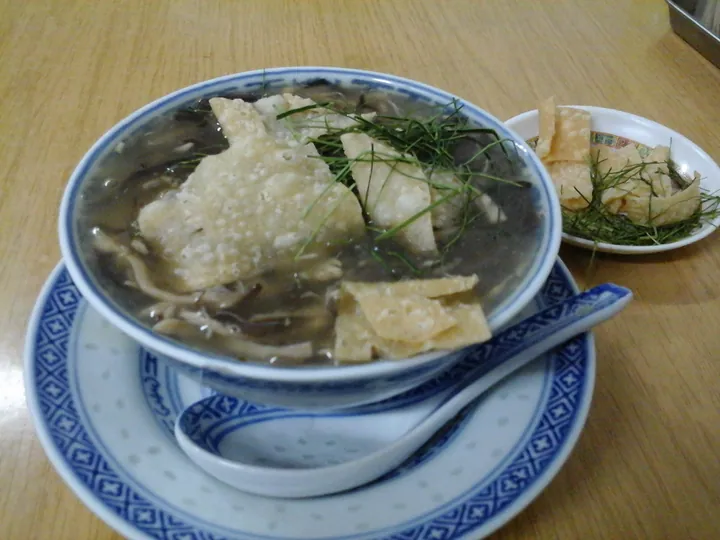
Thick Snake Soup (蛇羹) is a Cantonese thickened soup built on the shredded meat of at least two kinds of snake, eaten in Hong Kong both as a delicacy and as a warming tonic. It is mostly served in autumn and winter by specialist shops called 'snake kings' (蛇王), many of them in Sham Shui Po (深水埗) and Kowloon City (九龙城).
How it is made
The snake meat is pulled into fine threads. In one method it goes into a machine with stock so that it takes up the stock's flavour; in another it is boiled with chicken, pork bones, lean meat, fish maw, wood-ear fungus, ginger, lemon leaves and spices; the mixture is stewed for more than six hours. Salt, pepper and dark soy sauce season it. Other common additions are shredded shiitake (冬菇), goji berries, Sichuan pepper, star anise and snake bones.
The step that makes it a geng (羹) rather than a broth is the thickener, usually cornflour or water-caltrop paste, which leaves the soup thick but translucent. Water snakes and pythons are widely used; Chinese cobra, banded krait, Indo-Chinese rat snake, tri-rope beauty snake and hundred-pace viper also go into the pot, and many restaurants let diners choose a live snake.
Flavour and texture
Chrysanthemum and spices give the soup a faint sweetness. The meat is light pink; its texture and taste are likened to chicken, and it is richer and chewier than fish.
How it is eaten
A bowl comes with very finely shredded lemon leaves and white chrysanthemum petals, traditionally added to soften the saltiness. Diners also add white pepper, sesame oil and Zhejiang vinegar (浙醋), and eat it with thin wafers of fried dough (薄脆) or dan san (蛋散), a fried egg-dough pastry. When the preferred crab-claw chrysanthemum is scarce, boltonia takes its place. In Chinese tradition the soup counts as a 'warming' food, and it belongs to the cold months.
Where it comes from
Snake King Lam (蛇王林) is described as the first Hong Kong shop to specialise in snake soup; it opened on Bonham Street (般咸街) and later moved to Hillier Street (禧利街) in the same district. The trade had its heyday in the 1980s, when more than 100 eateries made snake soup. A well-known Cantonese variant, Taishi five-snake soup (太史五蛇羹), is credited to the late-Qing figure Jiang Kongyin (江孔殷), known as Jiang Taishi.
Sources & reading
Written from the linked sources and fact-checked against them on 2026-09-24. Recipes and servings vary between kitchens.
Image credits & notes (1)
- A bowl of Hong Kong-style snake soup (she geng) garnished with fried wonton crisps and shredded chrysanthemum leaves. · 蛇羹,配炸馄饨皮和菊花丝,港式做法。Photo: Ohconfucius (talk) (Uploads) · Ohconfucius at English Wikipedia · CC BY-SA 3.0 · taken 2013-12-15Resized for the web; the photo itself has not been edited. Thumbnails may show a cropped view.
