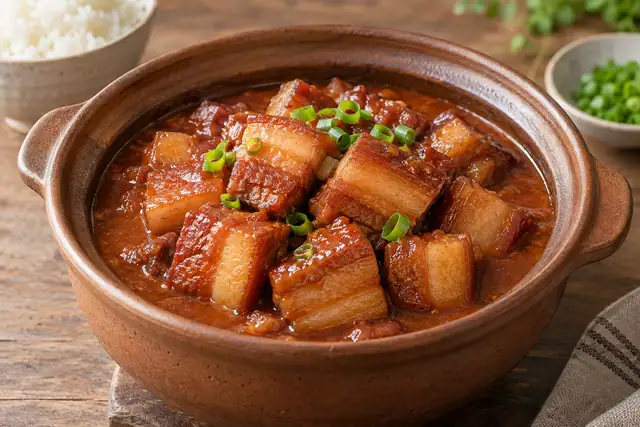
Lishan Pork Braised in Fermented Tofu 厉山腐乳炖肉
Lishan Pork Braised in Fermented Tofu is featured among the local specialties of Hubei.

Lishan Pork Braised in Fermented Tofu (厉山腐乳炖肉) is a Suizhou braise of pork simmered with fermented bean curd, listed among the local specialities of Suizhou in northern Hubei, where meat and poultry cooking dominates the table.
How the braise is built
Fu ru is fermented bean curd: tofu is inoculated with mould, salted and matured, which turns it into a soft, strongly savoury paste that is eaten as a condiment across East Asia. In cooking it is used as a seasoning rather than as an ingredient in its own right, exactly the role it plays here.
The braise follows the ordinary northern Hubei pattern. Pork, usually belly or a cut with some fat, is browned and then simmered with liquid until tender, and the fermented bean curd is worked into the sauce so that it seasons the meat and thickens the flavour. Dun in the name simply means simmering the ingredients together, and the result depends on how long the pot is left and how much of the bean curd goes in.
What it tastes like
This is a rich, salty, deeply savoury dish. Fermented bean curd brings a fermented tang and, depending on the type used, either a red tint or a pale one; red varieties are made with red yeast rice and taste fuller, while white varieties are milder.
Northern Hubei cooking is also described as leaning towards chilli, so a version served in Suizhou may carry heat on top of the salt. The pork should be soft enough to cut with chopsticks and the sauce thick enough to cling to rice.
Where it belongs
Suizhou falls in the northern group of Hubei cooking, which the province's cuisine literature covers together with Xiangyang and Shiyan, and which is built around meat and poultry dishes with a preference for chilli. Lishan is the town in Suizhou that gives this dish its name.
That is also why this dish reads differently from the soups and vegetable braises of the Wuhan plain. It is a cold-weather meat dish from a part of the province where the kitchen leans on preserved seasonings — cured meat and fermented bean curd — to carry a plain cut of pork.
Ingredients and dietary questions
The two fixed parts are pork and fermented bean curd. Cooks add ginger, garlic, soy, sugar or chilli, and some thicken the sauce with the mashed bean curd itself rather than with starch.
Fermented bean curd is a high-sodium food, so ask for the sauce to be served on the side if you are limiting salt. It is made from soybeans, so it is not suitable for anyone avoiding soy, and chilli is common enough in this part of Hubei that you should confirm before ordering if you want it mild.
How to order it
Say li shan fu ru dun rou (厉山腐乳炖肉). In Suizhou it is a home-style meat dish, ordered as one of several plates for a shared table rather than as a single portion.
Useful questions: how fatty the cut is, whether the sauce is red or white fermented bean curd, and whether chilli is added. If you are eating with rice, ask for the dish to come with the sauce a little looser, which makes it easier to spoon over.
How it reaches the table
The braise is served in a clay pot or a deep dish with the sauce still around the meat, and it is eaten with steamed rice and a plain green vegetable to balance the salt.
Because the flavour is strong, a small portion goes a long way. For two people, one braise plus a vegetable and a cold dish is usually enough.
More dishes to compare
Explore related local specialties and compare their names, preparation notes and ordering guidance.
Changyang Cured Pork Trotters 长阳腊蹄子 →
Changyang Cured Pork Trotters starts from cured pig's trotters, so the salt and smoke are built into the meat before cooking and the dish is defined by that cure. Li Shan Fu Ru Dun Rou starts from fresh pork and borrows its savour from fermented bean curd added in the pot. One is a preserved-meat dish; the other is a fresh-meat dish dressed with a preserved seasoning, which is a useful distinction when reading a northern Hubei menu.
Questions before you order
What is fu ru in the dish name?
It is fermented bean curd — tofu that has been mould-fermented, salted and matured. It is normally eaten as a condiment, and here it is used as the seasoning that flavours the braise.
Is the dish very salty?
Usually yes, because fermented bean curd is a high-sodium food and it is the main seasoning. Ask for the sauce to be served separately if you want to control how much reaches your rice.
Source introduction: Wikipedia contributors: 腐乳 · CC BY-SA 4.0 (Wikipedia text, attribution required). English guide adapted from the cited material, with additional preparation and ordering guidance.
Source introduction: Wikipedia contributors: 楚菜 · CC BY-SA 4.0 (Wikipedia text, attribution required). English guide adapted from the cited material, with additional preparation and ordering guidance.