

Songzi Chicken 松滋鸡
Songzi Chicken is featured among the local specialties of Hubei.
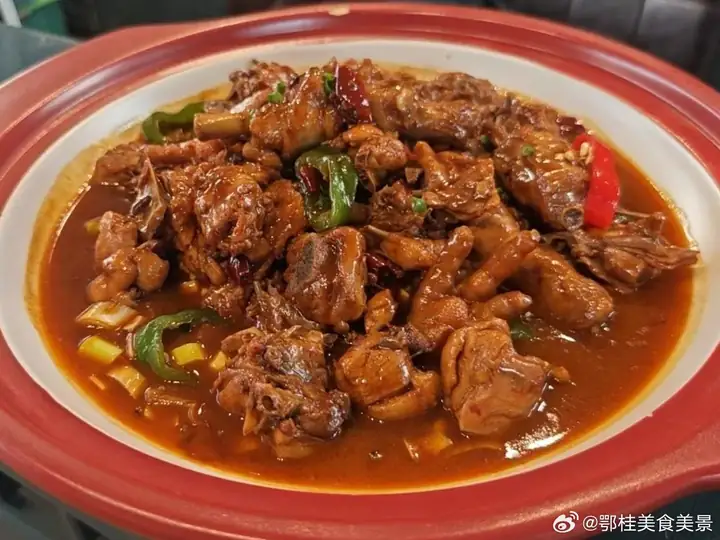
Image notes
Resized for the web; the photo itself has not been edited.
Songzi Chicken (松滋鸡) is farm chicken cooked in rapeseed oil and broad-bean paste and served in a pot, from Songzi (松滋) in Jingzhou (荆州), Hubei. It is also called Du Family Chicken (杜家鸡) or Granny Du's Chicken (杜婆鸡), after the woman in her seventies who, according to the Songzi city government, created it.
Where it comes from
China News Service tells the story this way: more than 70 years ago a Granny Du at a small restaurant in the town of Shadaoguan (沙道观) in Songzi cooked local farm chickens into a hotpot with a secret recipe and a strong bean-paste flavour. Long-distance drivers and travelling traders made detours to eat it, and word of mouth spread its name. For the original, China News Service sends diners to Shadaoguan, to order a pot of chicken with a few small side dishes at a street restaurant.
Travellers carried the dish across the country, and in Wujiashan (吴家山), in Wuhan's Dongxihu District (东西湖区) about 300 kilometres away, a whole street of restaurants now serves Songzi Chicken.
How it is made
The birds are small and short-shanked, and most of them are raised free-range on the hills around Songzi. Cooks pick young birds of four or five months for braising and running chickens over ten months old for soup. Local rapeseed oil and broad-bean paste are the heart of the dish: the chicken pieces are fried dry in a little oil, then ginger, garlic, star anise and cassia go in, and the meat is turned until golden. The secret bean paste follows, then stock, and the pot simmers for about 15 minutes. The best-known local way is to cook it over a large round firewood stove, with a small hole cut in its side for cooking rice.
Flavour and texture
The Songzi government describes the chicken as golden, firm and chewy, fragrant, rich without being greasy and properly spicy, and notes that the pot is almost all chicken rather than padded out with cabbage or tofu sheets. It is salty and savoury in the Hubei (Chu) style, with a strong bean-paste aroma, and is eaten with rice cooked over the wood fire.
Sources & reading
Written from the linked sources and fact-checked against them on 2026-09-24. Recipes and servings vary between kitchens.