

Yingcheng Braised Pork Hock 应城扒肉
Yingcheng Braised Pork Hock is featured among the local specialties of Hubei.
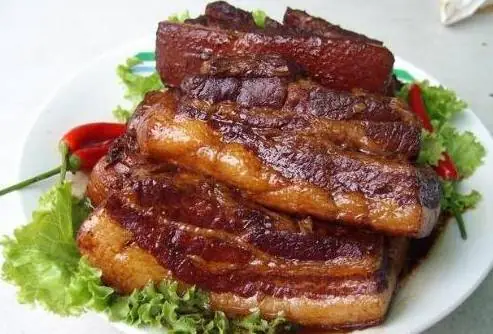
Photo adjustments
EXIF orientation normalized; resized without changing aspect ratio; converted to WebP. No subject edits.
Yingcheng Braised Pork Hock (应城扒肉) is a braised pork-hock dish from Yingcheng in Xiaogan, Hubei, listed by the municipal government as a traditional dish with 蹄膀 as its main ingredient and described as golden, full-flavoured and 肥而不腻.
How the dish is built
扒 names a treatment rather than an ingredient: a slow, covered braise in which the piece is cooked until it can be served whole and soft, then often finished with a thickened sauce so the surface takes on a shine. The cut the Xiaogan municipal page names is 蹄膀, the pork hock — the lower leg with its thick skin and heavy connective tissue — which is precisely the cut that needs long, gentle cooking before it turns tender. The page's description of the finished dish as 色泽金黄, golden in colour, fits the caramelised, sugar-led branch of Hubei braising rather than a dark soy-led one.
Flavour and texture
A cooked hock eats in two registers. The skin and the layer beneath it turn soft and gelatinous, collapsing against the tongue; the meat inside keeps its fibres and shreds rather than slicing cleanly. The municipal description targets the combination directly: 香美醇鲜 for savoury depth, and 肥而不腻 for the balance that keeps the richness from becoming greasy. In practice that balance depends on how much fat is skimmed and how long the sauce is reduced, which is why two restaurants can serve the same dish and only one feels light.
The county behind the name
Yingcheng is a county-level city under Xiaogan, sitting in the middle of the Jianghan plain, and the municipal page introduces it as a well-provisioned place with lakes and waterways in every direction. The dish is listed under Xiaogan's speciality foods rather than as a restaurant signature, and the page describes it in the language of a traditional dish of the Han Chinese kitchen. That is the extent of the claim made here: the name belongs to the county, the main ingredient is the hock, and the cooking belongs to the braising tradition of the plain rather than to any one kitchen.
Ingredients and dietary checks
Pork hock is the whole of the protein, so this is not a dish to order around a pork-free diet. A braise of this kind usually carries soy, sugar, rice wine and a spice bag, so ask 咸不咸 (how salty is it), 甜不甜 (is it sweet) and 可以少放糖吗 (can you use less sugar) if the caramelised style matters to you. Ask 用的是什么油 (what oil is used) and 有没有放酒 (is cooking wine used) if you are avoiding alcohol, since a braise is exactly where it hides. Gluten can come in through soy sauce, so 有没有不放酱油的 (is there one without soy) is the question to ask.
How to order it
Order it as a shared plate and check the portion first: 一份够几个人吃 (how many people does one order serve) and 有没有小份 (is there a smaller portion). Useful follow-ups are 有骨头吗 (does it still have the bone), 可以切一下吗 (can you cut it up for us), 配米饭还是馒头 (does it come with rice or steamed bread) and 可以打包吗 (can you pack it to take away). If you want to see the dish before committing, ask 是什么部位 (which cut is it) — the answer should come back 蹄膀. And if the sauce is the attraction, ask 汁多一点 (a little extra sauce).
How to eat it and plan a table
Put it in the middle and treat it as the rich course. Spoon the sauce over plain rice or split a steamed bun to dip in it, then take a piece of the skin and a piece of the meat together — eaten separately, the meat reads dry and the skin reads heavy. One order covers three or four people alongside a vegetable and a soup, and a sharp, vinegary side dish resets the palate between mouthfuls.
More dishes to compare
Explore related local specialties and compare their names, preparation notes and ordering guidance.
Huangzhou Dongpo pork 黄州东坡肉 →
Huangzhou Dongpo pork (黄州东坡肉) uses belly in neat blocks, cooked so the layers stay stacked and the sauce is dark and sweet; Ying Cheng Ba Rou is built on the hock instead, golden rather than dark, and served as a soft piece of skin and meat rather than a squared block.
Questions before you order
What cut is in Yingcheng Braised Pork Hock?
The Xiaogan municipal page names 蹄膀 — the pork hock — as the main ingredient. That is the skin-and-collagen cut, and it is why the dish needs a long braise and ends up soft enough to cut with a spoon.
Is it very fatty?
It is rich by nature — the page describes it as 肥而不腻, full-flavoured without being greasy — but how well that balance is hit depends on the kitchen, so ask 有没有不肥的 (is there a leaner part) and order one order for three or four people with a sharp vegetable alongside.
Sources & reading
The supplied food list supports this name and regional association. The culinary terms below are explained as menu vocabulary; a local recipe, origin story and venue availability have not been independently verified.