

Steamed Rice-Field Eel 蒸鳝鱼
Steamed Rice-Field Eel is featured among the local specialties of Hubei.
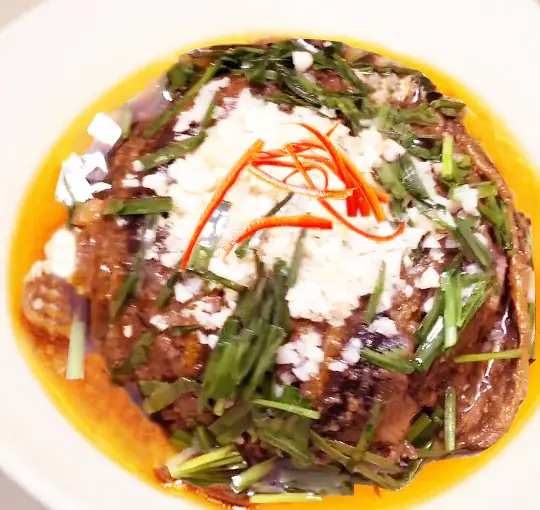
Photo adjustments
EXIF orientation normalized; resized without changing aspect ratio; converted to WebP. No subject edits.
Steamed Rice-Field Eel (蒸鳝鱼) is one of the steamed fish dishes of Tianmen (天门), a city on the Jianghan Plain of Hubei that promotes itself as China's home of steamed dishes. Its best-known form is cannon-steamed eel (炮蒸鳝鱼), which the Hubei Provincial Department of Culture and Tourism says is made best in the Ganyi (干驿) area, and which the Tianmen city government says was chosen for the State Council's protocol banquet menu in 2014.
How it is made
Accounts of the name differ. The Hubei culture department describes cannon steaming as a way of rice-meal steaming scaleless fish in which, it is said, the skin is treated with scalding-hot oil until it blisters, and says only Tianmen cooks still make it. A Jimu News (极目新闻) report produced with Tianmen's media centre describes the eel being steamed first and then doused with hot oil to release its aroma, the oil said to crackle like firecrackers.
The Tianmen city government traces the name to Ganyi's restaurant steamers before the 1960s. A small bamboo steamer (馏子) of eight to ten tiers stood in a round hole on an upturned fir-wood steam basin, and the stack looked like a cannon aimed at the sky, with steam rising like gun smoke. Large steamers have replaced the tiers, but the burst steaming over a fierce fire has not changed.
Flavour and texture
The city government sums up what Ganyi cooks want from their fish as gun (滚), lan (烂) and dan (淡). The fish is served scalding hot, cooked until the flesh comes off the bones while each piece keeps its shape, and seasoned without being too salty or sour, so its faint sweetness shows and no fishy smell remains. The Hubei culture department calls cannon-steamed eel smooth and appetising, and Jimu News says the flesh is as soft as tofu. Tianmen also makes clear-steamed eel (清蒸鳝鱼), steamed in seasoned stock, which the department describes as tender and fragrant.
Where it comes from
Ganyi lies between Chen Lake (沉湖) to the south and Huayan Lake (华严湖) and Songshi Lake (松石湖) to the north. Its three steamed fish (干驿三蒸) are cannon-steamed eel, clear-steamed soft-shelled turtle and rice-meal steamed snakehead, and a celebration or guest banquet there without them is thought much the poorer. Jimu News reports that families often cook cannon-steamed eel for honoured guests and serve it as the signature dish at festivals and family celebrations.
Ganyi also makes an eel roll, jijiu rang shan (祭酒瓤鳝): flattened eel pieces are rolled round minced lean pork, tied with chives, coated in starch, fried, steamed and dressed with scalding oil and vinegar. It commemorates Lu Duo (鲁铎), a Ganyi man who served as chancellor (祭酒) of the Ming imperial academy, because tying chives (系韭) sounds like his title.
Sources & reading
Written from the linked sources and checked sentence by sentence against quoted extracts by a separate reviewer on 2026-09-24. Recipes and servings vary between kitchens.