

Qifengdu Fish Rice Noodles 栖凤渡鱼粉
Qifengdu Fish Rice Noodles is featured among the local specialties of Hunan.
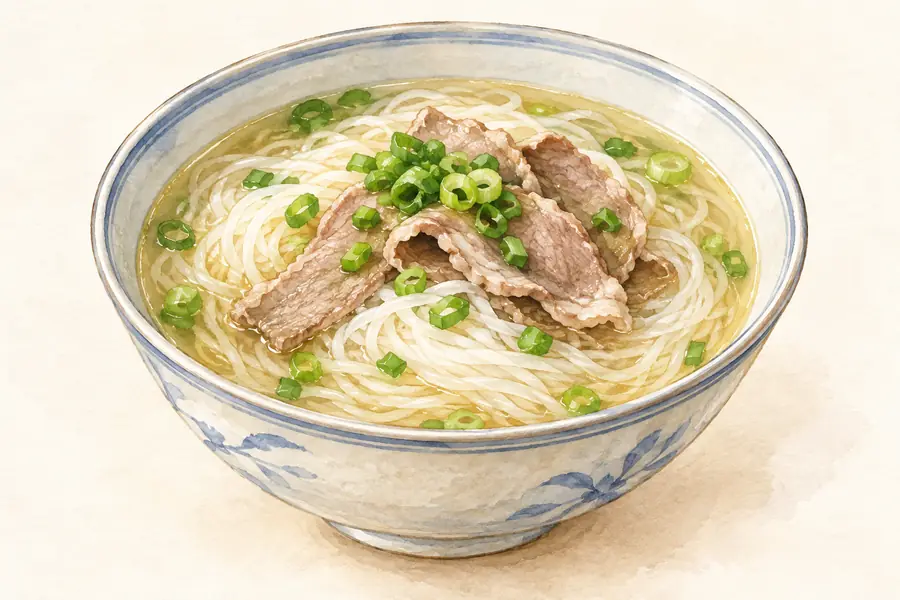
Qifengdu Fish Rice Noodles (栖凤渡鱼粉) are rice noodles served in fish broth, named after Qifengdu (栖凤渡), a town in Suxian district (苏仙区) of Chenzhou (郴州). The making technique was entered on Hunan's provincial intangible cultural heritage list in 2016.
How it is made
Wu Anying (吴安英), a third-generation inheritor of the technique who was 75 when Hunan Daily visited her in 2023, says a bowl goes through three stages, preparing the noodles, simmering the broth and cooking the noodles, in sixteen steps in all, which together give fragrant noodles, a fresh broth and a clean, spicy heat. The noodles are blanched in boiling water until they turn translucent. In the bowl they get a large ladle of fish broth simmered until milky white, then chilli oil fresh from the pan and a scatter of chopped spring onion.
Ingredients and flavour
Wu holds that an authentic bowl needs local produce: tea-seed oil, ginger, douga (豆膏, a bean paste) and small rice chillies (米椒).
Where the name comes from
A local legend, which Wu told Hunan Daily, ties the dish to Pang Tong (庞统), the Three Kingdoms adviser to Liu Bei known as the Young Phoenix (凤雏). On his way to serve as magistrate of Leiyang (耒阳), he stopped at the old Xihe ferry (西河古渡), slept badly and woke at midday to find the inn sold out. The innkeeper bought a river silver carp from a passing fisherman, made a fish soup seasoned with bean paste and tea oil, and cooked dried rice noodles in it. In Pang Tong's memory the ferry was later called Qifengdu, "where the phoenix roosted", and the noodles took the same name.
How it is eaten
Qifengdu town and its surroundings have more than 40 fish-noodle shops, and deputy town head Huang Lifang (黄莉芳) told Hunan Daily that they sell the noodles at breakfast, lunch and dinner. The parking spaces beside National Highway 107 in the town are filled with cars from across China that are passing through. Many Chenzhou people eat a bowl before setting off on a business trip far from home, and some returning from elsewhere eat one first. A Chenzhou saying runs "walk a thousand li or ten thousand li, you still cannot leave Qifengdu behind" (走千里路、万里路,舍不得栖凤渡).
Sources & reading
Written from the linked sources and fact-checked against them on 2026-09-25. Recipes and servings vary between kitchens.