

Hunyuan liangfen 浑源凉粉
Hunyuan liangfen is a cold potato-starch jelly from Hunyuan County in Datong, served with Shanxi vinegar, chili oil, lotus beans and dried tofu. Its appeal is the contrast between a cool, springy base and sharp, crunchy toppings, and the bowl is a practical way to taste Hunyuan’s everyday food culture.
Tap any red Chinese text to hear it in Mandarin.
The bowl
Hunyuan liangfen is a local form of liangfen rather than a generic name for every Chinese starch jelly. Sources place it in Hunyuan County, at the foot of Mount Heng in Datong, and describe potato starch as the base that sets into a clear, white jelly.
The jelly is cut into broad strips or pieces and dressed to order. A Hunyuan-style condiment spread can include vinegar, garlic water, chopped scallions, cucumber, coriander and chili oil. The ingredients that make the bowl particularly recognizable are crisp lotus beans (莲花豆 Lián Huā Dòu) and chewy dried tofu (豆腐干 Dòufu Gān). Some reported versions also add a smoked chicken egg, so the toppings should not be assumed to be identical from one stall to the next.
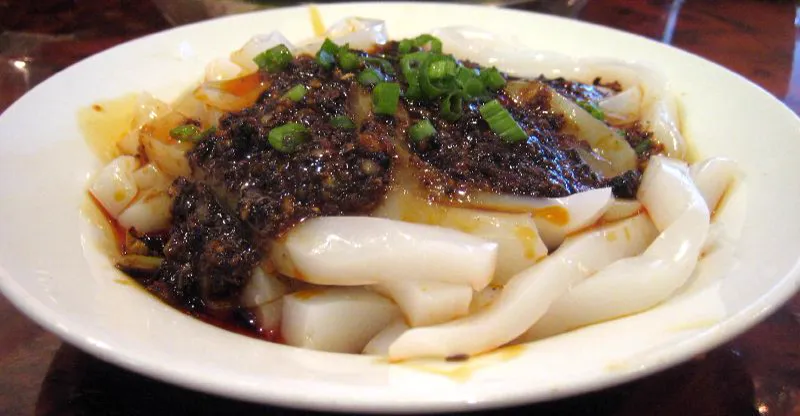
The first impression is visual: translucent white jelly, red chili oil and green herbs. The useful comparison is in the mouth. The set starch is cool, smooth and lightly resilient; vinegar and chili give it a sharp edge, while lotus beans and dried tofu add crunch and chew. Local descriptions use phrases such as “slippery,” “cool” and “spicy,” but the texture contrast is more informative than a claim that every bowl tastes the same.
Why it belongs to Hunyuan
Hunyuan liangfen is identified with Hunyuan rather than presented as a single Shanxi-wide recipe. A 2024 report describes the dish as a food passed down locally and says its preparation technique is listed as a Shanxi provincial intangible cultural heritage. The China Cultural Heritage platform also includes Hunyuan liangfen among Shanxi’s characteristic snacks.
A 2026 local report portrays liangfen as part of ordinary Hunyuan eating: family hospitality, casual gatherings, quick meals and seasonal refreshment all appear in its account. That is a useful clue for visitors. Look for the way the jelly is cut and finished at the counter, and pay attention to the small bowls of toppings; the dish’s local identity is carried as much by assembly and condiments as by the starch base.
How to order
Show the Chinese name 浑源凉粉 Hún Yuán Liángfěn when ordering. Ask which toppings are included that day, especially 莲花豆 Lián Huā Dòu, 豆腐干 Dòufu Gān, 辣椒油 Làjiāoyóu and 熏鸡蛋 Xūnjī Dàn. If you want to taste the plain jelly before the stronger seasoning, ask for the dressing or chili oil on the side where the vendor can provide it. Serving styles and recipes vary, so this is a comparison request rather than a fixed standard.
Do not infer dietary suitability from the pale jelly alone. The potato-starch base does not tell you whether a particular bowl includes egg, meat-related seasonings or a prepared chili oil. Visitors with vegetarian, allergy or spice requirements should ask about the toppings and dressing before eating.
Where to eat it
You can find Hunyuan liangfen all over Shanxi, so there is no need to seek out one particular restaurant. To find one near you, search for “浑源凉粉” in Meituan (美团) or Amap (高德地图) and check recent reviews, distance and opening hours.
More dishes to compare
Explore related local specialties and compare their names, preparation notes and ordering guidance.
Shanxi wantuo grain jelly 山西碗托 →
The batter is heated or steamed in small bowls until it sets. Once cooled, the resulting round is loosened and sliced into strips or pieces, ready for a cold dressing or, in some shops, a hot stir-fry. It has a smooth surface and a firmer, more substantial bite than a delicate dessert jelly. Vinegar sharpens the grain flavour, while garlic and chilli can make an otherwise mild base taste quite assertive.
Flower-shaped steamed dumplings 百花烧麦 →
Thin hot-water-dough wrappers are gathered around savory fillings and shaped with elaborate, open flower-like tops before steaming. Different flowers or filling combinations may appear within one assortment. The delicate, almost translucent edges contrast with a generous, moist center. Flavor depends on the selected meat or other filling.
Sources & reading
Recipes and servings vary between kitchens.
Image credits & notes (1)
- Northern Sichuan-style liangfen, photographed at a Chinese restaurant in Falls Church, Virginia, used here only as an illustrative regional comparison rather than a photograph of Hunyuan liangfen. Photo: Prince RoyPhoto: CC BY 2.0