

Milk Tea with Roasted Millet 炒米奶茶
Milk Tea with Roasted Millet is featured among the local specialties of Inner Mongolia.

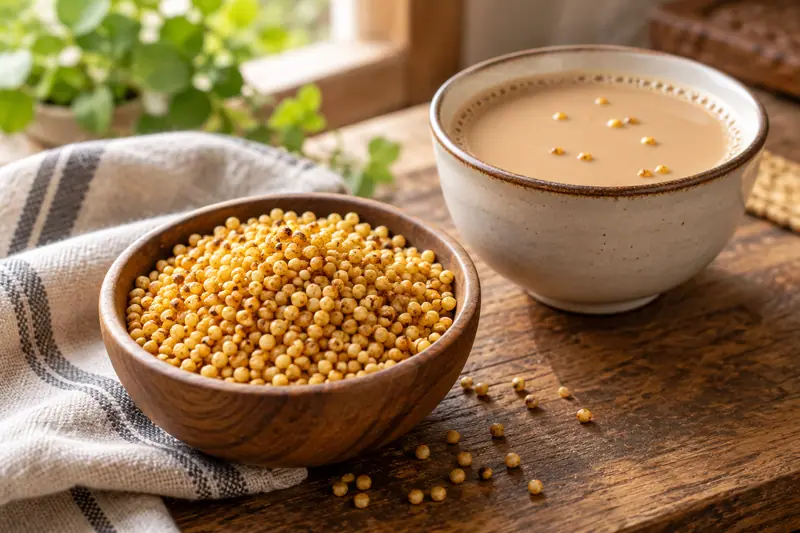
Milk Tea with Roasted Millet (炒米奶茶) pairs Mongolian milk tea with roasted millet (炒米), and in Tongliao (通辽), Inner Mongolia, roasted millet can be soaked in milk tea with butter and fresh milk curd. Inner Mongolia News describes Tongliao as the place where Mongols live in the greatest concentration, and says locals call roasted millet "Mongol rice" (蒙古米).
Ingredients
The grain is roasted proso millet. Tongliao's version is made from the hard proso millet (糜子) of the Horqin (科尔沁) grassland, and its making technique is listed as autonomous-region intangible cultural heritage. Newly harvested millet is first steamed, then stir-fried dry over a fierce fire mixed with fine sand; the sand is sieved out and the grain is husked in a stone trough. Inner Mongolia News describes the finished grains as yellow but not scorched, firm but not hard, glossy, crisp and sweet.
The tea is made from brick tea. In an account of Mongolian tea drinks from the Inner Mongolia gazetteer platform Fangzhi Neimenggu (方志内蒙古), republished by the Ulagai Administrative Area (乌拉盖管理区) government, green or black brick tea is crushed and boiled in a pot of water with constant stirring. After three or four minutes fresh milk is poured in slowly, and the tea is ladled over and over until tea and milk have blended into a light coffee colour. A little salt may be added.
How it is made
There are two ways of bringing the millet and tea together. For a cooked millet tea, the same gazetteer text has roasted millet or foxtail millet (小米) fried first in beef tallow or butter; brewed brick tea goes into the pot and simmers with it, and milk is added once the grain is cooked, so the drink smells of both tea and grain. The simpler way, which Inner Mongolia News gives for Tongliao, is to soak the roasted millet in milk tea and add butter and fresh milk curd (奶豆腐).
How it is eaten
Mongol milk tea may also be enriched with milk skin (奶皮子), cream, milk curd or air-dried meat. Herders still keep the habit of drinking milk tea in the morning and at midday, and a pastoral saying holds that one can go a day without a meal but not a day without tea.
Sources & reading
Written from the linked sources and fact-checked against them on 2026-09-24. Recipes and servings vary between kitchens.