

Guyang Naked-Oat Noodles 固阳莜面
Guyang Naked-Oat Noodles is featured among the local specialties of Inner Mongolia.
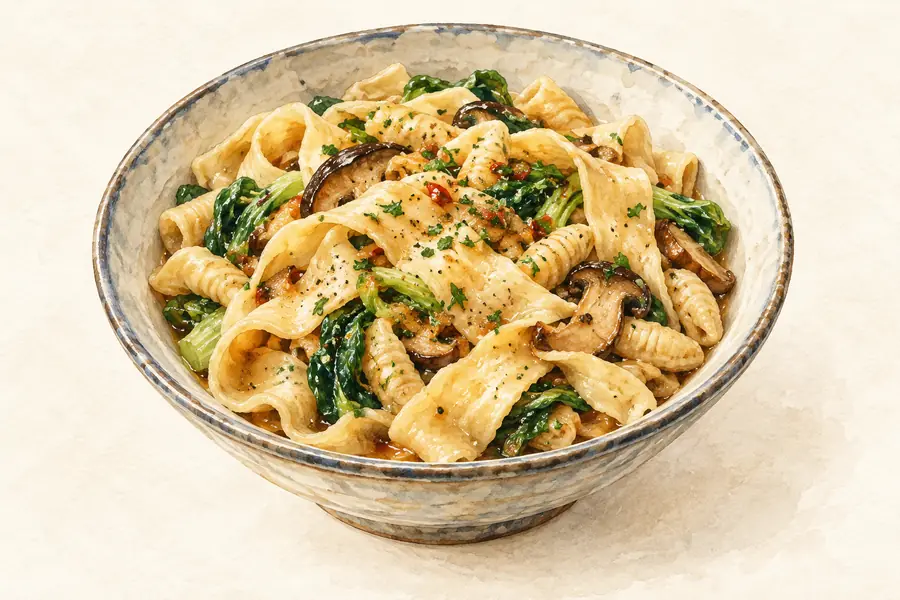
Guyang Naked-Oat Noodles (固阳莜面) are made from youmian (莜面), the flour milled from naked oats (莜麦) grown in Guyang County (固阳县) in Baotou (包头), Inner Mongolia. The dough is rubbed, pushed and pinched by hand into strands, rolls and little dumplings, many of them steamed and dipped in a sauce each diner mixes for themselves.
Ingredients
Naked oats are a hulless oat: an annual grass that tolerates cold and drought, has a long growing season and grows on high, cold uplands. Inner Mongolia News Network (内蒙古新闻网) writes that Guyang farmers grow it in the traditional way without chemical fertiliser or pesticides, and counts Guyang youmian the best in Inner Mongolia, quoting the local saying that Guyang naked oats are the best under heaven. Locals count the flour among Guyang's 'three treasures' (固阳三宝), and China Daily reports that it is one of eight Guyang farm products approved by the Ministry of Agriculture and Rural Affairs for agricultural-product geographical-indication protection, which locals call the 'eight treasures of Guyang' (固阳八宝).
How it is made
The Inner Mongolia intangible-heritage platform lists the hand techniques as rubbing, pushing, pinching, pressing, stirring and kneading. They give a family of named shapes: rubbed strands (搓条条), pushed rolls called wowo (推窝窝), pinched 'little fish' called yuyu (捏鱼鱼), rolled dundun (卷囤囤), dumplings (包饺饺), stir-fried kuailei (炒快垒) and pressed hele noodles (压饸饹).
A People's Daily Online (人民网) piece reprinted by Nongjia Shuwu (农家书屋) magazine groups youmian dishes into five cooking methods: steaming, deep-frying, quick-boiling, griddle-baking and stir-frying. Steaming alone has 17 common styles, among them wowo, yuyu, dumplings and golden sticks (金棍).
How it is eaten
Youmian is eaten hot or cold, and can be dressed cold with vegetables and a spicy broth. The flour itself has little taste, so each diner mixes their own dip, sour, spicy, salty or sweet, and dunks each mouthful. At Guyang's Qin Great Wall culture and tourism festival, reported by China Daily in 2023, 1,001 people rolled youmian together, an attempt recognised by Big World Guinness (大世界基尼斯) as the largest youmian-rolling group, and the result was served with a mutton and potato soup cooked in a pot 2.4 metres across.
Where it comes from
Youmian food-making techniques (莜面饮食制作技艺), nominated by Guyang County, were entered on Inner Mongolia's first autonomous-region intangible-heritage list in 2007 as item NMVIII-4. The listing notes that farmers of the Houshan (后山) area began growing naked oats as early as the Wei, Jin and Northern and Southern dynasties. Cultivation spread after the Daqing Mountains (大青山) were opened to farming in the Qianlong reign of the Qing, and the northern foothills of the Yin Mountains (阴山) remain the main naked-oat growing area.

Sources & reading
Written from the linked sources and checked sentence by sentence against quoted extracts by a separate reviewer on 2026-09-24. Recipes and servings vary between kitchens.