

Hetao Cold Wheat Sheet Noodles 河套面筋
Hetao Cold Wheat Sheet Noodles is featured among the local specialties of Inner Mongolia.
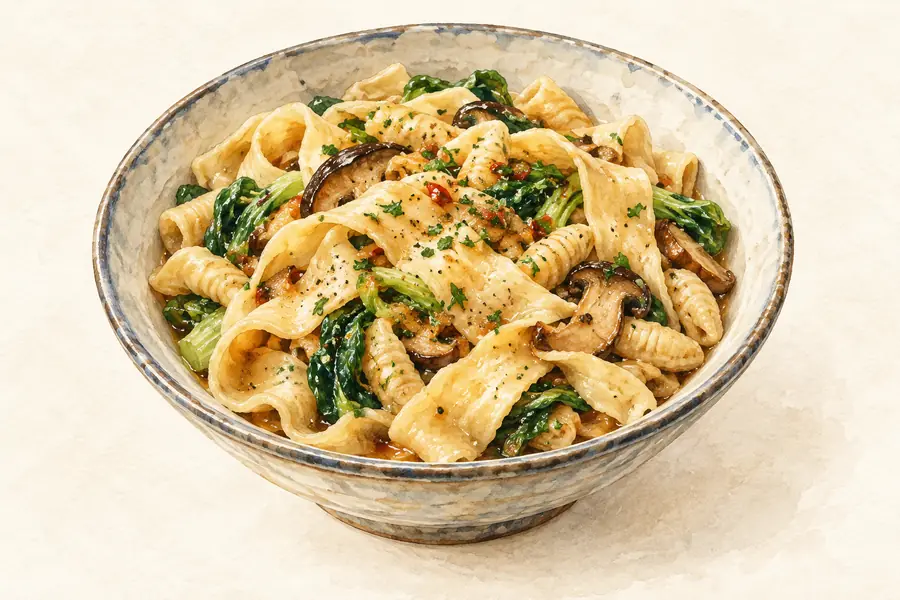
Hetao Cold Wheat Sheet Noodles (河套面筋) are a cold dish known to every household in Bayannur (巴彦淖尔): glossy, springy sheets made from wheat flour, cut into strips and dressed with sauces. In the Hetao (河套) area the dish is also called niangpi (酿皮); the Bayannur Daily notes that the same food goes by liangpi (凉皮, "cold skin") in Shaanxi, Gansu and Ningxia.
How it is made
A local legend retold by the Bayannur Daily describes the method. Flour is mixed into a dough and kneaded repeatedly in water; once the batter has settled it is strained, and the liquid is poured evenly over an iron tray set in boiling water. After a few minutes it sets into a shiny thin sheet. The leftover dough is steamed until it puffs into honeycombed pieces. The cooled sheet is cut into long strips and put in a bowl with the honeycombed pieces, chopped vegetables and seasoning liquids, and everything is tossed together.
The Bayannur Daily puts the dish's quality down to Hetao flour, which it says the noodle-pulling master Li Enhai (厉恩海) used to set a Guinness world record for the number of strands pulled from one kilogram of flour.
Flavour and texture
The Bayannur Daily describes the sheets as bright and translucent, shaped like rubber bands, chewy and elastic, and says that for this reason they have long also been called mianjing (面精, "essence of flour"). Inner Mongolia Daily describes the texture as smooth and chewy and the taste as fresh and clean, and a shop owner in Linhe (临河) says customers want it during the Spring Festival because it cuts through the rich food of the holiday.
Where it comes from
A local story credits Wang Zhaojun (王昭君), who lived for years at the Jilu Pass (鸡鹿塞) in the Hetao area with her husband Huhanye Chanyu (呼韩邪单于). Missing her mother's rice noodles where there was no rice, she is said to have made the sheets from wheat flour instead; the dish was named "Zhaojun bright skin" (昭君亮皮), later "Zhaojun cold skin". The China Culture Daily lists Hetao mianjin as one of the four Hetao snacks among the twenty Hetao flavours, alongside fried sour porridge (炒酸粥), roubeizi (肉焙子) and tangmaye (糖麻叶).
In Bayannur the dish is eaten at every point from breakfast to afternoon tea. At the Spring Festival, mianjin shops in Linhe District vacuum-pack it, and Bayannur people who live elsewhere carry it back with them as a New Year gift.
Sources & reading
Written from the linked sources and fact-checked against them on 2026-09-24. Recipes and servings vary between kitchens.