

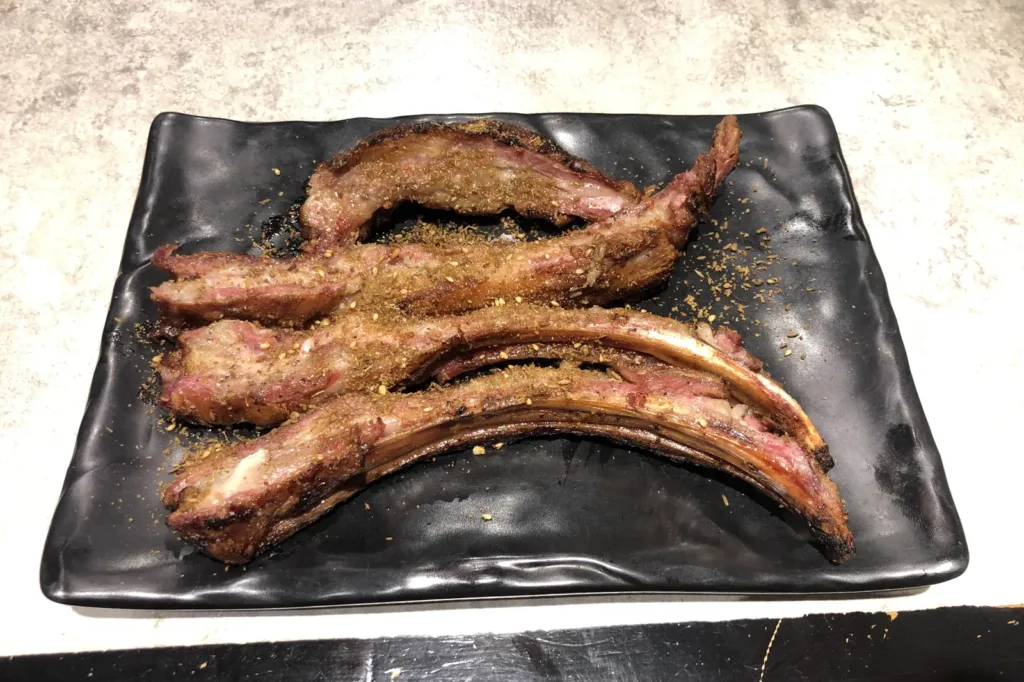
Roast Lamb Ribs 烤羊排
A Hulunbuir-associated grilled lamb dish: local sources describe grassland lamb ribs marinated and cooked over fire, while the actual cut, seasoning and venue vary by kitchen.
Tap any red Chinese text to hear it in Mandarin.
A Hulunbuir barbecue, not a fixed recipe
Roast lamb ribs (烤羊排, kǎo yángpái) belong to Hulunbuir’s broad grassland-lamb barbecue repertoire. A local-food page sourced to the Inner Mongolia Culture and Tourism Department lists roast lamb leg and ribs together, describes barbecue as a common way to cook in Hulunbuir, and says that local grassland lamb is marinated before it is grilled. That makes the dish a useful way to taste the region’s lamb culture, but not proof of a single citywide recipe or of a Hulunbuir invention.
The wider food context matters. Hulunbuir is an important mutton-producing area, and a 2020 grassland-lamb food festival treated Hulunbuir lamb as a regional product. The festival’s featured dishes included whole roast lamb, hand-held lamb, blood sausage, lamb vertebra and air-dried lamb; it did not establish roast ribs as a formally defined signature dish. In other words, order the ribs as a local association, not as a dish with one official cut, seasoning or cooking time.
What to look for on the plate
The documented local method is deliberately simple: marinate the ribs, then cook them over heat. The marinade and finishing seasoning are kitchen-specific, so the same Chinese name can produce a plain, salt-forward rack in one place and a more heavily seasoned barbecue in another. There is no reliable local source for one mandatory spice blend or roast time. Ask what is used before ordering if you need to avoid particular ingredients.
A government-hosted overview of Hulunbuir’s food culture connects its cooking to grassland ingredients and the area’s multi-ethnic traditions. Its detailed examples include whole goat cooked with heated cobbles, while a Xinhua report describes stone-roasted lamb and hand-held lamb as separate local practices. Those examples help explain why fire, bone-in meat and restrained seasoning recur in the region, but they should not be copied into every plate of roast ribs as though they were one recipe.
As you eat, judge the actual serving in front of you: look for meat browned by the grill, a texture that is tender rather than dry, and seasoning that lets the lamb remain recognisable. Ribs are usually a sharing order, but the rack size, amount of fat and degree of trimming vary. A sauce or spice at the table may also differ from the marinade. If you have an allergy, ask about the marinade, finishing sauce and shared grill rather than relying on appearance.
How to find it without chasing a “famous” restaurant
Search for 烤羊排 Kǎo Yángpái on Meituan (美团) or Amap / Gaode Maps (高德地图). If a citywide search is ambiguous, add 海拉尔 Hǎilā’ěr or 呼伦贝尔 Hūlúnbèi’ěr. Before choosing, check the menu, recent reviews, opening information and whether the dish is available today. A Hailar tourism guide lists roast lamb ribs among the foods found in a local food-street setting, which is useful as a lead to an urban dining area, not as a current endorsement of a particular shop.
This is a dish, not a venue. It has no ticket, single entrance, official visitor route or universal return connection. Once you choose a current restaurant or food area, use its live map listing for the final walk or taxi leg and arrange your return from that actual address. Do not assume that a grassland stop, a food street or a restaurant listed in an older guide will still serve ribs today.
A practical order
Use the Chinese name 烤羊排 Kǎo Yángpái when showing a menu or making a map search. Confirm whether the portion is a whole rack or cut pieces, how it is seasoned, and whether it is grilled to order. Share it with a simple side or the venue’s local accompaniments, and let the lamb’s texture tell you more than a ranking or a promotional label. Recipes and daily availability vary between kitchens.
Sources & reading
Image credits & notes (1)
- Grilled lamb ribs photographed at 25 Dongxiejie Barbecue in Beijing; used here as a visual dish reference, not as a photograph of Hulunbuir. Photo: N509FZPhoto: CC BY-SA 4.0