

Liangcheng Chopped Sheep Offal 凉城县羊杂碎
Liangcheng Chopped Sheep Offal is featured among the local specialties of Inner Mongolia.
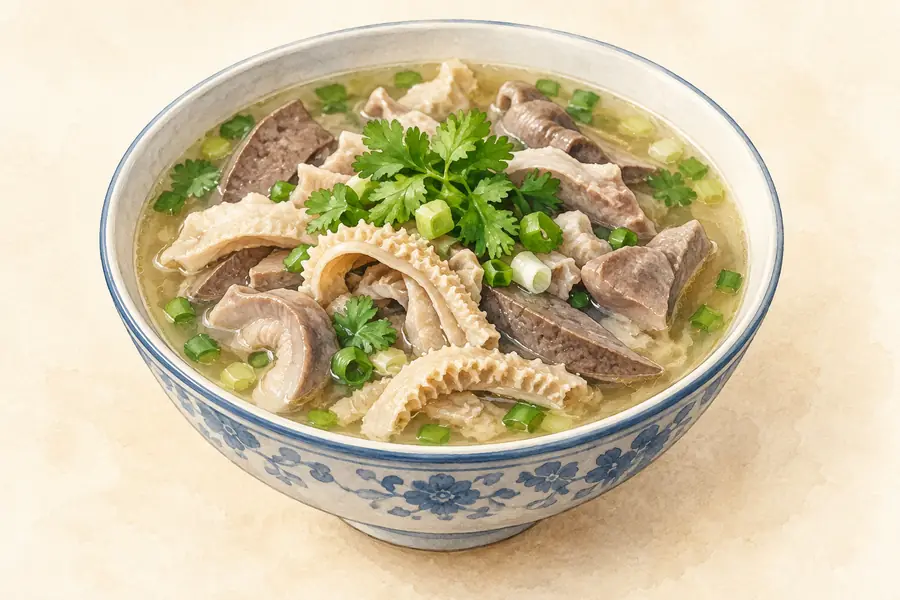
Liangcheng Chopped Sheep Offal (凉城县羊杂碎) is a sheep-offal dish from Liangcheng in Ulanqab, Inner Mongolia; 羊杂 is sheep offal and 碎 says the pieces are cut small.
Turning offal into a bowl
Offal cooking is cleaning first. Liver, heart, stomach, intestine and lung each need different handling: the stomach and intestine are scrubbed and repeatedly rinsed, sometimes with salt, flour or vinegar to pull out the strong smell, and tougher parts may be simmered separately until they soften. Only then is everything cut into small pieces and returned to a pot with a broth of bones, aromatics and, in some kitchens, chilli. Cooking times differ, so the parts that soften slowly go in first. The final texture should be tender with a slight resistance rather than uniform.
Mineral, savoury, chilli-edged
The flavour is distinctly organ meat: mineral and savoury, richer than muscle meat from the same animal. A well-made bowl is not bitter and not overpowering, because the cleaning removed what makes offal unpleasant. Chilli oil, coriander and vinegar are the usual finishing moves, and they cut the fat that comes with stomach and intestine. Textures vary piece to piece, from soft liver to springy stomach, which is the point of the dish and also why a first bowl should be ordered small, with a plain staple on the side.
Counties put their name on bowls
Offal stews are common across northern China, so the place in front of the name is what distinguishes one from another on a menu. Liangcheng sits in Ulanqab, and the entry is listed for that place rather than for the region. What the title says, in practice, is where the bowl comes from; what it does not say is how it is spiced or which organs are in it. Two bowls carrying the same district name can still differ from vendor to vendor along the same street.
Ingredients and dietary checks
The bowl is built on sheep offal, water and salt, with aromatics such as ginger, spring onion and garlic. Some versions use a bone broth and add vinegar, chilli oil, coriander or ground pepper at the table; some thicken the liquid with starch. Noodles or vermicelli may be put in the bowl as a staple. If you avoid wheat, ask 有面吗 (does it contain noodles) and 用酱油吗 (is soy sauce used). If you avoid coriander, ask 有香菜吗, since it is usually scattered on top by default.
How to order
Show 凉城县羊杂碎 and ask 大碗还是小碗 (large or small bowl) first, because the sizes vary a lot and a small one is a fair first try. Then settle 辣不辣 (how spicy) and 多放香菜吗 (plenty of coriander or none), since both are added at the last moment. Ask 里面有什么 (what is inside) if you want to know which organs are included, and 有面吗 (does it come with noodles) if you want it as a full meal. Many shops serve it from early morning, and it often sells out.
Eating it and building a meal
Stir the bowl before you start, because the chilli oil and the heavier pieces sit at the top and the broth underneath is milder. Eat it hot with a flatbread or a plain steamed bun to mop up the liquid, and keep the tea coming. It works as a substantial breakfast or a lunch, and it is heavy enough that a second dish is rarely needed. If you are sharing, order a small bowl each and a plate of bread to pass around rather than one large bowl for the table.
More dishes to compare
Explore related local specialties and compare their names, preparation notes and ordering guidance.
Sheep Offal in Broth 羊杂碎 →
Sheep Offal in Broth (羊杂碎) is the plain title for this dish: sheep offal cleaned, cut small and simmered, the version that appears across northern China under one name. Liang Cheng Xian Yang Za Sui adds a place name, which is how a vendor tells you whose bowl this is. The contents and the seasoning still come from the kitchen, so reading the two together is a quick lesson in how local naming works on northern menus.
Questions before you order
What exactly is in the bowl?
Mixed sheep offal, usually liver, heart, stomach and intestine, cut small and simmered in broth, often with noodles. Ask 里面有什么 (what is inside) if you want to know which parts a particular vendor uses.
Is it very spicy?
Often it has a chilli edge, but the heat is usually added at the end. Ask 辣不辣 (how spicy) and 不放辣 (no chilli) before it is served, since the oil goes on last.

Sources & reading
The supplied food list supports this name and regional association. The culinary terms below are explained as menu vocabulary; a local recipe, origin story and venue availability have not been independently verified.