

Dingzui Pork Stewed with Daylily 丁嘴金菜烩肉
Dingzui Pork Stewed with Daylily is featured among the local specialties of Jiangsu.
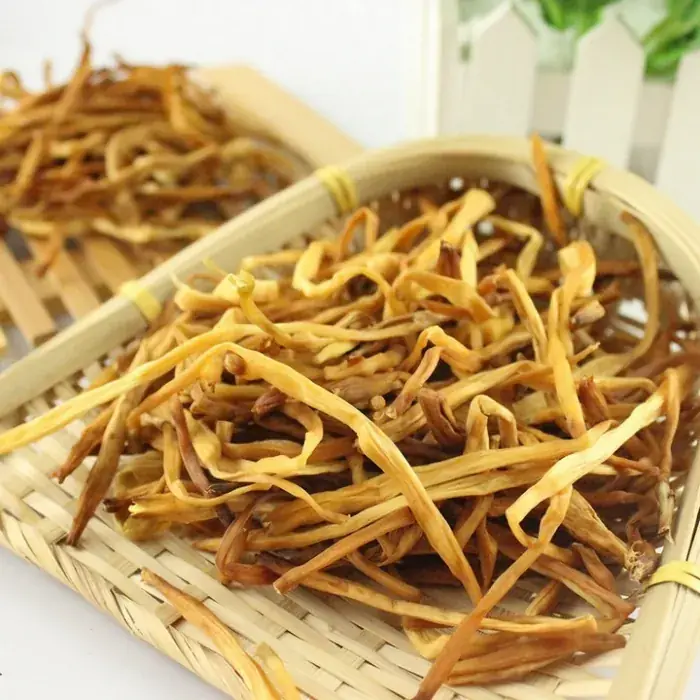
Photo adjustments
EXIF orientation normalized; resized without changing aspect ratio; converted to WebP. No subject edits.
Dingzui Pork Stewed with Daylily (丁嘴金菜烩肉) is a Suqian dish built on Dingzui's dried daylily, the local golden-needle vegetable, stewed with pork. The vegetable is the reason the dish exists.
The vegetable comes first
The district government's heritage page describes how Dingzhuang's daylily is made: the flower buds grown locally are picked by hand, steamed, sun-dried, sorted and then stored. The technique has been passed down in Dingzui township for 1,800 years according to the Suyu district government.
That processing is what turns a fresh flower bud into a dry vegetable that can be kept and cooked. Drying concentrates the flavour and firms the texture, which is why daylily is used in braises rather than eaten raw. The dish itself pairs the soaked daylily with pork and simmers the two together, so the vegetable takes up the meat juices while keeping its own bite.
Firm strands, savoury sauce
The page's description of the local daylily is unusually specific: large flowers with thick flesh, long and evenly cut, pale yellow in colour, dry with a sheen, firm and soft, and holding up through long cooking with a slightly crisp bite.
Those qualities are exactly what a braise needs. A vegetable that keeps its shape and texture after simmering can be cooked with pork without collapsing, and it keeps the dish from turning into a soft stew. The page also records the flavour as fresh and the flesh as tender, with sugar, protein, vitamin C, calcium, fat and carotene among its nutrients.
A township's crop with prizes
Dingzhuang's daylily is grown across Dingzui, Daxing, Yanghua and Guanmiao townships, with Dingzui's own crop the most famous of the local varieties. Merchants from Shanghai and Zhenjiang were already buying it through local brokers in the late Qing and Republican periods and shipping it to Zhejiang, Guangdong, Shanghai and southern Jiangsu.
The Suyu district government records two exhibition outings: the product was shown at the Nanyang industrial exposition in 1910 and at the Panama international exposition in 1938, where it won a gold award. In the 1990s it was one of Jiangsu's best-known local products and demand outstripped supply. Its status is now formal. The Dingzhuang daylily processing technique was listed as a municipal intangible heritage project in December 2007, the Dingzui golden-needle vegetable received national agricultural product geographical indication registration in January 2016, and the local production system was named a China important agricultural heritage site in January 2020.
Daylily and pork
The two components are the dried golden-needle vegetable and pork, with the usual braising seasonings. The vegetable is the distinguishing part, and the local varieties named by the page include the large black-beak type, which is the best known of them.
Pork is essential to the dish's name, so it is not a vegetarian preparation. Because daylily is dried before use, the vegetable must be soaked and rinsed well, which is a step worth asking about if the taste of the finished dish seems sharp.
Ordering it
Ask for it by name in Suqian restaurants that serve local food. The Suyu district government notes that the region's dried daylily can be cooked into more than ten hot and cold dishes, so the vegetable appears in several forms rather than only one.
Buying the dry vegetable is the easier route outside Suqian. It is sold packed, keeps well, and is the ingredient that carries the place name.
At the table
It is served as a warm dish with rice, in the same role as other Jiangsu braises: an everyday main plate rather than a banquet showpiece.
Because the vegetable holds its texture, the dish also eats well as a leftover, which is unusual for a braised vegetable and is part of why the local crop is valuable to cooks.
More dishes to compare
Explore related local specialties and compare their names, preparation notes and ordering guidance.
Crystal pork terrine 水晶肴肉 →
Zhenjiang's crystal pork terrine is a cold, jellied pork dish cut into neat blocks and eaten with vinegar and ginger. Dingzui's daylily braised with pork is a hot stew in which the vegetable, not the meat, is the point. One depends on setting and slicing, the other on a dried crop that survives long cooking.
Questions before you order
What is jin cai?
It is the local name for the golden-needle vegetable, or daylily. The Suyu district government records that the Dingzhuang daylily is also called yellow-flower vegetable and is the flower bud of a herbaceous plant.
How is the vegetable processed?
By hand picking, steaming, sun drying, sorting and storing, according to the district government's heritage page. The technique has been listed as a municipal intangible heritage project since December 2007.
Sources & reading
The supplied food list supports this name and regional association. The culinary terms below are explained as menu vocabulary; a local recipe, origin story and venue availability have not been independently verified.