

Rugao Dong Candy 如皋董糖
Rugao Dong Candy is featured among the local specialties of Jiangsu.
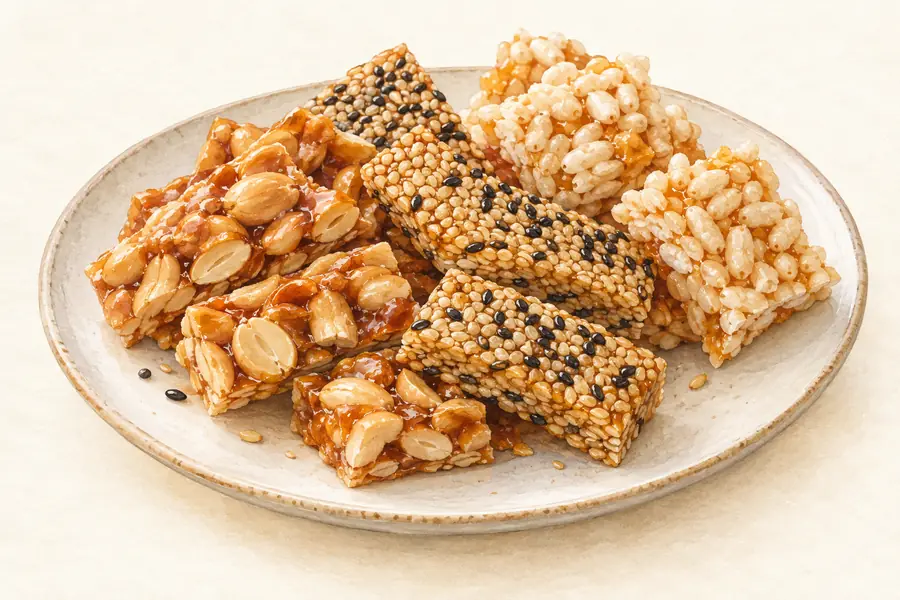
Rugao Dong Candy (如皋董糖) is a crumbly, layered sweet from Rugao (如皋), Jiangsu, made from roasted barley flour, sesame and malt syrup and cut into small squares. It is named after Dong Xiaowan (董小宛), a courtesan of the late Ming who is said to have invented it, and it is listed as a Jiangsu provincial intangible cultural heritage item.
How it is made
Good barley is cleaned, roasted with fine yellow sand until the grains split, freed of the sand and ground into a roasted flour called jiaoxie (焦屑). Sesame seeds are roasted and ground, the husks separated, and the kernels roasted again to a pale yellow; too little heat leaves them without aroma, too much makes them bitter.
The core step is the sugar bone (糖骨): malt syrup (饴糖) cooked slowly over a low flame in an iron wok, with experienced masters setting the heat and time by the season so that it stretches well. Once cool, it is rolled thin, dusted with the barley flour and sesame powder, kneaded repeatedly, pressed into shape with three long wooden strips and cut into squares about an inch across.
Flavour and texture
The pieces are white with a yellowish tinge, and the cut face shows a spiral grain likened to tree rings. The sweetness of the syrup mixes with a crumbly fragrance. The essayist Yu Bin, writing for Shanghai Observer (上观新闻), says it eats more like a pastry than a sweet: loose and powdery rather than crisp, and hard to eat without getting flour on your fingers.
Where it comes from
Dong Xiaowan, one of the 'Eight Beauties of Qinhuai' (秦淮八艳), married the scholar Mao Pijiang (冒辟疆) and after the fall of the Ming lived with him at Shuihui Garden (水绘园) in Rugao. The Qing book Chongchuan Zhiwenlu (崇川咫闻录) records that she made the candy and sent it to Mao from Qinhuai before joining him. Local accounts add that in Rugao she made it with roasted barley flour, black sesame and malt syrup, and that Mao often served it to guests. A rival story from Gaoyou (高邮) credits the Ming scholar Dong Lin (董璘), who made the sweet for his elderly mother.
In Rugao the craft passed through the Qilinge (麒麟阁) tea-snack shop, founded at the end of the Qing dynasty. Duan Haoxiang (段昊翔) of the Qilinge food factory carries it on and became a representative inheritor of the provincial heritage item in 2020.
How it is eaten
Each square is traditionally wrapped in coloured paper and packed into gift boxes. In Rugao people sit in their courtyards with a pot of tea and a few squares of Dong candy.
Sources & reading
Written from the linked sources and checked sentence by sentence against quoted extracts by a separate reviewer on 2026-09-24. Recipes and servings vary between kitchens.