

First Delicacy Under Heaven 天下第一鲜
First Delicacy Under Heaven is featured among the local specialties of Jiangsu.
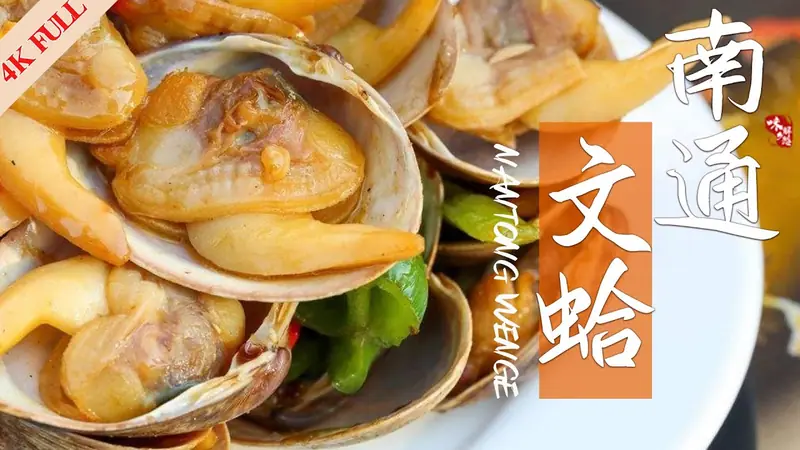
Image notes
Resized for the web; the photo itself has not been edited.
First Delicacy Under Heaven (天下第一鲜) is a folk nickname for the hard clam (文蛤, wenge), a speciality of Nantong (南通), which faces the Yellow Sea to the east and the Yangtze to the south; it is also the name of a Nantong clam dish. Zhu Yunlong (朱云龙), a cookery professor at Yangzhou University, told Jianghai Evening News that the classic Nantong dish is "tiao wenge" (跳文蛤, "jumping clams"), which is also praised as the First Delicacy Under Heaven. He places the nickname in a trio with Xuzhou's "First Soup Under Heaven" and Suzhou's "First Dish Under Heaven".
How it is made
"Tiao" (跳, "jump") describes the speed of the stir-fry: because the clam meat is so tender, it needs only two and a half turns of the spatula over leaping flames to cook through, which brings out the most flavour.
The Nantong local-history portal describes clams as both an everyday family dish and a banquet course, stir-fried, flash-fried in oil, braised, poached in soup, dressed raw, or packed into jars with salt, ginger, scallion and wine as a relish. Minced clam meat mixed with flour, egg, ginger and scallion is fried into clam cakes. For a dish to go with drinks, the meat is cleaned in alum water, lightly salted, rinsed and dressed with baijiu, sesame oil, soy sauce, vinegar, minced ginger and sugar.
Where it comes from
The local name for the clam is "che'e" (蛼蛾), taken from the "che'e" (车蛾) of the ancient dictionary Shuowen (说文). Nantong sits at the mouth of the Yangtze, where plentiful plankton feed the clams, and the city has become one of China's main clam-producing areas for both export and the home market. Jianghai Evening News singles out the clams of Xiaoyangkou (小洋口) and describes Rudong (如东) clams as a tribute item since the Sui and Tang dynasties.
According to the local-history portal, the praise goes back more than 1,400 years to the Liang dynasty, when Emperor Yuan of Liang, Xiao Yi (萧绎), wrote of the clam as a food finer than all others. Clams were eaten most keenly in the Northern Song, when Ouyang Xiu (欧阳修) wrote a poem on first tasting them. Other Nantong dishes built on clams include baked clams (烙文蛤), loquat clams (枇杷文蛤) and jade clam cakes (翡翠文蛤饼).
Sources & reading
Written from the linked sources and fact-checked against them on 2026-09-24. Recipes and servings vary between kitchens.