

Caul Fat Rolls 网油卷
Caul Fat Rolls is featured among the local specialties of Jiangsu.
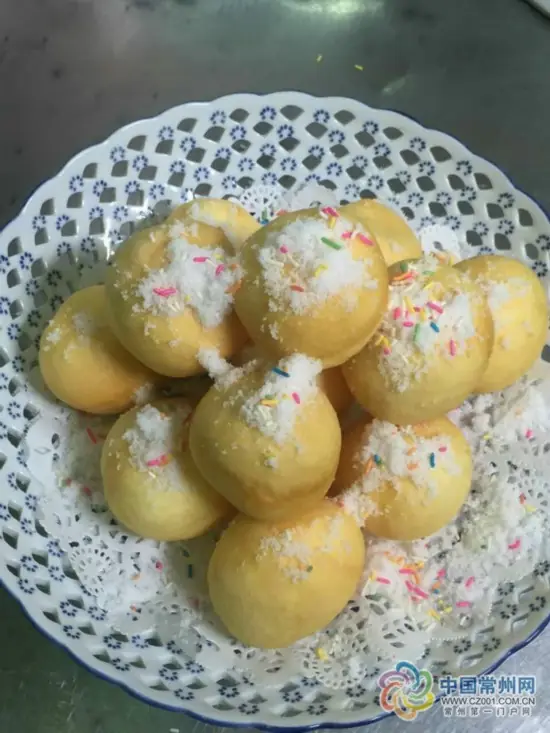
Image notes
Resized for the web; the photo itself has not been edited.
Caul Fat Rolls (网油卷), also called wanggao juan (网膏卷), are a Changzhou (常州) sweet: sweet bean paste wrapped in pig's caul fat, coated in a whipped egg-white batter and deep-fried, rather like a sesame ball. The Zhonglou District (钟楼区) government describes the shell as thin and crisp with a rich smell of fat, and the filling as soft and sandy, sweet without being cloying. "Changzhou caul fat roll making technique" is on the Changzhou municipal intangible heritage list.
How it is made
The ingredients are pig's caul fat, sweet bean paste (or jujube paste), egg white, soft white sugar, dry starch and vegetable oil. In the method set out by the Zhonglou government, clean caul fat is dried, cut into long sheets, rolled around lines of bean paste, cut into short pieces and dipped in starch at both ends. Egg white is whipped to a foam and mixed with starch into a batter. Each piece is coated and fried in moderately hot oil while the cook ladles oil over the top; once the surface firms it is turned, fried to a pale rice-yellow, then fried a second time and dusted with sugar.
Sun Hua (孙华), kitchen technical director at Tingsonglou Garden Hotel (听松楼花园酒店), told the Changzhou Evening News (常州晚报) that caul fat is an offcut rarely used in kitchens now, but it is the key because it smells richer than lard; wrapped around the paste, it clings to the ball like the veins in marble. His bean paste also contains jujube paste. The oil temperature and the few minutes of frying decide the result: too long and the skin turns brittle, too short and it stays oily.
Where it comes from
A Changzhou legend credits Su Dongpo (苏东坡), who died in Changzhou in 1101, with the idea of frying a bean-paste ball in a "snow coat"; local cooks are said to have reached today's version in the late Qing dynasty, a little over a century ago. In the mid-20th century it was a popular snack at the Ma Fuxing (马复兴) noodle shop at Shuanggui Lane (双桂坊) on South Street, which is now the protection unit for the heritage technique. The Changzhou Evening News reported in 2018 that the dish, once neglected, was coming back into favour.
Sources & reading
Written from the linked sources and fact-checked against them on 2026-09-24. Recipes and servings vary between kitchens.