

Xinyu Stir-Fried Rice Noodles 新余炒粉
Xinyu Stir-Fried Rice Noodles is featured among the local specialties of Jiangxi.

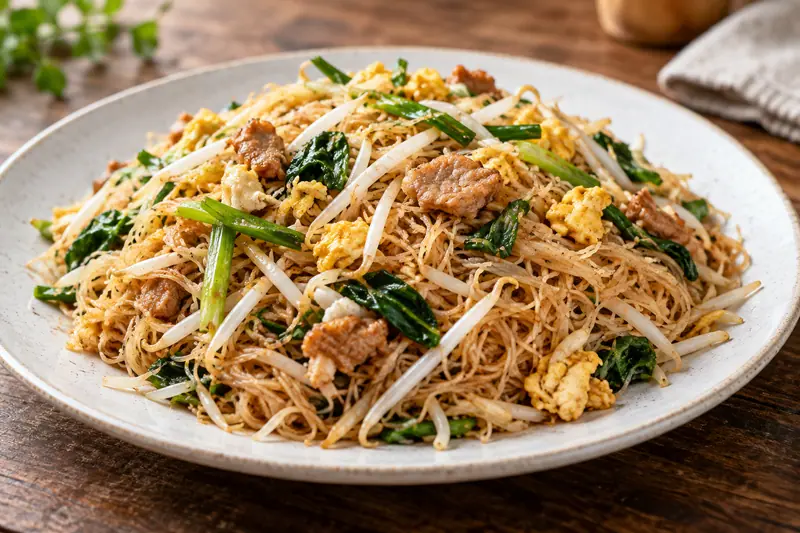
Xinyu Stir-Fried Rice Noodles (新余炒粉) is a stir-fried rice-noodle dish listed for Xinyu, in Jiangxi, and 炒 states the method: the noodles are finished in a wok rather than served in broth.
Why the wok has to be hot
Rice noodles arrive at the wok already cooked, so the job is to heat and season them without letting them break or stick. A hot, well-oiled pan is essential; on lower heat the strands sit in their own moisture, clump together and turn pasty. The usual order is to cook the aromatics and any meat or egg first, then add the noodles and toss them hard and fast, folding rather than stirring so the strands stay long. Seasoning goes in near the end so it does not burn, and the whole dish is done in a couple of minutes.
Dry, separate and lightly smoky
The defining quality is that the noodles come out dry and separate, each strand coated with seasoning rather than sitting in sauce. Fast cooking over high heat gives the surface a faint toasted note that a boiled or dressed bowl does not have. Chilli and fermented savoury flavours are common in this part of Jiangxi, so the dish can be quite assertive. If the noodles arrive as a soft, stuck-together mass, the pan was too cool or too crowded.
One city and its way with rice noodles
新余 is a small city in central Jiangxi, and 炒粉 is a common shape across the province: the same rice strand treated in different ways from town to town. What makes one version recognisable is usually the topping and the seasoning rather than the technique, and the same 炒粉 name appears under several Jiangxi place names. Read 新余炒粉 as Xinyu's own reading of a provincial habit, and check what goes into the wok rather than assuming it matches a neighbouring city.
Ingredients and dietary checks
Expect rice noodles, oil, aromatics and a savoury seasoning, with egg, pork, pickles or greens commonly added. Rice noodles contain no wheat, but soy sauce, stock powder and shared woks mean the finished dish is not automatically gluten-free; ask 有酱油吗 (is soy sauce used). Ask 有肉吗 (is there meat) and 有鸡蛋吗 (is there egg) for a vegetarian version, and 辣不辣 (how spicy) before ordering, since stir-fried noodle dishes are usually seasoned heavily.
How to order
Show the characters 新余炒粉 and ask three short questions: 加什么 (what toppings), 辣不辣 (how spicy) and 少油可以吗 (can it be less oily). Ask 一份多少 for the portion size, because stir-fried noodle dishes are often sold as a single-person plate. If you want the noodles on their own rather than with meat, say so before the wok goes on, since the topping is usually cooked first and mixed through.
Eating it and building a meal
Eat this straight from the wok while it is hot, because rice noodles stiffen and stick as they cool. It works as a quick meal on its own, or as one dish at a shared table beside a soup and a vegetable. Do not order it too early in a long meal, since it does not hold well on a plate, and ask for a bowl of clear soup if the seasoning turns out to be stronger than you expected.
More dishes to compare
Explore related local specialties and compare their names, preparation notes and ordering guidance.
Pingxiang stir-fried rice noodles 萍乡炒粉 →
Pingxiang stir-fried rice noodles (萍乡炒粉) is the neighbouring entry: the same wok-fried rice-noodle idea under a different Jiangxi city name, with its own topping and seasoning habits. Comparing the two shows that in Jiangxi the technique is shared and the local identity sits in what goes into the pan.
Questions before you order
Is the dish served with broth?
Usually not. 炒 means the noodles are finished in a wok, so they arrive dry and separate rather than swimming in liquid.
Why do stir-fried rice noodles clump together?
The noodles are already cooked, so a cool or crowded pan traps moisture and they stick. High heat and fast folding keep the strands long and separate.
Sources & reading
The supplied food list supports this name and regional association. The culinary terms below are explained as menu vocabulary; a local recipe, origin story and venue availability have not been independently verified.