

Xingguo Steamed Fish with Rice Meal 兴国米粉鱼
Xingguo Steamed Fish with Rice Meal is featured among the local specialties of Jiangxi.
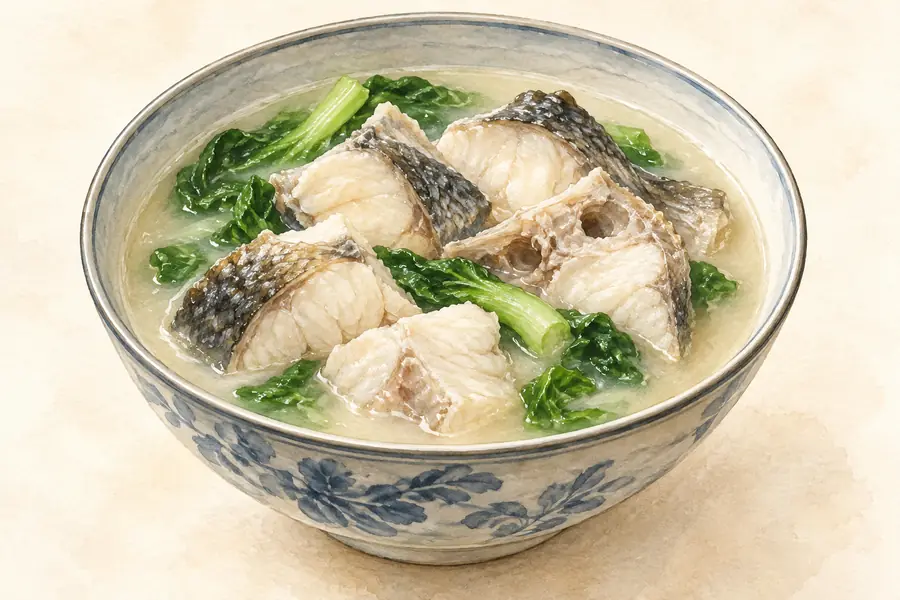
Xingguo Steamed Fish with Rice Meal (兴国米粉鱼) is a traditional dish of Xingguo County (兴国县), Jiangxi: thin slices of grass carp, coated in flour and steamed in a round bamboo steamer under a paste of chilli, ginger and sesame. Mao Zedong (毛泽东) named it Four Stars Facing the Moon (四星望月) in 1929, and the name made it widely known; under that name it is on Jiangxi's third provincial list of intangible cultural heritage.
How it is made
The Ganzhou city government (赣州市人民政府) names grass carp as the main ingredient and steaming as the method. The fish must be fresh and is cut into thin slices. The Xingguo County government gives two versions of the coating: one page mixes the slices with refined sweet-potato starch, another with rice flour. A bamboo steamer is lined with a few green vegetable leaves, then with dried rice noodles (粉干) and slices of taro, which are steamed through over a high flame. The fish goes on top, covered with a paste pounded from chilli, ginger and sesame (one version adds garlic), and the steamer is closed again for about eight minutes over a strong fire.
Flavour and texture
Ganzhou describes the flavour as salty and savoury, with a golden colour, a strong fragrance, tender flesh and a fresh, spicy taste free of any fishiness. When the lid comes off, the Xingguo government writes, a strong aroma and the smell of chilli rise with the steam.
How it is eaten
The dish comes to the table in the bamboo steamer it was cooked in, about a foot across. In Xingguo it is a fixture of banquets for festivals, weddings and guests, where it stands for reunion and family happiness; Xingguo's Hakka (客家) people put fish first on their menus as an omen of surplus every year. The custom reaches neighbouring counties and has influenced Hakka areas of Jiangxi, Guangdong and Fujian.
Where it comes from
Locally the dish was simply called flour-steamed fish (粉蒸鱼). In April 1929, while the Red Fourth Army was campaigning in southern Jiangxi, Mao came to Xingguo with only a few officers and men, and the local Communist leaders Chen Qihan (陈奇涵) and Hu Can (胡灿) served it to him in its steamer surrounded by four small side dishes. When Chen asked him to give it a name, Mao likened the round steamer to a full moon and the four plates to stars around it. The Xingguo government says the dish later entered the Chinese Famous Recipes collection (中国名菜谱) and state banquets at Zhongnanhai (中南海), and that the Lianjiang Academy (潋江书院), where Mao ate it, is now a place of remembrance.
Sources & reading
Written from the linked sources and checked sentence by sentence against quoted extracts by a separate reviewer on 2026-09-24. Recipes and servings vary between kitchens.