

Soybean Paste Soup 酱汤
Soybean Paste Soup is featured among the local specialties of Jilin.
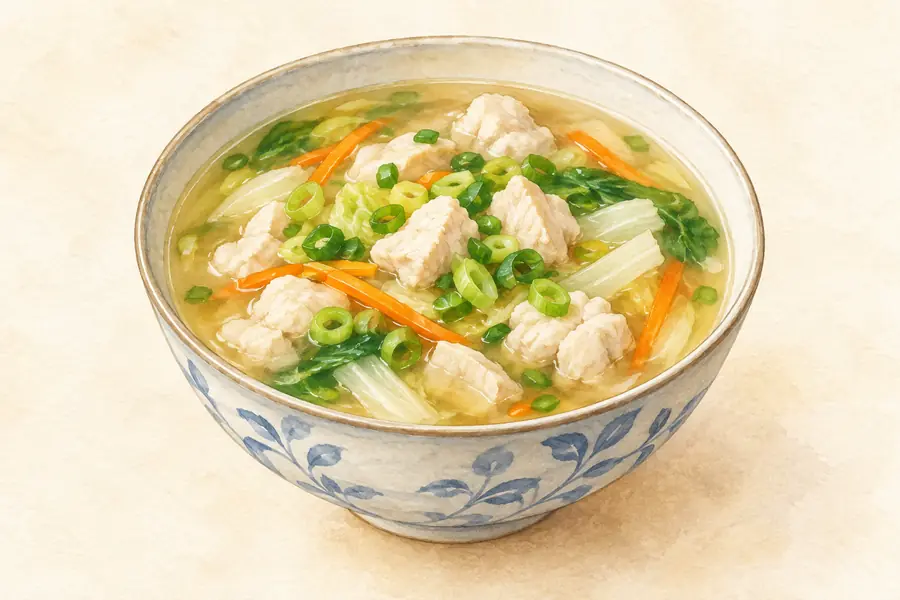
Soybean Paste Soup (酱汤) is the fermented soybean paste soup of the ethnic Korean (朝鲜族) community in the Yanbian Korean Autonomous Prefecture (延边朝鲜族自治州). Yanbian University (延边大学) counts it, with ginseng chicken soup and oxtail soup, among the "three bowls of soup" of traditional Yanbian food, and describes it as a fixture of ordinary family tables. It is cooked from Yanbian soybean paste (大酱) with vegetables, seafood or tofu.
How it is made
Jin Xuanzhou (金鉉宙), who has run a paste-soup restaurant in Yanji (延吉) for more than 20 years, told the news site dotdotnews (點新聞) in 2023 that he uses paste aged about two years, which tastes purer and a little more pungent. His own version starts from rice-washing water, adds two spoonfuls of paste fermented from northeastern soybeans, then frozen cabbage, pork belly, courgette, potato and tofu, with chilli paste for those who like heat, all simmered over a low flame. Other local versions boil or stir-fry the paste with pork belly, or cook it with pork spine or spare ribs. Because the paste is already long-fermented, he says, a short boil is enough to release its aroma, unlike southern Chinese soups simmered for eight to ten hours.
Ingredients
The paste itself is made slowly. At a paste works in Longshan village (龙山村) in Yanbian, soybeans are soaked for 8 to 10 hours, boiled in an iron pot for about 2 hours, pounded and shaped into blocks. The blocks dry outdoors for three or four days, hang from straw ropes for about 20 days, then ferment for around 40 days in a yellow-clay house. Finally they soak in brine in crocks with dried red dates and red chillies for about 40 more days; the brine becomes soy sauce and the crumbled blocks become the paste. In 2009 the Jilin provincial government placed ethnic Korean soybean paste (朝鲜族大酱), put forward by Yanbian prefecture, on its second provincial intangible-heritage list under traditional craftsmanship.
How it is eaten
The soup is not much to look at and its smell can put first-timers off, but the flavour is a deep paste aroma, with the cabbage adding freshness and the pork belly rich without being greasy. It is eaten with crisp pickles and with rice soaked in it, and in Yanbian every barbecue restaurant serves it as a side dish.
Sources & reading
Written from the linked sources and checked sentence by sentence against quoted extracts by a separate reviewer on 2026-09-24. Recipes and servings vary between kitchens.