

Liaoyuan Dragon-Head Fish 辽源龙头鱼
Liaoyuan Dragon-Head Fish is featured among the local specialties of Jilin.
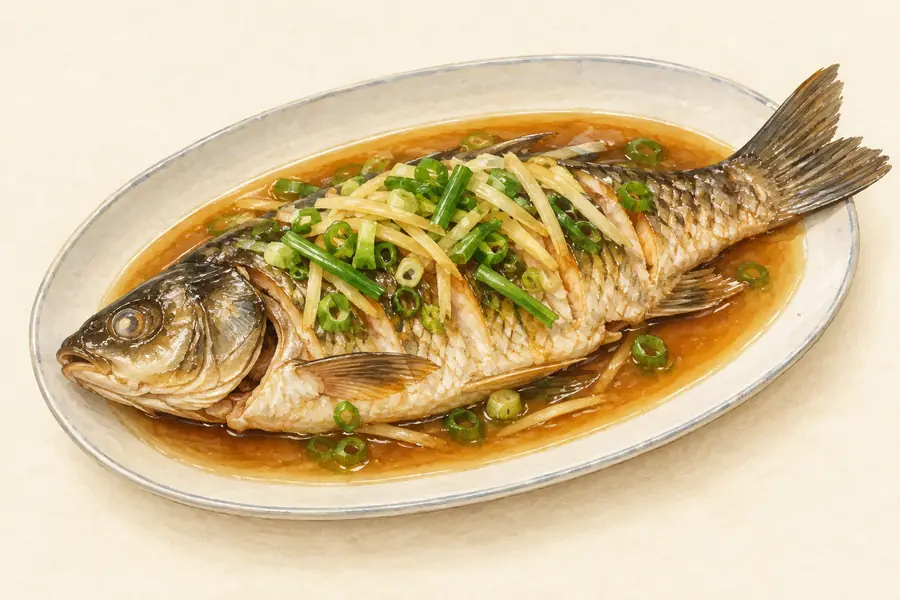
Liaoyuan Dragon-Head Fish (辽源龙头鱼) is a fish preparation listed for Liaoyuan in Jilin, where Liaoyuan is the city and 龙头鱼 is a name whose relation to the fish actually used has to be checked locally.
What the name does not settle
Because 龙头鱼 names a soft-fleshed fish in other parts of China, the first thing to establish here is which fish the kitchen actually uses. Soft fish of that kind are usually braised, steamed or fried in a light batter, since they fall apart easily and cannot be handled much. A braise is built with ginger, scallion, soy and a little vinegar or wine, and the fish is turned once; a fried version is protected by a starch coating. Either way the cooking is gentle and short.
Delicate flesh that needs help
The flesh of soft marine fish of this kind is delicate, watery and almost without resistance, which is why it is coated or sauced rather than grilled. A braise gives a savoury, slightly sweet result with the sauce doing most of the flavour work; a fried version is crisp outside and creamy inside. Inland, the same dish name may be built on a freshwater fish with a firmer texture, which changes the eating experience completely.
An inland city with a coastal name
辽源 is a city in south-central Jilin, well inland, while 龙头鱼 as a fish name belongs to the coastal south. That mismatch is the key thing to note about this entry: the label is used in Liaoyuan, but the fish behind it is a local decision and the record does not establish which species is used. The name should be treated as the dish's local name rather than as a description of the catch.
Ingredients and dietary checks
Fish, starch or batter for coating, ginger, scallion, soy, vinegar or cooking wine, and often sugar. Soy and wine are the restrictions to check, along with the fish itself. Ask 是什么鱼 (which fish), 有没有刺 (does it have bones), 有小麦吗 (is there wheat) and 有酒吗 (does it contain alcohol), since marinades and braises usually contain both wheat and wine.
How to order 辽源龙头鱼
Show 辽源龙头鱼 and ask 是什么鱼 (which fish) and 怎么做 (how it is cooked) — 红烧 (braised), 清蒸 (steamed) or 炸 (fried) — then 一份多大 (how big a portion) and 多少钱 (the price). Fish is often priced by weight, so if the menu says 时价 (market price) ask for the number before the kitchen starts cooking.
Share it and eat it hot
Serve it as a shared dish in the middle of the table with rice alongside, and take the flesh from the top side of the fish first so the bones are easier to manage. Soft fish breaks up quickly, so use a spoon as well as chopsticks and finish it while it is hot. If the dish is fried, eat it first, since the coating softens as the sauce sits.
More dishes to compare
Explore related local specialties and compare their names, preparation notes and ordering guidance.
Qingling braised fish 庆岭活鱼 →
Qingling braised fish (庆岭活鱼) is the other Jilin fish entry, a braised dish from Jilin's lake and river cooking. Both are braises rather than grills, so the comparison is useful for asking which fish each kitchen uses and how much sauce is left in the pan.
Questions before you order
What fish is 龙头鱼?
Elsewhere in China the name refers to a soft-fleshed marine fish, but this record places the dish in inland Jilin, where the species used is a local choice. Ask 是什么鱼 (which fish) rather than assuming.
Why is the dish usually saucy or battered?
Soft-fleshed fish break apart under handling, so a coating or a braise holds them together and carries the seasoning. The cooking is short and gentle for the same reason.
Sources & reading
The supplied food list supports this name and regional association. The culinary terms below are explained as menu vocabulary; a local recipe, origin story and venue availability have not been independently verified.