

Spanish Mackerel Dumplings 鲅鱼饺子
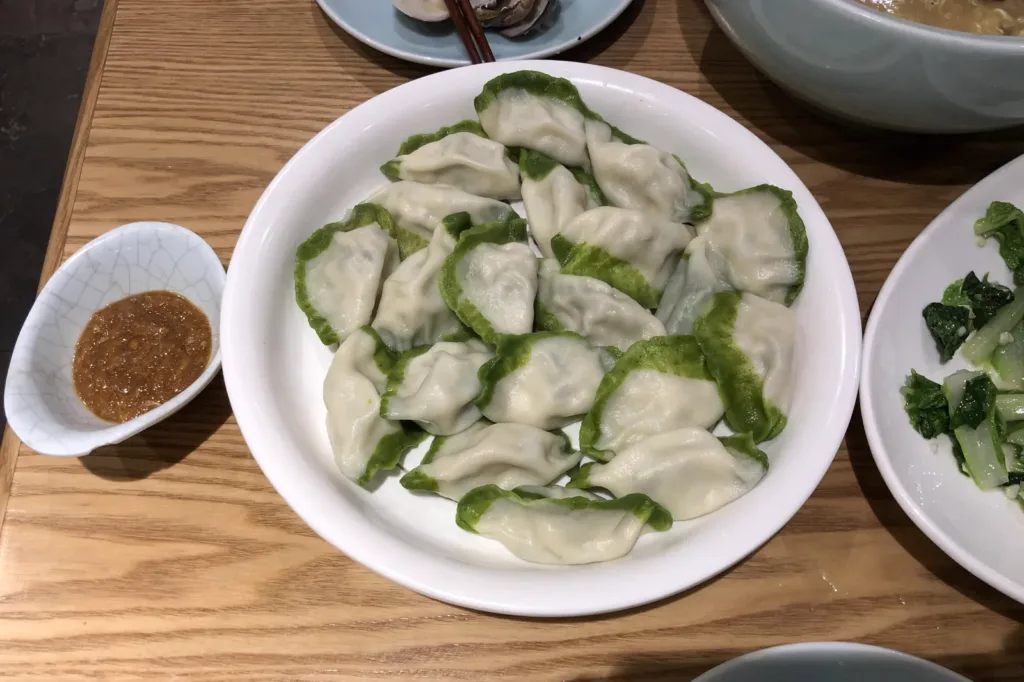
Spanish mackerel dumplings (鲅鱼饺子, bàyú jiǎozi) are boiled wheat dumplings associated with Dalian’s seafood-dumpling tradition. A soft fish filling is commonly paired with Chinese chives; recipes vary, and some local versions also use pork or another source of fat.
Tap any red Chinese text to hear it in Mandarin.
Dalian’s seafood dumpling tradition
Dalian is a coastal city where fish is part of ordinary home cooking as well as restaurant food. A local report describes鲅鱼 as an everyday, relatively affordable seafood that people in Dalian fry, braise, smoke and turn into dumplings; another local account places鲅鱼 dumplings on older residents’ New Year tables.
The same local account says that dumplings were not common in Dalian’s early street food, and that specialist dumpling houses appeared in the late 1940s. It names the Pan family’s mackerel-dumpling house as one of the earliest and says it sold mackerel dumplings specifically. That is a useful local history of Dalian’s seafood-dumpling culture, not proof that the city invented every form of鲅鱼饺子. Wider coastal versions are also associated with the Jiaodong region across the Bohai area.
What to expect in the bowl
The usual presentation is a boiled dumpling with a thin wheat wrapper and a generous, soft filling. To make it, cooks remove the bones and work the fish into a paste rather than leaving large flakes. One Dalian report describes a traditional approach using in-season mackerel, pork fat in a “two-eight” proportion, Sichuan-pepper water and egg white; the filling is stirred in one direction until it firms up, with chopped Chinese chives added at the end.
Treat that description as one local method, not a fixed recipe. Restaurants and families change the fish-to-fat balance, seasonings and aromatics, and some versions use only fish. Fresh dumplings and frozen products may also behave differently in the pot. The appeal is the contrast between a tender, juicy fish filling and the chew of the wrapper, with chives adding a sharp green note.
How to order
Keep the Chinese name 鲅鱼饺子 Bàyú jiǎozi handy; 鲅鱼水饺 Bàyú shuǐjiǎo is another useful menu term. If you avoid pork, ask 馅里有猪肉吗? Xiàn lǐ yǒu zhūròu ma? (“Does the filling contain pork?”). If you want to know about chives, ask 里面有韭菜吗? Lǐmiàn yǒu jiǔcài ma? Recipes are not standardized, so do not assume that a fish dumpling is pork-free or suitable for a particular allergy. Ask the restaurant about its current filling and kitchen handling.
Where to eat it
You can find Spanish Mackerel Dumplings all over Liaoning, so there is no need to seek out one particular restaurant. To find one near you, search for “鲅鱼饺子” in Meituan (美团) or Amap (高德地图) and check recent reviews, distance and opening hours.
Image credits & notes (1)
- Cooked mackerel-stuffed jiaozi photographed in Qingdao, Shandong; a regional example of the dish, not a Dalian restaurant or Dalian-specific preparation. Photo: N509FZPhoto: CC BY-SA 4.0