

Home-Style Braised Greenling 家焖黄鱼
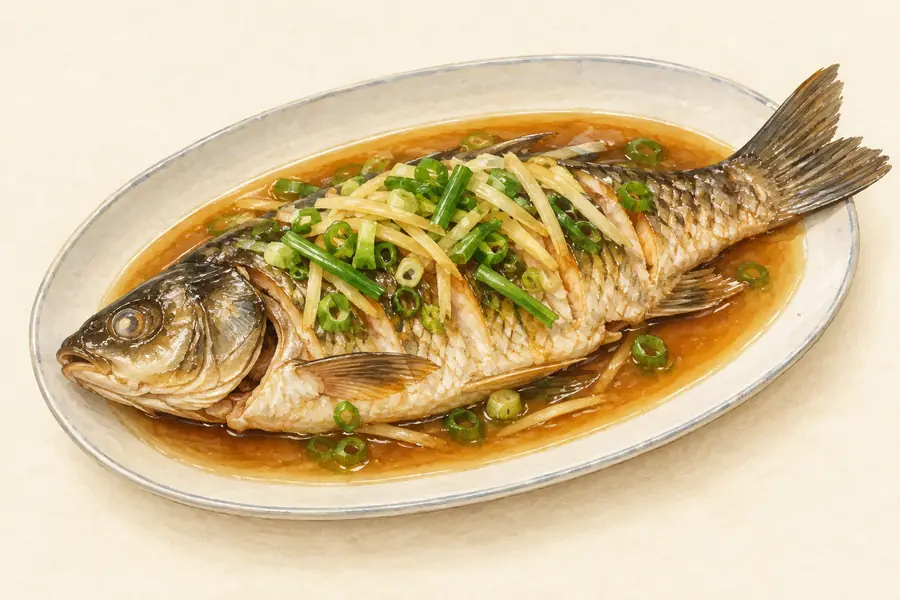
Home-style braised greenling (家焖黄鱼) is a Dalian way of cooking the local fish known as huangyu or huangyu bangzi. The fish is Hexagrammos otakii, called fat greenling in English; its sweet, thick flesh is prized when braised until it separates into garlic-clove-like flakes.
Tap any red Chinese text to hear it in Mandarin.
Dalian’s “yellow fish” is a local name for this greenling, not a complete English species name. Local reporting identifies huangyu and huangyu bangzi as names for Hexagrammos otakii, a nearshore fish associated with rocky coasts and islands. A Dalian Ocean University survey at Zhangzi Island also recorded it as one of the area’s main economic reef fish.
The fish belongs to Dalian’s coastal food culture rather than to a dish with one canonical recipe. “家焖” means a home-style braise: local reporting names it as a usual preparation, while also mentioning sweet-and-sour fish, dry-braised fish, huangyu noodles, sashimi and mixed-fish stew as other ways the same fish is eaten.
What to expect
When cooked, the flesh is described as translucent, fresh and sweet, with thick meat that breaks into garlic-clove-like segments. The local comparison “northern grouper” refers to its eating qualities in a region where grouper is not native; it is not a taxonomic name.
The species lives in temperate marine waters and is associated with rocky coastal areas; FishBase lists a broad depth range and an October–December breeding period. The Dalian report says local fish are often at their plumpest in spring and summer and treats autumn as the spawning season. These are useful seasonal clues, not a promise that every market or restaurant will carry the same fish at the same time.
Ordering it in Dalian
Use the Chinese name 家焖黄鱼 (jiā mèn huáng yú). English menus may translate 黄鱼 simply as “yellow fish,” so the Chinese name is the clearer way to ask for this specific Dalian preparation. It is a fish dish; seasoning, size, portion and availability vary between kitchens. Ask what fish is being used if the menu gives only an English translation, and do not assume the dish is a fixed recipe or available at every seafood restaurant.