

Manchu Eight Plates and Eight Bowls 满族八碟八碗
Manchu Eight Plates and Eight Bowls is featured among the local specialties of Liaoning.
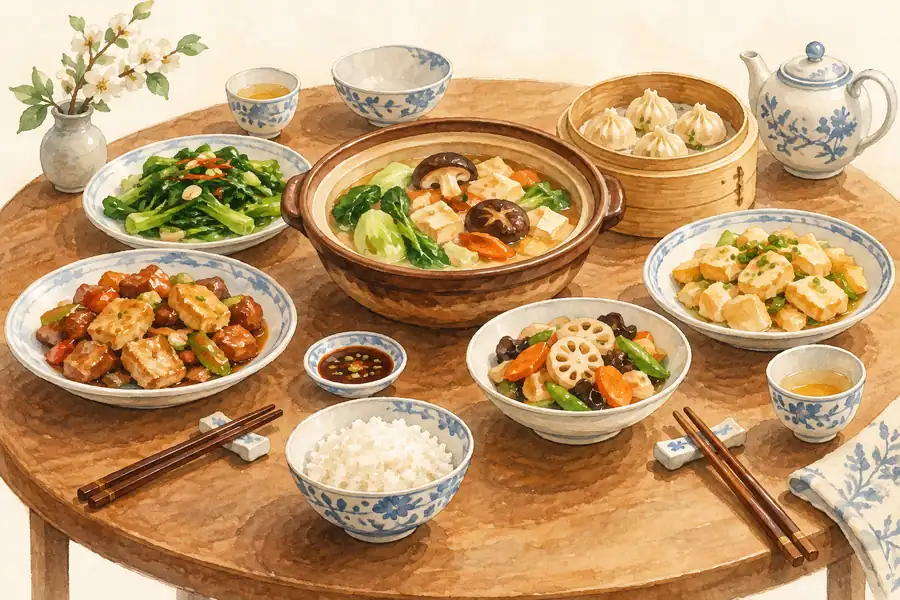
Manchu Eight Plates and Eight Bowls (满族八碟八碗) is a Manchu banquet table from Fushun (抚顺), Liaoning, served at farmhouse restaurants in Xinbin Manchu Autonomous County (新宾满族自治县). People's Daily Online calls it the authentic Manchu feast table: the plates are genuinely large platters and the bowls are deep, tall ones.
What is on the table
According to the Liaoning Daily (辽宁日报), the eight plates are usually four cold and four hot dishes, and the eight bowls usually four meat and four vegetable ones. The cooking covers slow-braising, covered stewing, cooking in soy paste, braising, stewing, stir-frying, steaming and quick-frying in a thickened sauce. Typical dishes are red-braised pork, pickled cabbage with boiled white pork and blood sausage, chicken stewed with mushrooms, pork-skin jelly and a mixed vegetable soup, made from Xinbin produce. People's Daily Online adds that the choice of ingredients is not fixed and that the table comes in two forms, the "three-six" (三六席) and "two-eight" (二八席) settings.
Fushun has set the dishes down in a 17-part municipal standard, DB2104/T 0001-2019, recorded in the national register of local standards for January 2020. Its parts include liver sausage, flour sausage, pork-skin jelly, crispy white pork, stir-fried free-range eggs, fried river fish and pork belly stewed with green beans.
Where it comes from
The Liaoning Daily describes the table as the forerunner of the Manchu-Han Imperial Feast (满汉全席) and retells a legend. After the Later Jin army won the Battle of Sarhu (萨尔浒之战) and returned to the old town (老城), Nurhaci (努尔哈赤) had each of the Eight Banners bring one dish and one soup. The eight offerings turned out to be four cold and four hot, four meat and four vegetable, read as a sign that the realm would stay "four-square and stable" (四平八稳), and Nurhaci ordered the same spread for victory and wedding feasts from then on. People's Daily Online says that after the banners moved south of the Great Wall, the dishes gradually became part of the Manchu-Han feast.
A survey of Xinbin's cultural industries by Liu Xiaochun (刘晓春), published by Chinese Social Sciences Net, names the Eight Plates and Eight Bowls among the county's intangible-heritage items, alongside Manchu hotpot, the qipao and ginseng processing.
Where to eat it
You can find Manchu Eight Plates and Eight Bowls all over Liaoning, so there is no need to seek out one particular restaurant. To find one near you, search for “满族八碟八碗” in Meituan (美团) or Amap (高德地图) and check recent reviews, distance and opening hours.
Sources & reading
Written from the linked sources and fact-checked against them on 2026-09-24. Recipes and servings vary between kitchens.