

Portuguese Egg Tart 葡式蛋挞
Portuguese Egg Tart is featured among the local specialties of Macau.
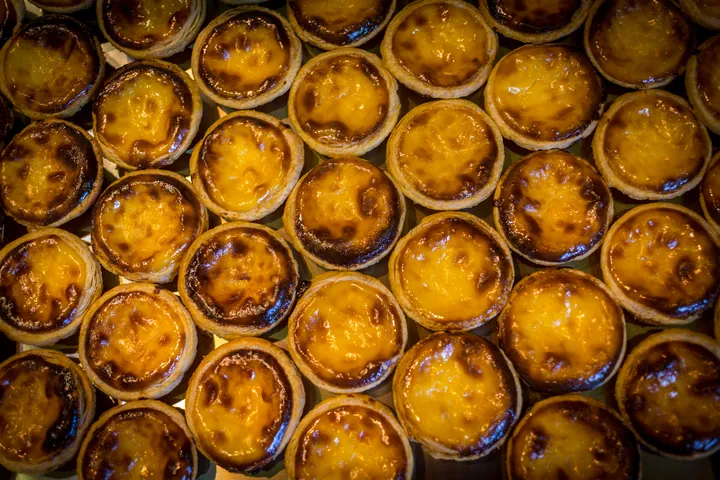
Portuguese Egg Tart (葡式蛋挞) is a small puff-pastry tart found in Macau (澳门) and across the Portuguese-speaking world. Its characteristic dark surface comes from sugar caramelising under strong heat.
Flavour and texture
It has a puff-pastry shell, and the caramelised surface marks this egg-tart style.
Where it comes from
In Portuguese it is called pastel de nata, with pastéis de nata as the plural. In Guangdong (广东), Hong Kong (香港) and Macau, the shortened Chinese name is puta (葡挞), meaning Portuguese tart. Another Portuguese name, pastel de Belém, means “pastry of the Belém district”. The tart is widespread in Portugal and Portuguese-speaking countries, and is also found in places with substantial Portuguese communities, including Canada, Luxembourg and France. In Taiwan (台湾), the name is shortened to danta (蛋挞), or egg tart.
Source introduction: Wikipedia contributors: 葡式蛋撻 · CC BY-SA 4.0. English translation and adaptation of the cited encyclopedia revision.
Sources & reading
Adapted into English from the cited encyclopedia revision and fact-checked against them on 2026-09-26. Recipes and servings vary between kitchens.
Image credits & notes (1)
- Portuguese-style egg tarts (pastéis de nata), fresh from the oven with caramelised tops · 葡式蛋挞,出炉后表面焦糖化Photo: Photo Claude TRUONG-NGOC · Claude Truong-Ngoc / Wikimedia Commons - cc-by-sa-3.0 · CC BY-SA 3.0 · taken 2015-09-12Resized for the web; the photo itself has not been edited. Thumbnails may show a cropped view.
