

Cold Noodle Sheets 凉皮
Liangpi (凉皮) is a cool, slippery sheet noodle cut into strips and dressed with vinegar, chilli oil and fresh herbs. In Yinchuan, a documented local version is associated with steamed sheets from Tieqiao Julian in Liangtian Town, while the wider dish has wheat- and rice-based forms whose texture and toppings vary.
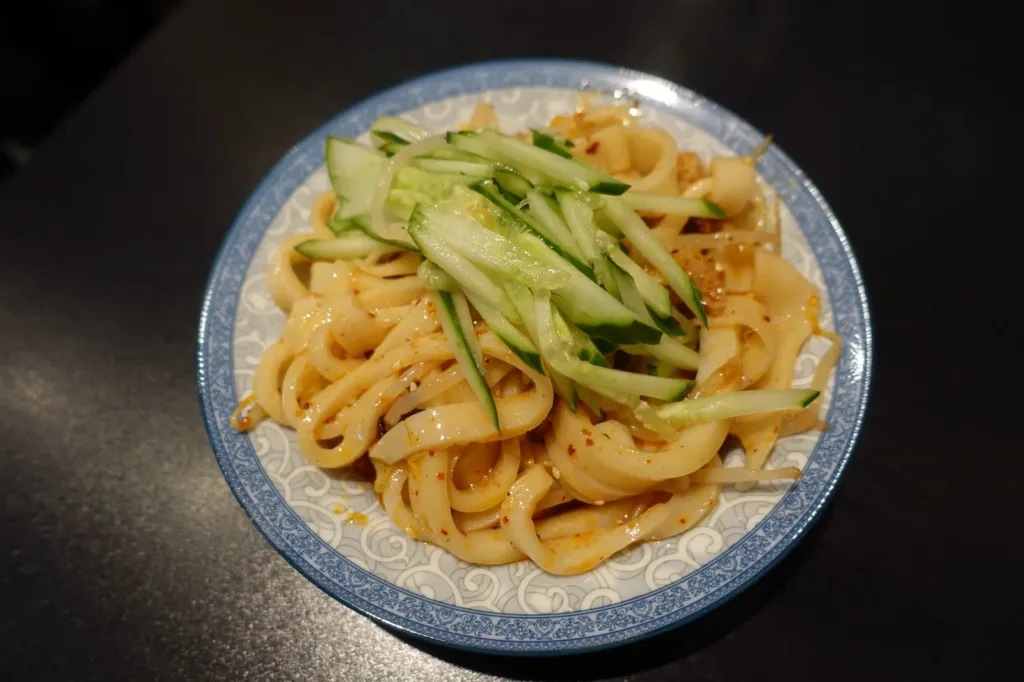
Yinchuan’s liangpi is best read as a local version of a wider northwest Chinese food, not as a claim that the city invented every form of liangpi. A Yinchuan Daily report traces Tieqiao Julian to a 1996 roadside stall beside an iron bridge in Liangtian Town, Jinfeng District; the shop’s story is part of a local village-food and migrant-entrepreneurship account, not a city-wide recipe.
That report says early-morning dough mixing and steaming made sheets with a smooth, springy bite, while its chilli oil helped distinguish the shop’s version. A 2023 local tourism guide describes the sheets as steamed, then paired with fragrant vinegar, concentrated chilli oil and Chinese chives (韭菜). These details are useful for what to look for in Yinchuan, but belong to the documented local version, not every bowl called liangpi.
What you are eating
Liangpi means “cold skin” and is served as broad sheets or strips. In a traditional wheat-flour method, a dough is repeatedly washed in water to separate starch from gluten. The starch-rich liquid settles, becomes a thin batter, and is steamed into sheets; the gluten can be steamed separately and cut into the same bowl. Rice-flour and direct wheat-starch methods also exist, so one shop’s translucent softness is not a fixed standard.
At the table, look for cool, slippery or springy strips that carry sauce, then balance sour vinegar with chilli heat. Yinchuan’s local account highlights 香醋, 辣椒油 and 韭菜; elsewhere, garlic, cucumber, bean sprouts, soy sauce, sesame oil or paste, coriander and steamed wheat gluten may appear. Ask what this shop adds rather than expecting a universal list.
Because wheat-based versions and wheat-gluten pieces are common, liangpi is not automatically gluten-free. Rice-flour versions exist, but preparation and shared surfaces vary. If you have coeliac disease or a wheat allergy, ask in Chinese whether the sheets are wheat-based, whether 面筋 (wheat gluten) is included, and whether the sauces or shared tools are suitable; appearance alone cannot answer that.
Where to eat it
You can find Liangpi all over Ningxia, so there is no need to seek out one particular restaurant. To find one near you, search for “凉皮” in Meituan (美团) or Amap (高德地图) and check recent reviews, distance and opening hours.
Sources & reading
Image credits & notes (1)
- A plate of liangpi noodles in spicy sauce at La Taverne de Zhao in Paris, photographed on 17 September 2016; a regional dish example, not a Yinchuan or Tieqiao Julian shop photograph. Photo: Guilhem VellutPhoto: CC BY 2.0