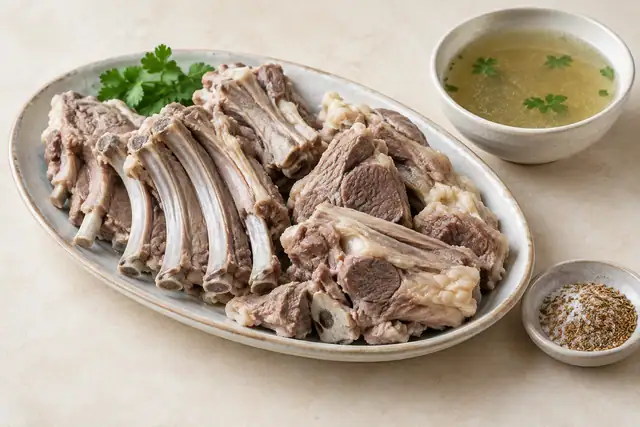
Darlag Hand-Grabbed Mutton 达日手抓羊肉
Darlag Hand-Grabbed Mutton is featured among the local specialties of Qinghai.
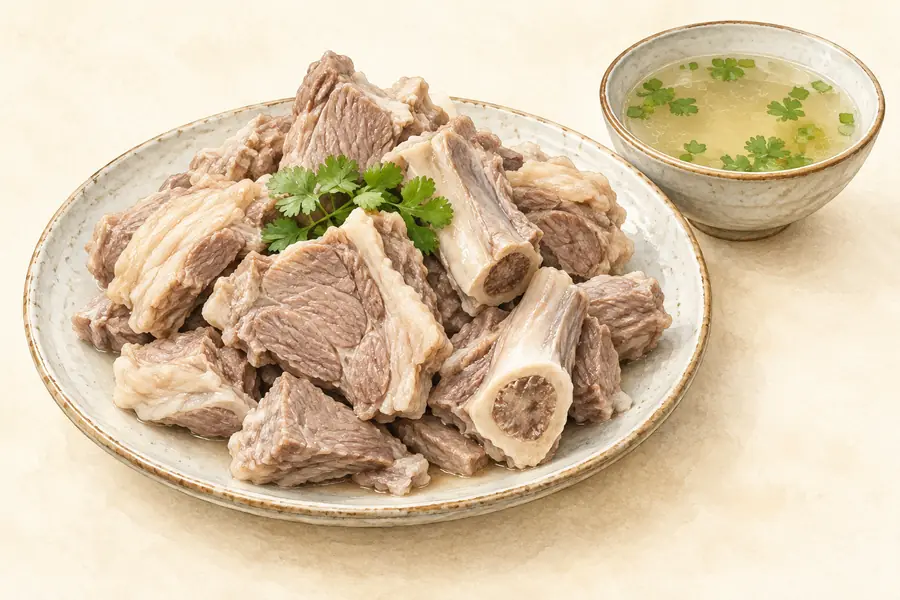
Darlag Hand-Grabbed Mutton (达日手抓羊肉) is hand-served mutton named for Dari County in Qinghai: 达日 is the place, and 手抓羊肉 is the serving style — large bone-in pieces simmered in salted water and eaten by hand.
Understanding the preparation
手抓羊肉 is a way of serving mutton rather than a fixed recipe: a joint or a rack is simmered in water until the meat loosens from the bone, then it is brought to the table in large pieces and eaten by hand. Salt is usually the only seasoning at the pot, with the broth kept and served alongside.
Two things decide the result. The cut decides the time — ribs and shoulder forgive a long simmer, while a lean leg needs less. The second is the animal: lean pasture mutton has little fat to protect it, so an overcooked piece turns dry rather than tender. Ask the kitchen which cut is being served if you want to judge how it was handled.
What the serving style gives you
Eaten this plainly, mutton tastes of itself: a clean, slightly sweet broth, fat that softens rather than shouts, and a finish that comes from salt and the meat rather than from spice. The point of the style is that nothing hides a poor piece, which is why it is the form people use when they want to know what the meat is like.
The name and its setting
The name is built from two ordinary parts. 达日 is the place, and 手抓羊肉 says how the dish is served rather than how it is flavoured. A place prefix on a mutton dish normally marks where the plate belongs, and it says nothing about the cut, the seasoning or the animals behind it.
That means the useful question here is not “what is the recipe” but “which animal and which cut”. Anything beyond that — a particular farm, a particular herd, a family method — is not something the name itself carries.
Ingredients and dietary questions
Mutton, water and salt are the base of the plain version; pepper, Sichuan pepper, onion or garlic may be added at the pot, and chilli usually arrives as a dip rather than in the broth. There is no pork and no alcohol in a plain boil, but sauces and dips can contain both, so ask about the dip if either matters. Nothing here is suitable for a vegetarian table — the broth is meat-based.
Ordering it
Ask for 手抓羊肉, and add 达日 if you want to make the place clear. Portions are commonly sold by weight or as a platter, so ask how much is in an order before committing — a “small” order of meat can still be generous. Useful questions are 多少钱一斤 (how much per jin), 是哪个部位 (which cut) and 有蘸料吗 (is there a dip).
How it is eaten
It comes out on a board or in a wide dish and is eaten with the hands: take a piece, dip it in salt or a chilli mix, and work it off the bone. The cooking broth is often poured into bowls to drink at the end, and tea follows. Cutlery is rarely part of the service, and a shared platter is the normal way to order it.
More dishes to compare
Explore related local specialties and compare their names, preparation notes and ordering guidance.
Qinghai hand-served lamb 手抓羊肉 →
Qinghai hand-served lamb (手抓羊肉) is the province-wide name for the style: large pieces of mutton simmered and eaten by hand with a salt dip. 达日手抓羊肉 uses the same serving style under a place name, so the difference is the name on the label rather than the way the meat is cooked.
Questions before you order
Is 手抓羊肉 a recipe or a serving style?
A serving style. Mutton is boiled until it comes off the bone, cut into large pieces and eaten by hand with salt and the cooking broth. Names such as 达日手抓羊肉 add a place to that style rather than describing a different method.
How much should I order?
It is usually sold by weight or as a shared platter, so ask how much is in one order and how many people it suits. Two people are often served by a single small platter once rice, noodles or bread are added.
Source introduction: Wikipedia contributors: 手抓肉 · CC BY-SA 4.0. English guide adapted from the cited material, with additional preparation and ordering guidance.
Source introduction: Wikipedia contributors: 达日县 · CC BY-SA 4.0. English guide adapted from the cited material, with additional preparation and ordering guidance.
Source introduction: Wikipedia contributors: 羊肉 · CC BY-SA 4.0. English guide adapted from the cited material, with additional preparation and ordering guidance.