

Delingha Roast Mutton 德令哈烤羊肉
Delingha Roast Mutton is featured among the local specialties of Qinghai.
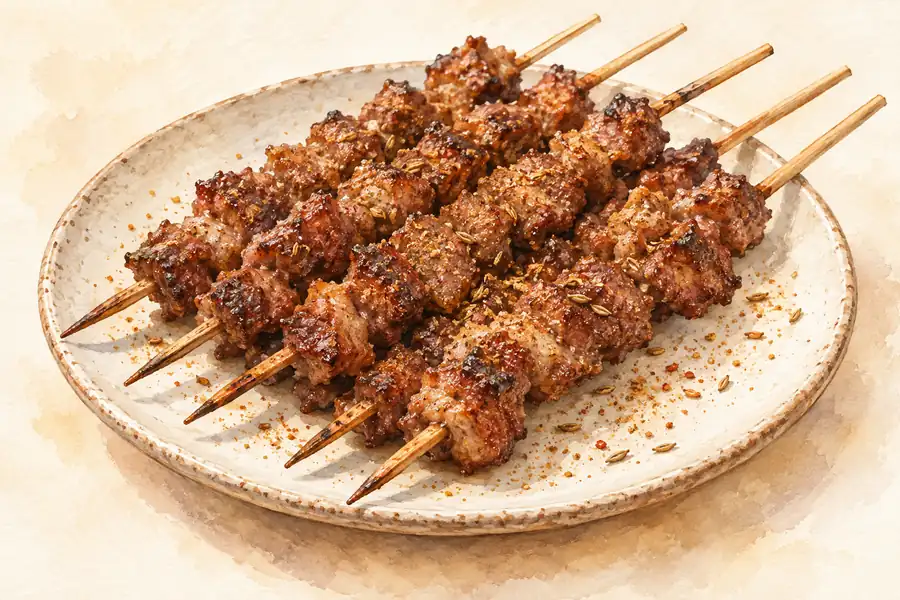
Delingha Roast Mutton (德令哈烤羊肉) is roast mutton named for Delingha in the Qaidam basin of Qinghai: 德令哈 is the city, and 烤羊肉 says the meat is cooked over fire rather than naming a cut.
Understanding the preparation
烤羊肉 covers everything from skewers over charcoal to bigger pieces roasted on a rack or in a covered pan. For skewers the standard method is to cut the meat small, keep some fat on each piece, thread it tightly and turn it often over a hot fire, seasoning with salt, cumin and chilli near the end so the spices do not burn.
For larger pieces the rule is the opposite: moderate heat and time, with the outside moved away from the hottest part of the fire when it colours, so the inside catches up. Lean plateau mutton has little fat to baste itself, so a piece that looks done outside can still be dry within.
What roasting gives you
Grilling concentrates the meat: the surface crisps, the fat renders and the smoke adds a flavour that boiling never produces. Cumin and chilli are the usual pairing with mutton in north-west China because their warmth cuts the richness. If you want the meat itself rather than the spice mix, ask for the skewers with salt only — 只放盐.
The name and its setting
The name joins a place to a method. 德令哈 is the city, in the Qaidam basin of Qinghai; 烤羊肉 says the meat is cooked over fire. A city prefix on a grill dish usually marks where the plate is eaten rather than a single standard marinade.
Practically, that means the useful questions are about the fire and the cut, not about a canonical recipe: whether the meat is on skewers or on the bone, how heavily it is spiced, and whether what arrives is a snack portion or a full platter.
Ingredients and dietary questions
Mutton, salt, cumin and chilli are the usual four; oil, soy-based marinade, onion and garlic may be added before grilling. Marinades can contain cooking wine or wheat-based sauce, so ask 有酒吗 and 有酱油吗 if you avoid alcohol or gluten. Grilled skewers are not suitable for a vegetarian table, and they are usually cooked on the same fire as other meats.
Ordering it
Skewers are ordered by the stick — 十串 means ten — while ribs, leg or rack come by weight or as a platter. Ask 多少钱一串 (how much per skewer) or 多少钱一斤 (how much per jin) to size an order, and ask 辣不辣 (how spicy) because the chilli level varies widely between kitchens. 不要辣 removes it; 少辣 reduces it.
How it is eaten
Skewers are eaten straight off the stick, hot, with tea or a cold drink, and are usually shared as a group order rather than plated as a course. Larger roasted pieces arrive on a board and are pulled apart by hand, with salt or chilli powder for dipping and the usual bowl of broth or soup alongside.
More dishes to compare
Explore related local specialties and compare their names, preparation notes and ordering guidance.
Golmud Roast Lamb Ribs 格尔木烤羊排 →
Golmud Roast Lamb Ribs (格尔木烤羊排) names the rack — 羊排 is lamb or mutton ribs — while 德令哈烤羊肉 names the meat and the city without fixing the cut. Both are roast mutton from the same area, so the practical difference is what lands in front of you: a whole rack on the bone, or skewers and smaller pieces.
Questions before you order
Is 烤羊肉 always skewers?
No. The phrase can describe skewers, a rack roasted over fire, or pieces finished in a covered pan. Ask 是串还是排 — skewers or a rack — before ordering, because the portion size and the price are calculated differently.
How hot is it normally served?
Hot off the fire. Skewers are eaten as they come, so a large order arrives in waves; a rack may rest briefly before being cut. If you want to eat slowly, ask for the skewers to come in two rounds rather than all at once.
Source introduction: Wikipedia contributors: 德令哈市 · CC BY-SA 4.0. English guide adapted from the cited material, with additional preparation and ordering guidance.
Source introduction: Wikipedia contributors: 烤串 · CC BY-SA 4.0. English guide adapted from the cited material, with additional preparation and ordering guidance.
Source introduction: Wikipedia contributors: 羊肉 · CC BY-SA 4.0. English guide adapted from the cited material, with additional preparation and ordering guidance.