

Jainca Mutton 尖扎羊肉
Jainca Mutton is featured among the local specialties of Qinghai.
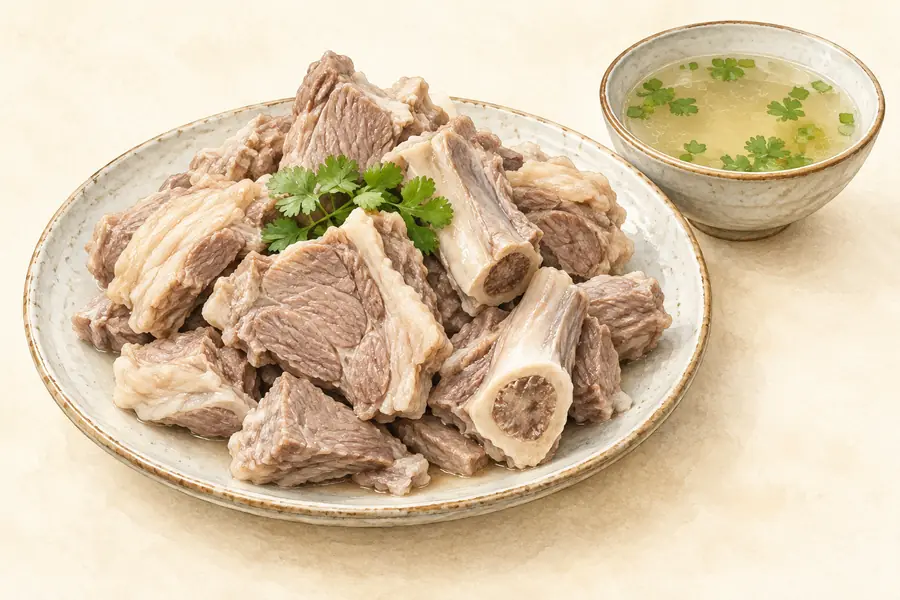
Jainca Mutton (尖扎羊肉) is lamb or mutton carrying the name of Jianzha County in Huangnan Tibetan Autonomous Prefecture, Qinghai: 尖扎 is the county and 羊肉 is the meat.
Understanding the preparation
羊肉 covers both lamb and adult mutton, and the age of the animal changes how it should be cooked. Young lamb is tender enough to grill or to stir-fry quickly; older mutton carries more flavour and needs a long simmer in salted water before it softens.
Three treatments cover most of what a menu will offer: boiled in pieces and served on the bone, grilled over charcoal, or sliced thin and turned through a hot wok with onion and chilli. Which one you get depends on the cut, not on a house secret — ask before ordering.
What the meat gives you
Boiled, the meat tastes of the animal and the broth, with a slight sweetness and the fat softened rather than crisped. Grilled or fried, the surface browns and the fat renders, and cumin and chilli do most of the aromatic work. The plain version is the one that shows whether the meat was good.
The name and its setting
尖扎 is a county in the north of Huangnan Tibetan Autonomous Prefecture, in eastern Qinghai, and the Yellow River runs the length of it, covering 96 km inside the county line. The prefecture places this northern belt — Jianzha and Tongren — between 1,900 and 4,118 metres above sea level, which is low country by Qinghai standards and the reason the county is not written off as pure pasture. The name on the menu marks where the plate belongs; it is not the name of a shop.
The useful questions are about the animal rather than a recipe: lamb or adult mutton, which cut, and how it will be cooked. The plain treatment to compare against is 手抓肉 or 手把肉, recorded across the pastoral north-west as fatty bone-in mutton simmered with onion and little salt and then eaten by hand with a dip — which is what a Qinghai kitchen usually means when it says the meat is simply boiled.
Ingredients and dietary questions
The meat is the ingredient; salt, pepper, Sichuan pepper, cumin, chilli, onion and garlic are the usual additions, and a plain boil may use nothing but salt and water. Broths are meat-based. Ask about chilli — 不要辣 or 少辣 — and ask whether a marinade contains cooking wine or soy sauce if you avoid alcohol or wheat.
Ordering it
Say 羊肉 for the general dish and name the cut if you can — 羊排 for ribs, 羊腿 for leg, 羊肉串 for skewers. Ask 是羊羔还是大羊 (lamb or adult sheep) if age matters, and ask the price per jin or per portion before committing, because platters are usually sold by weight.
How it is eaten
Boiled mutton comes out on a shared board and is eaten by hand with salt or a chilli dip, followed by the cooking broth and tea. Skewers are ordered by the stick and eaten hot. Both are group food rather than a plated course, and bread, noodles or vegetables are normally ordered alongside.
More dishes to compare
Explore related local specialties and compare their names, preparation notes and ordering guidance.
Mutton Covered with Dough 羊肉盖被 →
Mutton Covered with Dough (羊肉盖被) is mutton cooked under a covering of dough — the “quilt” of the name — so the meat and a starch arrive in one pot. 尖扎羊肉 is a plain meat dish, boiled, grilled or fried without a dough cover. Both are Qinghai mutton, but one is a one-pot meal and the other is a plate of meat.
Questions before you order
Is 尖扎羊肉 lamb or mutton?
The Chinese 羊肉 does not distinguish them. Ask 是羊羔还是大羊 — lamb or adult sheep — because the age decides whether a quick grill or a long simmer suits the meat, and the flavour is noticeably different.
How is it normally cooked?
Three ways cover most menus: boiled in salted water and served on the bone, grilled over charcoal, or sliced and stir-fried quickly with onion and chilli. Ask which one the kitchen is serving before choosing a cut.
Source introduction: Wikipedia contributors: 尖扎县 · CC BY-SA 4.0. English guide adapted from the cited material, with additional preparation and ordering guidance.
Source introduction: Wikipedia contributors: 黄南藏族自治州 · CC BY-SA 4.0. English guide adapted from the cited material, with additional preparation and ordering guidance.
Source introduction: Wikipedia contributors: 手抓肉 · CC BY-SA 4.0. English guide adapted from the cited material, with additional preparation and ordering guidance.