

Maqen Tibetan Steamed Buns 玛沁藏包
Maqen Tibetan Steamed Buns is featured among the local specialties of Qinghai.
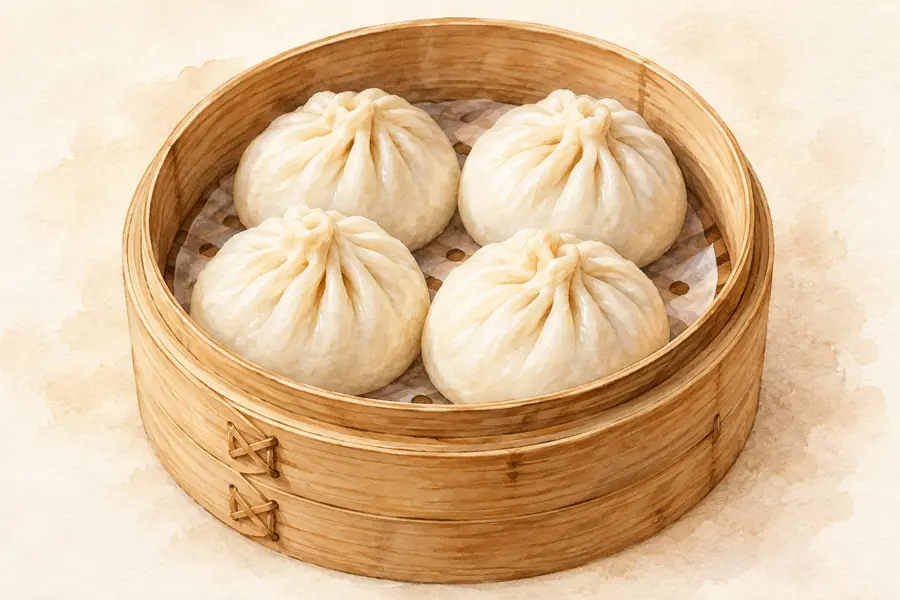
Maqen Tibetan Steamed Buns (玛沁藏包) is a Tibetan-style steamed filled parcel named for Maqin County in Golog Tibetan Autonomous Prefecture, Qinghai: 玛沁 is the county and 藏包 the bun.
Understanding the preparation
藏包 belongs to the family of pleated steamed parcels: a wheat-dough wrapper is rolled, filled, gathered into folds at the top and steamed until the dough sets around the filling. 包子 made this way are cooked by steam rather than in water or oil, which is why the wrapper stays soft and the filling keeps its juices.
Two things decide the result. The dough must be rested so it can be gathered without tearing, and the filling has to be moist enough to steam through — usually minced meat with onion and seasoning, sometimes with fat or broth worked in. A parcel with dry filling tastes of dough; one with too much liquid splits in the steamer.
What the style gives you
The wrapper is plain and slightly chewy, and the flavour comes from the filling and the steam that has collected inside it. Eaten hot, the first bite releases the juice; left to cool, the wrapper firms and the filling dries. That is the main argument for eating them when they arrive rather than later.
The name and its setting
The name joins a place to a food type. 玛沁 is a county in the north-west of Golog Tibetan Autonomous Prefecture, and the prefecture's seat lies inside it; 藏 marks the Tibetan-style kitchen and 包 the stuffed parcel, so this is a steamed parcel rather than a dumpling boiled in water. The Tibetan steamed parcels of the same family are documented as using a thicker dough and traditionally almost no seasoning beyond salt, and the Tibetan word behind them is linked to 馍馍, the north-west Chinese term for steamed wheat dough.
Because the name fixes the place and the food type rather than a recipe, the useful questions are about the filling, the seasoning and the size: which meat, how much chilli or pepper, and whether the order is a small steamer basket or a larger one to share.
Ingredients and dietary questions
Wheat-flour wrapper and a meat filling with onion, salt and pepper are the usual combination; the filling may include beef or mutton fat or a little broth. Wheat means the wrapper is not suitable for a gluten-free diet, and the fillings are normally meat-based, so there is rarely a vegetarian version unless the kitchen offers a vegetable one on request. Ask 什么肉 — which meat — before ordering.
Ordering it
Ask for 藏包 or 包子 and then for the count: 一笼 is one steamer basket, usually several parcels. Ask 什么肉 for the filling and 辣不辣 for the seasoning. Freshly steamed parcels take a few minutes, so ordering them at the start of a meal usually means they arrive with the first dishes rather than before them.
How it is eaten
They are eaten by hand or with chopsticks, dipped in vinegar with chilli or in a light soy dip, and bitten carefully on the first bite so the hot juice does not spill. Treat them as a snack or as one part of a larger meal rather than as a course on their own, and order tea alongside.
More dishes to compare
Explore related local specialties and compare their names, preparation notes and ordering guidance.
Tibetan Steamed Buns 藏包 →
Tibetan Steamed Buns (藏包) is the general name for the Tibetan-style steamed filled parcel, while 玛沁藏包 carries the name of one county in Golog Prefecture. The preparation is the same family — a gathered, pleated wrapper steamed over a filling — so the county name marks the place rather than a different dish.
Questions before you order
Is 藏包 a dumpling or a bun?
It is a steamed bun: a raised or rested wheat wrapper gathered around a filling and cooked by steam, the same broad family as 包子. Dumplings in the Chinese sense are usually boiled or pan-fried instead, so the texture is different.
What filling should I expect?
Minced meat with onion and seasoning is the usual filling for this family of parcels, sometimes with fat or broth added so it stays moist. Ask 什么肉 — which meat — and ask whether a vegetable version is possible if you prefer one.
Source introduction: Wikipedia contributors: 玛沁县 · CC BY-SA 4.0. English guide adapted from the cited material, with additional preparation and ordering guidance.
Source introduction: Wikipedia contributors: 果洛藏族自治州 · CC BY-SA 4.0. English guide adapted from the cited material, with additional preparation and ordering guidance.
Source introduction: Wikipedia contributors: 饃饃 (餃子) · CC BY-SA 4.0. English guide adapted from the cited material, with additional preparation and ordering guidance.