

Yak Jerky 牦牛肉干
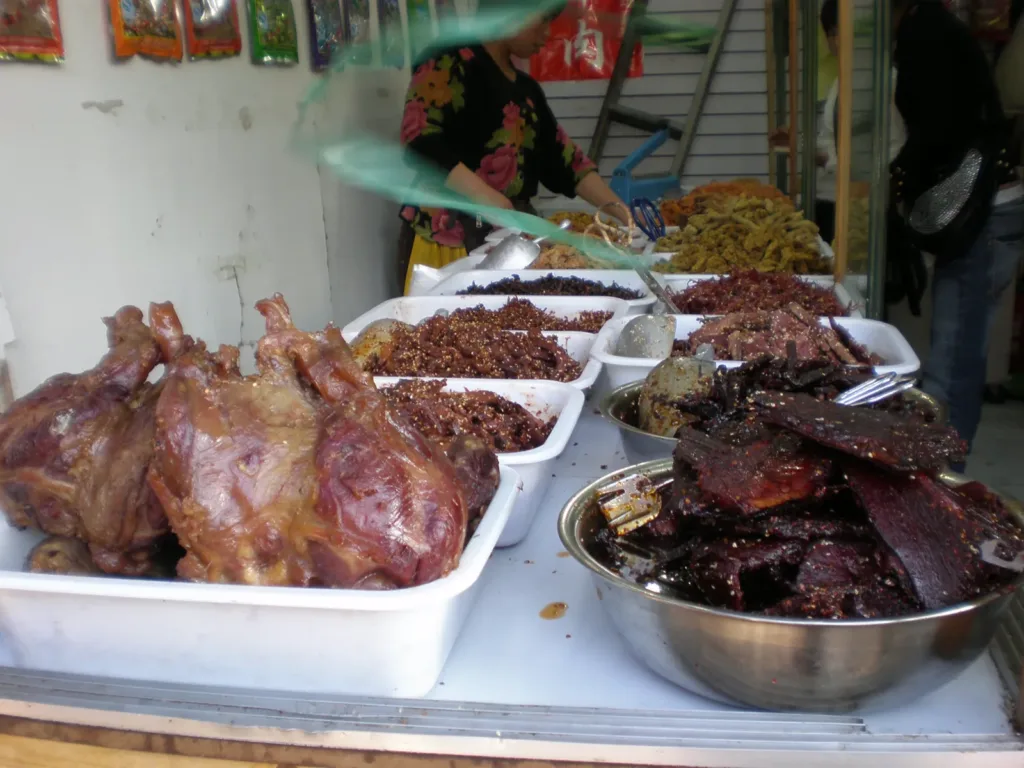
Yak jerky (牦牛肉干, máoniú ròugān) is a Qinghai highland meat snack that is especially easy to encounter in Xining as a packaged local product. It is not one fixed recipe: branded versions may be stir-fried, braised, hand-shredded or air-dried, with a firm chew and seasoning that can range from savoury to spicy.
Tap any red Chinese text to hear it in Mandarin.
What it is
The Chinese name to keep on your phone is 牦牛肉干 (máoniú ròugān). In Xining, it points to a family of dried yak-meat snacks rather than a single bowl or restaurant dish. Qinghai is the meaningful regional frame: one company account says it sources yak meat from Hainan Tibetan Autonomous Prefecture and southern Qinghai, while reporting on its Xining operation describes the city as a processing and sales base. That is a regional supply story, not proof that every packet comes from one company or one pasture.
How it is made
One documented Qinghai factory sequence begins with washing, selecting and cutting the meat, followed by pre-cooking and sorting. Depending on the product, it can continue through stir-frying or braising in seasoned liquid, heated drying, air-drying, airing and packing, then high-temperature and microwave sterilisation. A later factory report describes thawing, trimming, marinating, braising and vacuum packaging before inspection. These accounts show an industrial range rather than a universal home recipe.
The staged process is why two packs can differ in firmness and flavour. Look for the product style on the Chinese label instead of assuming that “yak jerky” means one texture: the producer’s own catalogue separates 炒制牦牛肉干 (stir-fried), braised or sauce-cooked, hand-shredded and air-dried lines.
What to taste
A dried strip should give you a concentrated, savoury meat flavour and a deliberate chew. Some versions are seasoned for heat; an English-language first-person account of Xining street food recorded curried, spiced and mala varieties of 牛肉干 Niúròugān. That is a useful clue to the range of flavours, not a current shop list or a promise that every market carries all three.
Start with a small packet if you are comparing styles. Tear or cut the meat into smaller pieces, and keep the Chinese name visible when asking what a packet contains. If you want to compare textures, ask whether the shop has 炒制 Chǎozhì, 卤汁 Lǔzhī, 手撕 Shǒusī or 风干 Fēnggān versions rather than ordering from the English name alone.
Dietary notes
Yak jerky is meat and is not vegetarian. A Qinghai report on one producer specifically identifies soy sauce among its seasonings, while the producer’s catalogue shows several product lines; formulations can therefore differ between packets. If you avoid soy, chilli or particular seasonings, read the ingredient label and ask the seller before eating. Do not infer that a packet is allergen-free or halal from its appearance or its English name.
Where to eat it
You can find Yak Jerky all over Qinghai, so there is no need to seek out one particular restaurant. To find one near you, search for “牦牛肉干” in Meituan (美团) or Amap (高德地图) and check recent reviews, distance and opening hours.
Image credits & notes (1)
- Dried yak meat being sold at the Dried Meat Yak store on Square Street in Lijiang's Old Town, Yunnan, photographed in 2008. This is an out-of-city visual example for the Qinghai-associated snack category, not a photograph of Xining, a current shop, or a verified Xining brand. Photo: BrokenSpherePhoto: CC BY-SA 3.0