

Minhe Mutton 民和羊肉
Minhe Mutton is featured among the local specialties of Qinghai.
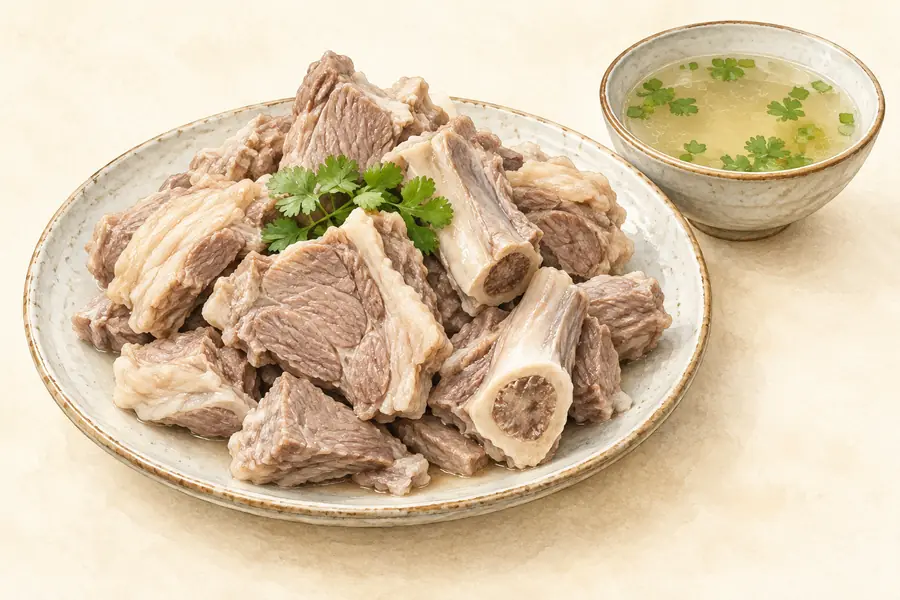
Minhe Mutton (民和羊肉) is mutton from Minhe Hui and Tu Autonomous County, a county under Haidong in eastern Qinghai, where the Yellow River runs along the southern edge.
An unfussy repertoire
Qinghai cooking is described as broad and unsentimental in method: roasting, frying, steaming, braising and boiling do most of the work, and the ingredient list stays short. Mutton is the backbone of the menu, and the cut and the sauce decide whether it arrives plainly boiled, braised with root vegetables, or browned and served with a stronger seasoning.
Sour, spicy, salty
The local profile is described as leaning sour, spicy, fragrant and salty, with textures that run from soft and crisp to tender, and a mellow 醇香 finish. That is a more forward palate than the coastal cuisines, so even a simple mutton dish may come with vinegar and chilli alongside the salt.
Minhe, on the Hehuang corridor
Minhe is a Hui and Tu autonomous county under Haidong, bordered by Gansu on three sides and by the Yellow River to the south. Its population is mainly Han, with Hui, Tu and Tibetan communities, and the county’s administration goes back to the Han dynasty, when a county was set up on the same ground. Qinghai cooking as a whole is described as Han and Hui styles fusing together and picking up Tibetan pastoral flavours.
Ingredients and what to check
Mutton is the constant. Ask whether the meat is on the bone, whether the stock is lamb- or beef-based, and whether chilli is part of the seasoning rather than a condiment on the side. If you are avoiding pork, say so — Qinghai’s braises and mixed plates sometimes combine meats in one pot.
Ordering for a table
Ask for the weight and for the cut, since mutton plates here are sized for sharing. A practical pattern is one generous meat dish with noodles, bread or a simple vegetable braise alongside, rather than several small meat plates competing for the same flavour space.
At the table
Large pieces may come to the table whole, to be cut into portions with a knife; ask the kitchen to portion them if you would rather not do it yourself. Dip in salt or the local chilli-and-vinegar mixture, and keep the accompaniments plain so the lamb is not buried.
More dishes to compare
Explore related local specialties and compare their names, preparation notes and ordering guidance.
Gonghe Mutton 共和羊肉 →
共和羊肉 is listed among the local specialities of Hainan Tibetan Autonomous Prefecture in western Qinghai. Both it and 民和羊肉 are county-named mutton dishes from the same province; 民和 is in the east on the Yellow River with a strong Hui and Tu presence, while 共和 lies in the Hainan prefecture in the west.
Questions before you order
What makes the cooking here distinctive?
The regional style is described as sour-spicy and salty with a mellow finish, and its methods are roasting, frying, steaming, braising and boiling rather than delicate saucing.
Should I expect chilli?
Possibly. Sour and spicy are named as part of the local palate, so ask whether chilli is in the dish or only on the table if you want it mild.
Source introduction: Wikipedia contributors: 青海菜 · CC BY-SA 4.0 (Wikipedia text, attribution required). English guide adapted from the cited material, with additional preparation and ordering guidance.
Source introduction: Wikipedia contributors: 民和回族土族自治县 · CC BY-SA 4.0 (Wikipedia text, attribution required). English guide adapted from the cited material, with additional preparation and ordering guidance.
Source introduction: Wikipedia contributors: 海东市 · CC BY-SA 4.0 (Wikipedia text, attribution required). English guide adapted from the cited material, with additional preparation and ordering guidance.