

Salted Milk Tea 奶茶
Salted Milk Tea is featured among the local specialties of Qinghai.
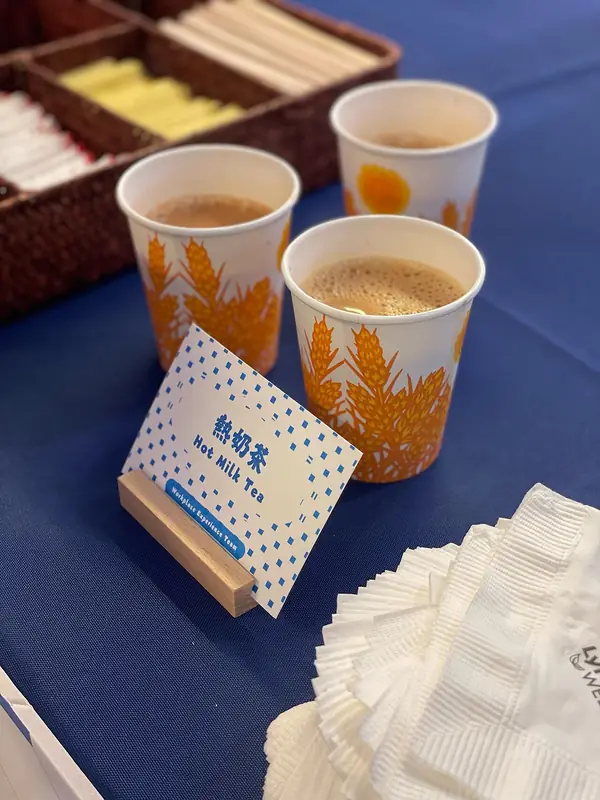

Photo adjustments
EXIF orientation normalized; resized without changing aspect ratio; converted to WebP. No subject edits.
Salted Milk Tea (奶茶) is the salted milk tea drunk with meals across the Tibetan plateau and the Mongolian regions, listed for Haixi Mongol and Tibetan Autonomous Prefecture in western Qinghai.
Brick tea in an iron pot
Mongolian milk tea is made in an iron pot. Water is brought to the boil, broken brick tea goes in for about five minutes, then roughly a fifth as much milk is stirred in, followed by salt — a minority of households use sugar instead. The pot is brought back to the boil and poured into bowls, and families often tie the tea into a cloth bag so the leaves need not be strained out.
Salty, not sweet
This is a salted tea. The tea is brewed strong enough to stand up to the milk, and the salt sharpens both. In the Tibetan areas a richer relative is drunk instead: 酥油茶 is brick tea beaten with butter and salt until it emulsifies, which is why the preparation is described as 打, beating, rather than brewing. Butter tea is more energy-dense and is described as a defence against the cold and the altitude.
A drink about hospitality
Milk tea is the gesture that opens a house. Mongolian households are described as drinking salted milk tea at all three meals, and a guest is poured a cup personally by the host — refusing it is treated as a breach of manners. In Tibetan areas the equivalent offering is butter tea, traditionally reserved for elders, guests and working adults.
Ingredients and what to ask
Ask first whether you are getting milk tea or butter tea; they are different drinks. Then ask whether sugar was used, since most versions are salted but a minority are sweetened. Things can also go into the bowl — 炒米, boiled mutton, fried dough or 奶豆腐 — and these additions are normal at breakfast.
Ordering
In Qinghai the drink is usually part of a meal rather than a quick order, so ask whether it comes by the bowl or by the pot and whether it is refilled. If you are watching salt, say so before it is brewed rather than after, because the salt goes in during cooking.
At the table
Drink it hot and keep the bowl topped up; in Mongolian practice the host does the pouring. A related dish worth knowing is 锅茶, which uses milk tea as a hotpot base and cooks butter, 奶豆腐, cheese, milk skin, 炒米 and dried meat in it — the same drink, turned into a meal.
More dishes to compare
Explore related local specialties and compare their names, preparation notes and ordering guidance.
Tibetan Butter Tea 酥油茶 →
酥油茶 is the Tibetan counterpart: brick tea boiled, then beaten with butter and salt in a tall wooden churn, or shaken in a leather bag, until it emulsifies. It is the traditional drink of Tibet, Qinghai and Sichuan’s Tibetan areas and is normally taken with 糌粑. Both it and 奶茶 are salted teas with milk fat, but milk tea is brewed and drunk by the bowl, while butter tea is beaten to order.
Questions before you order
Is 奶茶 here the sweet tea I know?
No. The version drunk in Qinghai and the Mongolian regions is salted, made with brick tea, milk and salt; only a minority of households sweeten it.
What is 锅茶?
A milk-tea hotpot. Milk tea is used as the base and butter, 奶豆腐, cheese, milk skin, 炒米 and dried meat are cooked in it.
Source introduction: Wikipedia contributors: 蒙古奶茶 · CC BY-SA 4.0 (Wikipedia text, attribution required). English guide adapted from the cited material, with additional preparation and ordering guidance.
Source introduction: Wikipedia contributors: 酥油茶 · CC BY-SA 4.0 (Wikipedia text, attribution required). English guide adapted from the cited material, with additional preparation and ordering guidance.
Source introduction: Wikipedia contributors: 藏族 · CC BY-SA 4.0 (Wikipedia text, attribution required). English guide adapted from the cited material, with additional preparation and ordering guidance.
