

Milk Skin 奶皮
Milk Skin is featured among the local specialties of Qinghai.
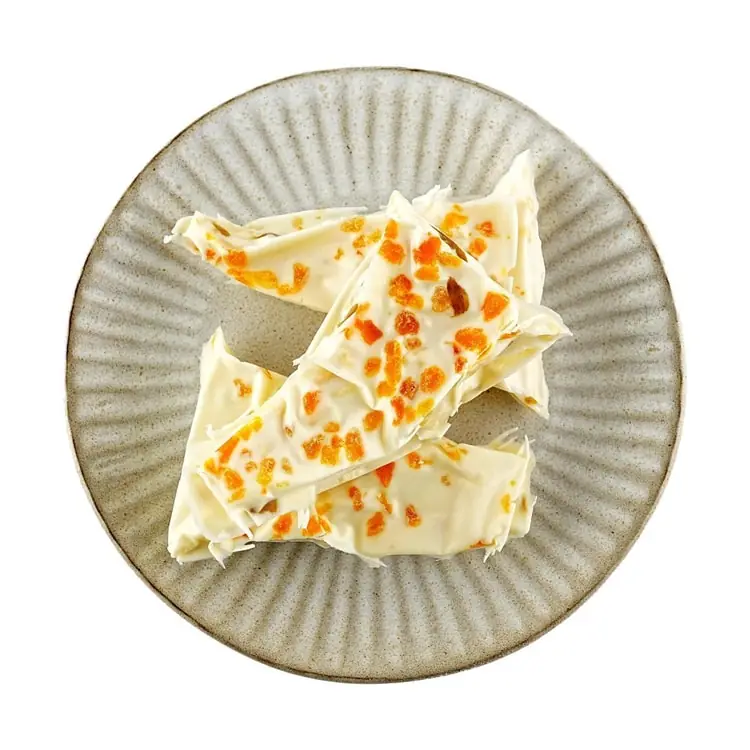
Photo adjustments
EXIF orientation normalized; resized without changing aspect ratio; converted to WebP. No subject edits.
Milk Skin (奶皮) is the skin that forms on heated milk — a concentrated dairy food eaten across the Mongolian and Tibetan regions, listed for Huangnan Tibetan Autonomous Prefecture in eastern Qinghai.
Skimming the skin
Fresh milk is poured into a pot and brought slowly to the boil. The cook repeatedly ladles the milk up and pours it back, adding more raw milk as it goes, until a layer of solids forms on the surface. The pot then comes off the heat and is left to cool for several hours, after which the skin can be lifted off in one piece.
Fat-rich and concentrated
The skin has a high fat content, which is exactly why it keeps better than most milk foods, and its flavour is concentrated rather than sour or sugary. In Mongolian food culture the whole family of milk products is called 查干伊德, the white food, and is described as the finest category of the cuisine — milk skin sits near the top of that group.
Dairy as a staple
Huangnan is a Tibetan autonomous prefecture in eastern Qinghai, and dairy there belongs to a way of life rather than to a dessert course. Tibetans are described as regularly making butter, yoghurt, cheese, milk curds and 奶渣 alongside the milk skin, and these foods are eaten with tea and 糌粑 as part of ordinary meals.
Ingredients and what to ask
Milk, and in the classic method nothing else at all. Ask whether sugar has been sprinkled on top before serving, and whether the piece in front of you is fresh or has been kept — the fat content makes it more durable than fresh dairy, so both are common. If you avoid dairy fat for health reasons, this is one to skip rather than reduce.
Ordering
Order a small portion. The skin is dense and rich, so a piece the size of a biscuit is already a full serving, and it is normally eaten alongside tea rather than as a course of its own. Ask whether it comes plain or sweetened, and whether it is served with 炒米.
How it is eaten
Take it in small pieces with hot tea or a plain bread. Because it is concentrated, it works best at the start of a meal or in the morning rather than after a heavy meat dish, and it travels well — milk skin is one of the foods traditionally carried on journeys, together with 炒米, 奶豆腐, butter and dried meat.
More dishes to compare
Explore related local specialties and compare their names, preparation notes and ordering guidance.
Menyuan milk skin 门源奶皮 →
门源奶皮 is a named milk-skin speciality from Menyuan, a Hui autonomous county in Haibei Tibetan Autonomous Prefecture in Qinghai. Both it and 奶皮 are milk skin, and both are described as more concentrated and richer in texture than yoghurt; the difference is that one is identified by the place that makes it and the other by the dairy preparation itself.
Questions before you order
Is 奶皮 the same as 奶皮子?
Yes. 奶皮子 is the full name of the preparation and 奶皮 is the short form used in menu and catalogue listings; the Mongolian name is өрөм.
How much should I order?
A small piece. Milk skin is fat-rich and dense, so it is normally taken in small amounts with tea rather than as a main dish.
Source introduction: Wikipedia contributors: 奶皮子 · CC BY-SA 4.0 (Wikipedia text, attribution required). English guide adapted from the cited material, with additional preparation and ordering guidance.
Source introduction: Wikipedia contributors: 蒙古奶食品 · CC BY-SA 4.0 (Wikipedia text, attribution required). English guide adapted from the cited material, with additional preparation and ordering guidance.
Source introduction: Wikipedia contributors: 藏族 · CC BY-SA 4.0 (Wikipedia text, attribution required). English guide adapted from the cited material, with additional preparation and ordering guidance.