

Qinghai Charcoal Hot Pot 青海土火锅
Qinghai Charcoal Hot Pot (青海土火锅), known in Huangzhong District (湟中区) as nuanguo (暖锅), is a shared dish built in layers rather than a raw-ingredient hot pot. Vegetables sit underneath cooked meat and other fillings, while broth keeps simmering above a charcoal chamber. Its particular character comes from the copper-pot tradition and from changing local combinations of meat, preserved vegetables, tofu, noodles and other ingredients.
Tap any red Chinese text to hear it in Mandarin.
A pot that arrives assembled
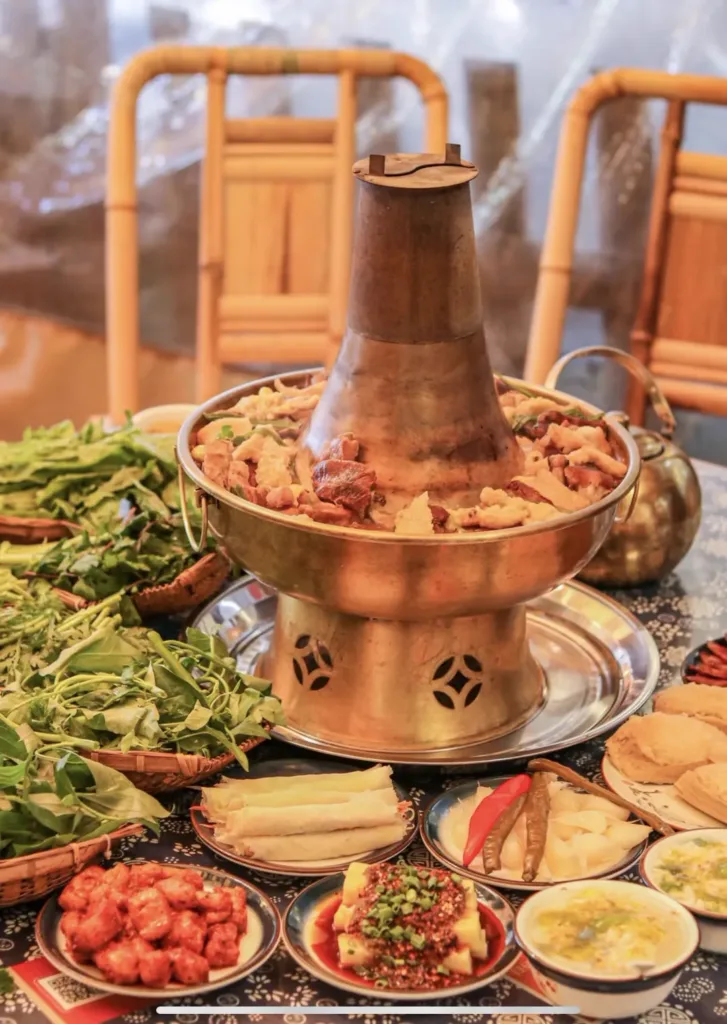
Traditional Qinghai tu huoguo is arranged before it reaches the table. Vegetables form the base; cooked beef or mutton, meatballs, braised tofu, fish or sliced meat make the upper layer; prepared meat broth is poured over, and charcoal under the central chimney keeps it simmering while the group eats. In Huangzhong reporting, this contrasts with a hot pot where diners swish raw pieces one by one: zhuang nuanguo (装暖锅) is closer to assembling a complete shared meal, although restaurants vary.
The taste is in the layers
A pot may combine sauerkraut, potatoes, vermicelli, tofu, meatballs and fried or braised items with beef or mutton. Fish, chicken, mushrooms and other local produce also appear in different versions. The broth is usually the quiet part of the dish: local descriptions emphasize a clear meat stock and restrained seasoning, so the vegetables, meat and charcoal heat remain distinct rather than disappearing into a heavily spiced base.
There is no single fixed recipe. Huangzhong’s local accounts describe different village and restaurant versions shaped by available produce and family preference, including lamb-, yak-, mushroom- and sauerkraut-centered variations. Treat the listed ingredients as a guide, not a guarantee: ask what is in the pot before ordering, especially if you avoid meat, fish, dairy, gluten or particular offal. The dish should not be assumed to be vegetarian, halal or allergen-free.
Why Huangzhong calls it a warming pot
In Xining’s Huangzhong District, Qinghai Charcoal Hot Pot is also called Huangzhong warming pot, or nuanguo (暖锅). The name describes both its practical warmth and its place in family gatherings, holiday meals and hosted banquets.
The vessel is part of the identity. Local reporting links Huangzhong warming pots to the area’s silver- and copperware workshops, where copper pots are hand-hammered and engraved; the pot’s central charcoal chamber is what lets the meal continue cooking at the table. Huangzhong’s silver- and copperware making and gilding technique is listed as a national intangible cultural heritage project, with a workshop tradition and documented forming, engraving, polishing and gilding processes. That heritage describes the craft tradition, not a promise that every restaurant pot is a hand-made collectible.
Ordering it in Xining
Look for the Chinese names 青海土火锅 Qīnghǎi Tǔ Huǒguō or 暖锅 Nuǎnguō.
Where to eat it
You can find Qinghai Charcoal Hot Pot all over Qinghai, so there is no need to seek out one particular restaurant. To find one near you, search for “青海土火锅” in Meituan (美团) or Amap (高德地图) and check recent reviews, distance and opening hours.
Sources & reading
Image credits & notes (1)
- Illustrative comparison only: a Qingcheng cured-rib copper hot pot photographed in Dujiangyan, Sichuan, China. It is not a photograph of a Xining or Huangzhong Qinghai Charcoal Hot Pot; it shows the copper vessel, central chimney and arranged ingredients that help explain the format discussed in this entry. Photo: Chensiyu2004Photo: CC BY-SA 4.0