

Rice with Droma Tubers 人参果饭
Rice with Droma Tubers is featured among the local specialties of Qinghai.

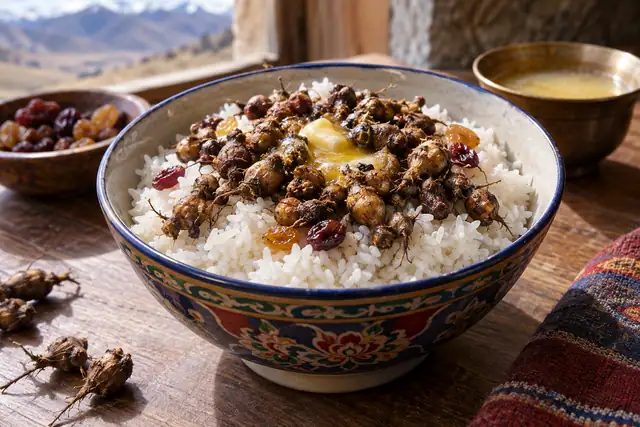
Rice with Droma Tubers (人参果饭) is the plateau rice dish built on foxtail-lily root — the plant Qinghai cooks call 人参果, "ginseng fruit", and Tibetans treat as a festive food.
Assembled, not cooked together
The dish is put together rather than simmered as one pot. Rice is cooked, the root is cooked, and the two are combined in a single bowl before sugar is scattered over the top and melted butter is poured on last.
That order matters. The butter goes on as a liquid dressing, so it coats rather than soaks in, and the eater stirs the bowl at the table to bring the three elements together. Nothing is baked and nothing is set, so the whole dish takes only as long as the two components take to cook.
Sweet, but not heavy
The combination is described as sweet without being astringent and rich without being greasy — an accurate warning, because rice, sugar and butter sounds like a heavy dessert and does not eat like one.
The root is the reason. Foxtail-lily root is starch-rich but not sweet on its own, and it brings an earthy, chestnut-like flavour and a slightly firm bite that stops the butter from dominating. The result is closer to a buttery grain pudding than to a cake.
A Tibetan dish on the plateau
The root grows across the cool north, but it is a Tibetan plateau food, and the dish belongs to Tibetan cooking rather than to the Chinese restaurant menu. It is treated as a symbol of reunion and harmony and is the first thing set out when guests are entertained, which is why it appears at festivals rather than every day.
In Yushu, the prefecture this entry is filed under, the root is collected and sold as a local product: herders bring foxtail-lily root, butter and air-dried beef to the cooperatives that pack and ship Yushu food around the country.
Four things
Cooked rice, the root, white sugar and butter — that is the whole list. The plant itself, Potentilla anserina, is a rose-family species of the cool northern hemisphere whose roots are starch-rich and can be boiled or brewed, and "ginseng fruit" is one of its recorded Chinese names.
Because the list is short, each ingredient shows. Better butter and freshly cooked root make a visibly different bowl from a version assembled from stored components, and the dish is usually made in small quantities for that reason.
Where to look for it
This is not a restaurant-menu staple, so look for it at Tibetan restaurants that serve festive food, at homestays, or during festivals and family gatherings rather than ordering it cold from a regular menu.
If you do find it, ask whether the version served is sweet or plain. Some kitchens leave out the sugar and serve the root and rice with butter alone, which reads as a savoury side dish; others follow the festive form with sugar.
How it is eaten
A bowl arrives with the butter already poured over the rice and root. You stir it yourself, mixing from the bottom so that the butter is spread through the grain instead of sitting on top, and eat it with a spoon.
It is served as a substantial dish in its own right, often early in a festive meal, and it is filling enough that a second bowl is unusual. If it is being shared, take a portion quickly — the butter sets as the bowl cools.
More dishes to compare
Explore related local specialties and compare their names, preparation notes and ordering guidance.
Hehuang mixed stew 熬饭 →
Hehuang mixed stew is the savoury grain-and-meat bowl of the same region, and the two make a useful pair. Both are one-bowl dishes that put a staple at the centre, but the stew simmers meat, cabbage, potato and noodles into a salty broth, while the rice dish keeps its four ingredients separate and finishes sweet. Meeting both shows the two ends of Hehuang comfort food: a simmered savoury pot and an assembled festival bowl.
Questions before you order
What is 人参果 in this dish?
It is not the ginseng fruit sold elsewhere. On the plateau the name refers to foxtail-lily root, a starch-rich root plant used as a Tibetan food.
Is it a dessert?
It is sweet when made in the festive way, with sugar, but it is served as a substantial dish at the start of a festive meal rather than as an after-dinner sweet.
Source introduction: Wikipedia contributors: 蕨麻 · CC BY-SA 4.0 (see https://creativecommons.org/licenses/by-sa/4.0/). English guide adapted from the cited material, with additional preparation and ordering guidance.
Sources & reading
The supplied food list supports this name and regional association. The culinary terms below are explained as menu vocabulary; a local recipe, origin story and venue availability have not been independently verified.