

Tongde Yak Meat 同德牦牛肉
Tongde Yak Meat is featured among the local specialties of Qinghai.
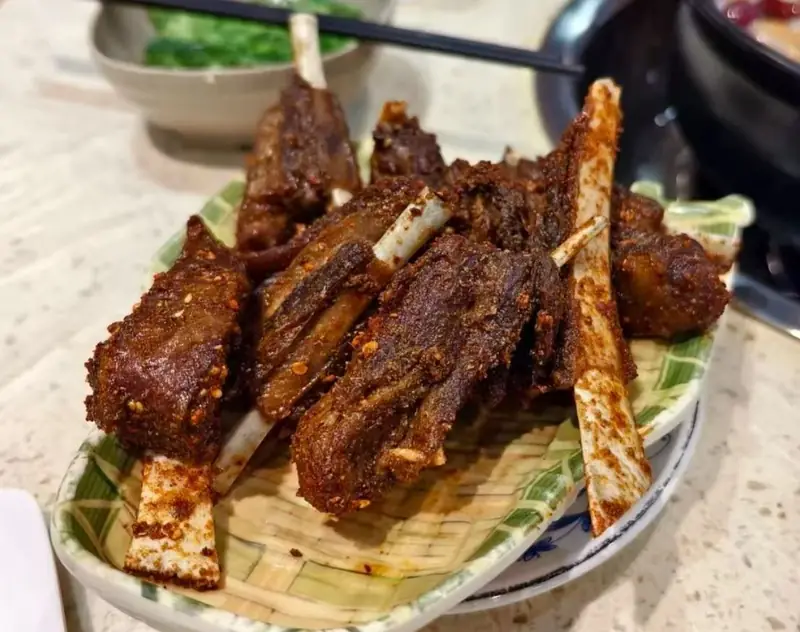
Image notes
Resized for the web; the photo itself has not been edited.
Tongde Yak Meat (同德牦牛肉) is yak beef from Tongde County in Hainan Prefecture, a herding county that has built its livestock policy around improving the local yak.
Bred first, cooked later
The story of this beef starts before the kitchen. Tongde positions itself as an organic livestock output area and works on the herd itself: artificial-insemination stations, selected bulls and cows, and breeding groups whose animals are individually recorded rather than pooled.
The animals move through a county market that handles live sales at scale, with the stated aim of moving the county from quantity to quality. For a visitor, the practical consequence is that the beef arriving at a table is sold as the product of a named county and a managed herd, not as anonymous meat.
Lean, firm, strongly flavoured
Yak is a grazing animal of high, cold pasture, and its beef is leaner and more intensely flavoured than grain-fed lowland beef. Expect a firmer chew and a deeper, slightly grassy note, less marbling and less sweetness.
That profile is why the meat is usually cooked simply. The regional repertoire boils, braises, roasts and steams with a short list of seasonings, letting the meat carry the dish rather than burying it under sauce. Slow cooking suits it better than quick frying, which can leave it dry.
Why the county matters
Tongde sits in the Hainan Tibetan Autonomous Prefecture, south of Qinghai Lake, in country that is grassland first and farmland second. Herding is the local economy, and the county’s improvement programme — named breeding groups, recorded animals, subsidies to bring stock to market — is designed to make that economy pay better.
The county also sells outside the province, taking livestock products to trade fairs in cities such as Xining and in Jiangsu, which is why the name now shows up on packaging far from the plateau.
What is on the plate
The main ingredient is simply yak beef, from animals raised on plateau pasture. In Qinghai kitchens much beef is yak rather than ordinary cattle, which is one of the things that separates the provincial cooking from other regional schools in China.
Beyond that, the usual companions are salt, chilli, garlic and sometimes a fermented paste or a light broth, depending on whether the meat is boiled, braised or roasted. Ask what the kitchen used before assuming a fixed recipe.
Ordering yak without surprises
Ask whether the cut is rib, shank or loin, and how it is cooked — boiled on the bone in the hand-grabbed style, braised, or dry-roasted. The hand-grabbed version is the most direct way to taste the meat, but it is rich and bone-in, so it is usually ordered for sharing.
Tongde beef is also sold dried and as cold cuts away from the plateau. If you are buying to take home, ask for vacuum packing and check whether the product is plain, salted or spiced, since the three taste very differently.
At a plateau table
Beef tends to arrive as the centre of the meal, with noodles or bread alongside and vegetables to cut the fat. In the winter-meat season, freshly butchered meat is what households buy in quantity, and the dish on the table follows the calendar as much as the menu.
Portions are large and designed for sharing, so ordering two meat dishes between two people is usually a mistake. Start with one, and add if the table clears it.
More dishes to compare
Explore related local specialties and compare their names, preparation notes and ordering guidance.
Haiyan Yak Meat 海晏牦牛肉 →
Haiyan beef and Tongde beef are both yak from lakeside pastoral counties, and comparing them is really a comparison of pasture and breeding policy rather than of recipes. Haiyan sits on the Qinghai Lake shore, while Tongde is a grassland county further south that has built an explicit yak-breeding programme. Cooked the same way — boiled on the bone or simply braised — the two are worth tasting side by side for the difference in fat and flavour that grazing country gives.
Questions before you order
Is 同德牦牛肉 different from ordinary beef?
It comes from yak raised on plateau pasture, so it is leaner and more strongly flavoured than most grain-fed beef, and it is usually cooked slowly.
When is the meat at its best?
In winter, when herding counties sell freshly butchered meat. Outside the season, look for vacuum-packed or air-dried cuts.
Source introduction: Wikipedia contributors: 青海菜 · CC BY-SA 4.0 (see https://creativecommons.org/licenses/by-sa/4.0/). English guide adapted from the cited material, with additional preparation and ordering guidance.
Sources & reading
The supplied food list supports this name and regional association. The culinary terms below are explained as menu vocabulary; a local recipe, origin story and venue availability have not been independently verified.