

Tsampa Roasted Barley Flour 糌粑
Tsampa Roasted Barley Flour is featured among the local specialties of Qinghai.
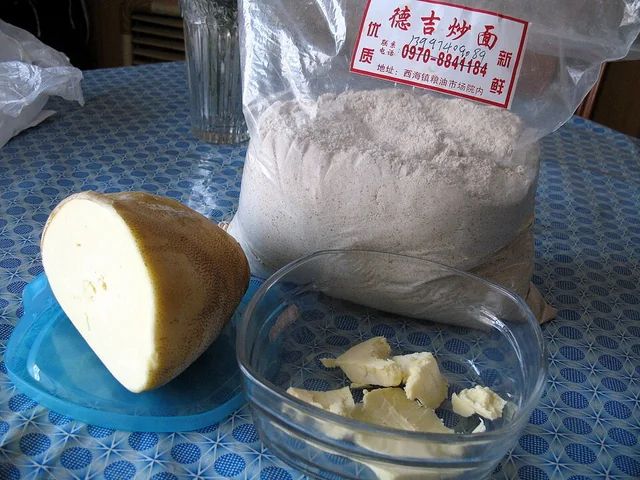

Photo adjustments
EXIF orientation applied where present; resized proportionally to at most 640 px on the long edge and encoded as WebP. No crop, retouching, recoloring or subject changes.
Tsampa Roasted Barley Flour (糌粑) is roasted barley flour, the staple that goes with butter tea on the Tibetan plateau: tea goes into the bowl first, the flour and other ingredients follow, and the eater kneads the mixture into a ball by hand.
From roasted grain to a bowl
The source starts with the grain: hulled barley is roasted and ground into flour, sometimes with pea flour mixed in. At the table the order matters. Butter tea is poured into the bowl first, then the barley flour goes in with 曲拉, sugar and barley wine; everything is worked with the fingers while the bowl is turned, pressing the flour into the tea along the rim until the mixture can be pressed into a ball.
What it is like to eat
The source describes the result as soft and fragrant, sweetened by the sugar rather than by the grain, and rich because of the butter worked into it. It also notes the nutritional side: the flour carries fat, protein and sugar, so a bowl delivers a great deal of energy at once, which is the point on a cold, high plateau.
A staple of the plateau
The source calls 糌粑 the staple food of Tibetan people and explains why it fits the landscape: it is simple to prepare, easy to carry and keeps for a long time without spoiling, which suits pastoral work far from a kitchen. In Qinghai the name is used across the province's Tibetan autonomous prefectures.
What goes into the bowl
Barley flour is the base, with pea flour as a possible addition. The source also names butter tea, 曲拉 (a dried dairy product), sugar and barley wine among the things stirred in, which means a bowl can contain dairy, and the wine means it is not automatically alcohol-free. Ask what has been added before kneading your own.
Ordering it
In restaurants the source records two directions the dish has taken: moulded shapes made with pastry moulds and served with a dip, hot tea or other ingredients, and plainer hand-mixed bowls. It also notes regional differences such as meat slices, chilli or a cake-like presentation, so the thing worth asking is which style the kitchen serves rather than assuming one standard form.
How it is eaten
The usual way is by hand. The flour is worked into the tea in the bowl, pressed into a ball and eaten while more tea is drunk, and the source treats a bowl of 糌粑 together with butter tea as a standard pairing. It is a filling food rather than a snack, and it is eaten for warmth as much as for taste.
More dishes to compare
Explore related local specialties and compare their names, preparation notes and ordering guidance.
Kunkuo oven-pot bread 焜锅馍馍 →
Kunkuo oven-pot bread (焜锅馍馍) is a round loaf baked inside a covered iron pot, which gives it a brown crust and a soft crumb, and it is bought freshly baked to share with soup. 糌粑 is not baked at all: the grain is roasted and ground first, and the eater does the last step by hand in a bowl of tea. One arrives finished from a bakery, the other is finished at the table.
Questions before you order
Does 糌粑 contain alcohol?
It can. The source lists barley wine among the ingredients mixed into the bowl along with butter tea, barley flour, 曲拉 and sugar, so ask what has gone in if you are avoiding alcohol.
Why is it eaten as a staple?
The source explains it through pastoral life: the flour is easy to prepare, easy to carry and keeps well without spoiling, and it supplies fat, protein and sugar in a form that provides warmth and energy.
Source introduction: Wikipedia contributors: 糌粑 · CC BY-SA 4.0. English translation and adaptation of the cited introduction, with additional preparation and ordering guidance.
Sources & reading
Named culinary source added during the audit. Source origin and local variants remain distinct; this is not a claim that all preparations have been individually verified.