

Gangzitou Hard Flatbread 杠子头火烧
Gangzitou Hard Flatbread is featured among the local specialties of Shandong.
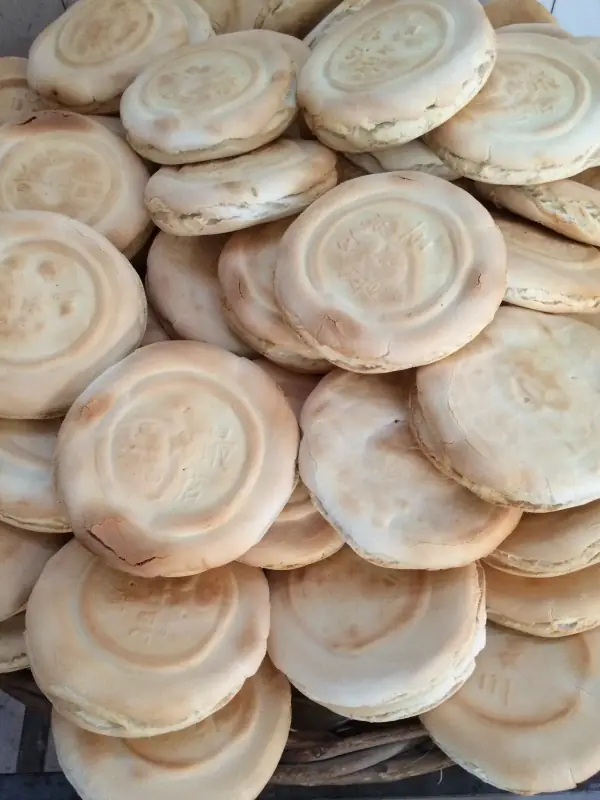
Image notes
Resized for the web; the photo itself has not been edited.
Gangzitou Hard Flatbread (杠子头火烧) is a very stiff baked wheat bread from Weifang (潍坊), long known as a food of old Weixian (潍县). Its name comes from the wooden pole (杠子) that bakers use to press and turn the dough until it is hard and even. It keeps for weeks, growing drier and harder, and was once stored by town households for the winter and carried by travellers heading to north-east China.
How it is made
In the traditional method described by the Weifang Evening News, 20 to 25 kilograms of hard dough were mixed at once in an oversized earthenware basin. A strong man then rolled and turned it on a board more than two metres long with a jujube-wood pole as thick as an arm, until it formed an even slab. The slab was rolled into a strip and cut into pieces weighed to half a jin (about 250 grams), each shaped thick at the edge with a thinner, raised centre, and baked in a flatbread oven.
In a 2021 report, Weicheng District (潍城区) baker Chen Xueliang (陈学亮), whose technique joined the district's intangible heritage list in 2018, presses his dough with a pole about 1.5 metres long, one end slotted into a hole in the wall, for more than ten minutes. He shapes each piece in a five-petal mould and, once the bread starts to colour, cuts five slits to let steam escape so it does not burst, leaving it with five 'wings'. Weifang records cited in the same report describe this winged loaf, made with 15 to 20 percent old dough added, as the town version.
How it is eaten
Straight from the oven the winged tips are crisp and the middle soft; Weifang people like to chew it with peanuts. Another way to eat it is 'braised gangzitou' (烩杠子头): the bread is broken into pieces and simmered in a pan with sliced pork belly fried with spring onion, ginger and star anise, plus soy sauce, then finished with chopped coriander and sesame oil.
Where it comes from
Farmers made the bread in the slack season, milling their own wheat, keeping the bran for their animals and selling the flatbread at town markets, which is why it was also called 'country flatbread' (乡火烧). The best known came from Liufanqiao (流饭桥), a village now in Weicheng District. An old Weixian custom was to buy the flatbread and scatter copper coins when a baby boy's head was shaved at one month old, wishing him a 'hard head' and good luck.
Sources & reading
Written from the linked sources and fact-checked against them on 2026-09-24. Recipes and servings vary between kitchens.