

Taoluo Mutton Noodles 涛雒羊肉面条
Taoluo Mutton Noodles is featured among the local specialties of Shandong.

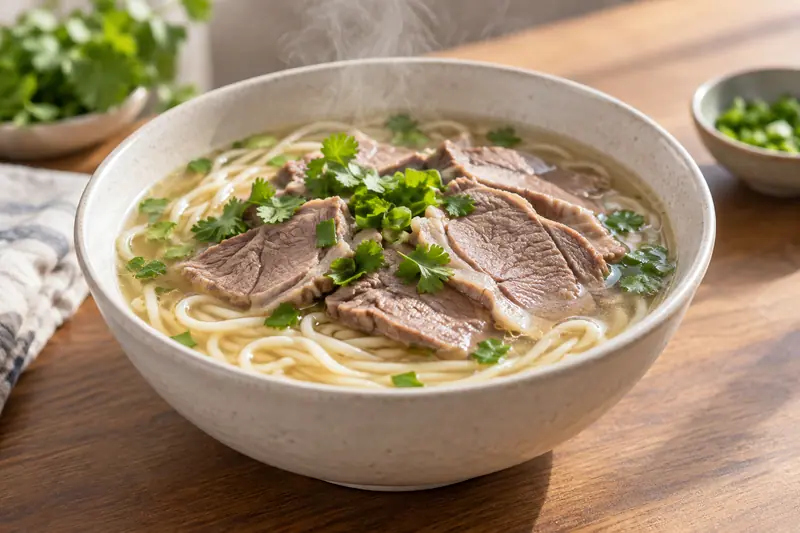
Taoluo Mutton Noodles (涛雒羊肉面条) are hand-rolled wheat noodles served in a clear mutton broth with sliced meat, from the town of Taoluo (涛雒) in Rizhao (日照). The Shandong Provincial Department of Civil Affairs calls them one of Rizhao's traditional noodle dishes and quotes a local saying: once you have eaten Taoluo mutton noodles, there is no need to roam the world.
Where it comes from
The Civil Affairs Department describes Taoluo as a trading town in southern Rizhao whose merchant trade grew from salt and shipping. In the late Qing dynasty, when merchants crowded the town, two families named Gao and Huang opened eating houses and created the mutton noodles. According to a feature carried by China News Service, Gao Changxiang ran the Gao family's shop, called Xiji (西记), with his three sons, while the brothers Huang Yongzhen and Huang Laoqi ran Tonghuiguan (同会馆); the Gao family's pot had the higher reputation.
How it is made
The noodles start from stone-ground flour of the grade called qiwu (七五, 'seventy-five'). For every 100 jin of flour the cooks add half a jin each of alkali and salt and 30 jin of water, then knead by hand; the more it is kneaded, the whiter and springier the dough. It is rolled with a rolling pin until the sheet is paper-thin and translucent, then cut into four-sided strands.
The two restaurants mostly used sheep of about 100 jin from Wulian Mountain (五莲山), Qiaozi Mountain (乔子山) and Deng Mountain (嶝山), kept in pens and slaughtered as needed. The meat is simmered slowly in a jar-shaped iron pot with a narrow mouth and wide belly until about 80 percent cooked, then boned and cut into thin slices. The original broth and the sliced meat are then seasoned with soy sauce, garlic, ginger and scallion.
How it is eaten
Sesame oil and a little vinegar go in just before eating, with coriander or yellow chives on top. A good bowl, the same feature says, has a broth clear to the bottom, with the soup and meat distinct from each other and a fresh aroma.
Sources & reading
Written from the linked sources and checked sentence by sentence against quoted extracts by a separate reviewer on 2026-09-24. Recipes and servings vary between kitchens.