

Datong Braised Pork Belly Strips 大同扒肉条
Datong braised pork belly strips (大同扒肉条), also called xiao shao rou (小烧肉), are a skin-on pork dish in Datong’s traditional Old Eight Great Dishes (老八大件). The meat is boiled with aromatics, cut into strips, fried until the skin blisters and colours, then returned to its broth and steamed in a bowl until tender. Datong’s 老八大件 belongs to banquet cooking rather than a single street snack. Shanxi’s government description ties the set to the old New Year table, while an English reference describes the eight large bowls at festivals and weddings. The set’s importance is cultural, but individual kitchens may serve the dish in different formats, and it is not guaranteed on every daily menu.
Tap any red Chinese text to hear it in Mandarin.
Datong’s 老八大件 belongs to banquet cooking rather than a single street snack. Shanxi’s government description ties the set to the old New Year table, while an English reference describes the eight large bowls at festivals and weddings. The set’s importance is cultural, but individual kitchens may serve the dish in different formats, and it is not guaranteed on every daily menu.
What to look for
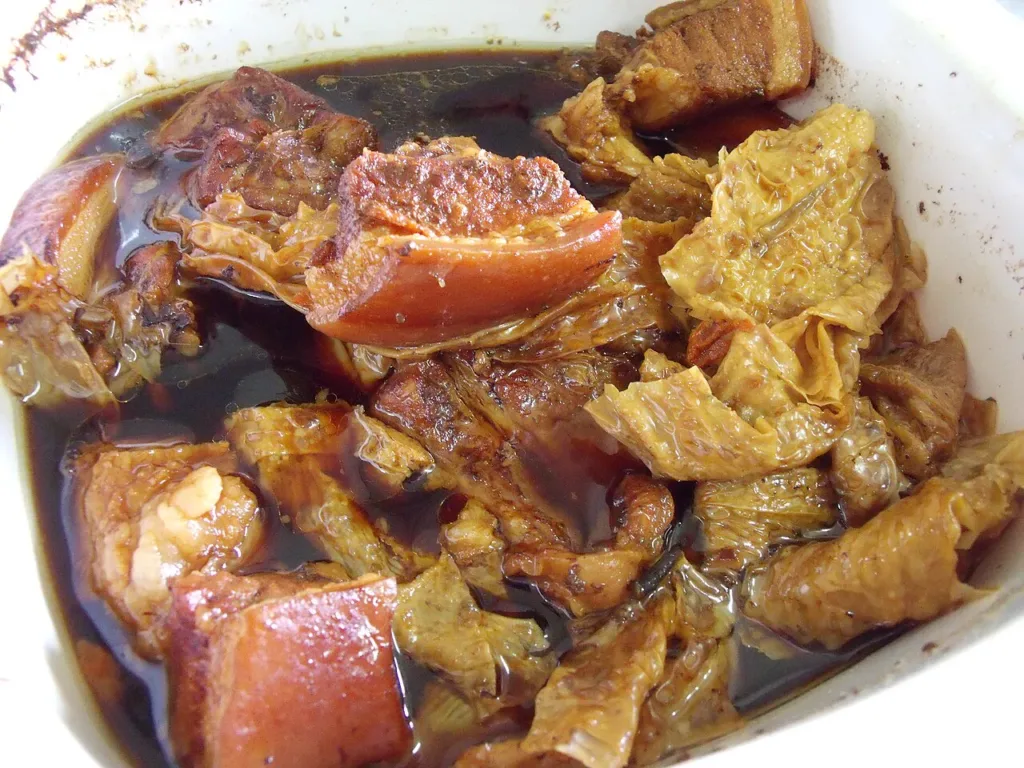
Look for strips of skin-on pork with a wrinkled, reddish-brown surface, soft meat and a glossy savoury sauce. A Datong food standard describes the intended result as red, tender, savoury and soft, with evenly wrinkled skin; that is a target description, not a promise that every restaurant follows one exact formula.
The core ingredient is skin-on pork belly, called 五花肉 or 腰条肉 in the local descriptions. Scallion, ginger, Sichuan pepper and star anise build the base. The traditional account also names chilli, soy sauce and Datong dry-pressed yellow wine. The Shanxi government text records an older colouring practice that used strips of calabash during boiling; dry-pressed yellow wine later took that role.
How it is made
The meat is first simmered in water with aromatics until partly cooked. It is then cut into strips roughly 1.2–1.5 cm wide, fried until the skin turns golden-red and blisters, and returned briefly to the original broth. The strips are arranged skin-side down in a bowl with aromatics and broth, then steamed over high heat for about two to three hours until soft. In the standardised version, the cooking liquid is drained, thickened with starch and finished with a little oil before it is poured back over the turned-out meat.
That sequence explains the dish’s texture: frying changes the skin, while the long covered steaming lets the meat soften and take on the seasoned broth. It is not the same thing as a quick stir-fried pork dish, and the “braised” English label should not hide the preliminary frying and final steaming.
Ordering and dietary notes
Keep the Chinese name 大同扒肉条 Dàtóng Bā Ròu Tiáo handy when asking about it. Do not assume that a menu called “Eight Great Dishes” uses the exact Datong version.
This is a pork dish. The documented versions use animal fat or cooking oil and seasonings such as soy sauce, cooking wine, salt and sometimes MSG; ask about ingredients if you have allergies or dietary restrictions.
Where to eat it
You can find Datong braised pork belly strips all over Shanxi, so there is no need to seek out one particular restaurant. To find one near you, search for “大同扒肉条” in Meituan (美团) or Amap (高德地图) and check recent reviews, distance and opening hours.
Sources & reading
Image credits & notes (1)
- Illustrative public-domain photograph of home-cooked braised pork belly; the source does not identify it as Datong扒肉条 or a Datong restaurant. Photo: David (Kcdtsg at English Wikipedia)Photo: Public domain