

Steamed Yellow Millet Cake 黄糕
Datong’s 黄糕 is a steamed cake made from yellow-millet flour. Served plain with a savoury stew it is soft and springy; shaped around a filling and fried, it becomes crisp outside and soft inside. The same food carries local good-wish customs through the homophone of 糕 and 高.
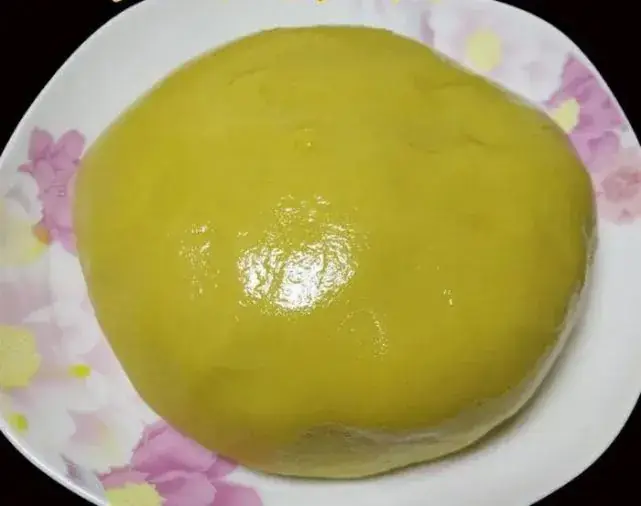
Image notes
Resized for the web; the photo itself has not been edited.
Tap any red Chinese text to hear it in Mandarin.
黄糕 (huánggāo) is not a sponge cake or a fixed sweet. In Datong, the name usually points to a preparation made from yellow-millet flour. The plain steamed form is called 素糕 (sugao); the filled, fried form is 油糕 (yougao). Ask for the Chinese name if you are looking for it on a local menu.
From millet flour to a smooth golden cake
A Datong cook begins by rubbing millet flour with cold water. The moisture is not treated as a universal measured formula: it directly affects the final texture. The damp flour is spread in a cloth-lined steamer and cooked for a little over ten minutes. While it is still very hot, the cooked mass is tipped into a basin. The cook repeatedly pulls, presses, rolls and kneads it, dipping their hands in cold water, until the loose granules become a smooth, glossy, golden oval. A thin coat of sesame oil finishes the surface and helps keep it from drying.
This hands-on kneading is the point of the plain cake. It gives the yellow-millet dough a soft but resilient bite rather than a crumbly, Western-style cake texture. Moisture, timing and technique vary between kitchens, so one serving may be softer or chewier than another.
Two ways to eat it
The plain form is served with a savoury dish, not necessarily as a sweet. A local report describes it alongside Datong-style mixed vegetable stew, 大烩菜 (dahuicai), as well as stewed chicken, lamb, bones, beef or chicken offal. Here, 素糕 means the plain steamed form; it does not by itself promise a vegan meal, because the accompanying stew may contain meat.
For 油糕, the kneaded dough is divided, flattened and wrapped around a filling before frying. Shape can be a useful local clue: an ingot-like shape is associated with a vegetable filling, a round cake with bean paste, and a three-cornered one with a marrow filling. At one Datong cake shop, a marrow filling included beef marrow, raisins, walnut, melon seeds, sesame, white and brown sugar, and the red and green candied strips known in old Datong; its vegetable filling used steamed potato, 地皮菜 (a wild edible fungus), carrot and garlic chives. These are examples from particular kitchens, not a single mandatory recipe.
Freshly fried 油糕 develops translucent blisters on its surface. The contrast is the attraction: a crisp, brittle shell around a soft, warm centre, with the filling deciding whether the bite is sweet, nutty, savoury or rich.
A food with good-wish language
The word 糕 sounds like 高, meaning “high”. That pun lets “eating cake” carry wishes for rising, progress and good fortune. Local accounts place fried cake in family milestones, celebrations and mourning hospitality, while the 2026 Datong landmark-food list presents the custom as part of the city’s food culture. The meaning is cultural rather than a promise that every shop or household follows the same calendar.
Use 黄糕 Huáng Gāo when asking at a venue you choose, confirm what filling is available that day, and ask about meat, nuts, sesame or other ingredients if you have dietary restrictions.
Where to eat it
You can find Steamed Yellow Millet Cake all over Shanxi, so there is no need to seek out one particular restaurant. To find one near you, search for “黄糕” in Meituan (美团) or Amap (高德地图) and check recent reviews, distance and opening hours.