

Jishan Fried Dough Twists 稷山麻花
Jishan Fried Dough Twists is featured among the local specialties of Shanxi.
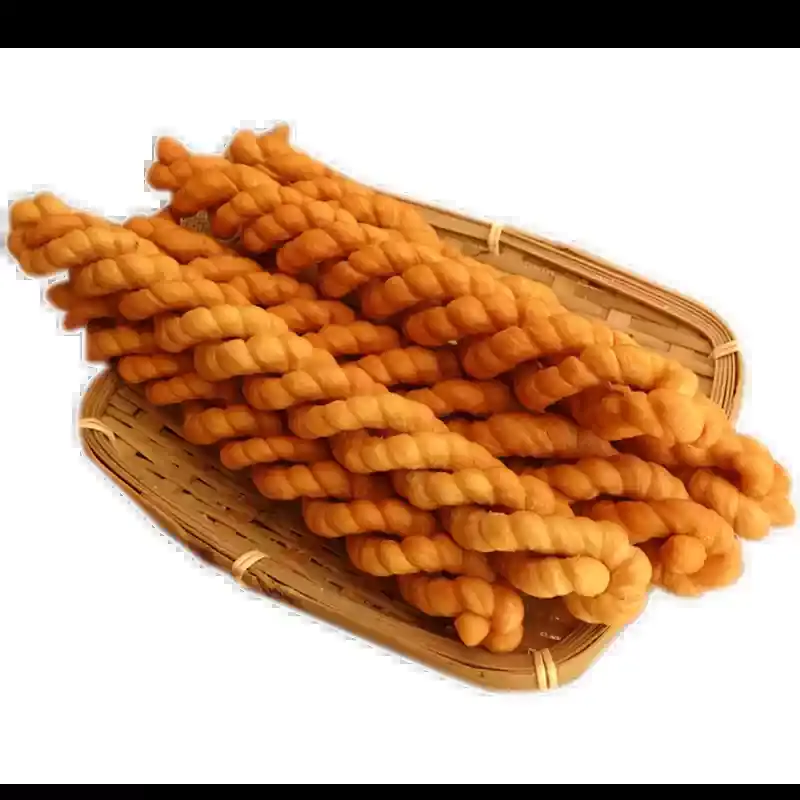
Image notes
Resized for the web; the photo itself has not been edited.
Jishan Fried Dough Twists (稷山麻花) are deep-fried twists of wheat dough from Jishan County (稷山县) in Yuncheng (运城), Shanxi. The Shanxi provincial government lists them as a traditional Yuncheng snack and says they take their name from Jishan as the home of Houji (后稷), the legendary ancestor who taught people to farm and plant the five grains.
Where it comes from
One story on the provincial government's page holds that the twist began as court food and reached ordinary people as two strands of dough stuck together, a form still seen around Hongtong (洪洞). In the Qianlong reign (乾隆) of the Qing dynasty a merchant from Xiwei village (西位村) in Zhaidian town (翟店镇) brought it home, made it for sale and later changed it from two strands to three.
A second, local story ties it to scorpions. On the second day of the second lunar month, families pulled dough into long strips, twisted them into the shape of a scorpion's tail, fried them and ate them, a custom called "咬蝎尾" (biting the scorpion's tail). That single fried strand is said to have grown into today's two- and three-strand twists.
In poorer times white flour and cooking oil were out of ordinary reach, so the twists were eaten only now and then, at weddings, on visits to relatives and when entertaining guests at festivals. Jishan County has since set up a Jishan mahua association and registered a trademark for the name.
How it is made
The dough is made stiff and worked by hand. A recipe published by the provincial government mixes flour with powdered sugar, vegetable oil, milk powder, soda and alum; a savoury batch uses less sugar and adds egg and salt. The strands are twisted together and fried until golden, with a pattern of fine lines along the twist.
Flavour and texture
Twists come sweet or savoury, and the sweet ones are sold either plain or dusted with powdered sugar. They are golden and glossy and are described as crisp, oily without being greasy, leaving nothing behind when chewed and keeping without going soft. The Deng family (邓氏) twists, a three-generation Jishan business, come in more than ten flavours, among them flaky, chocolate, five-spice and "怪味" (literally "strange flavour").
Sources & reading
Written from the linked sources and fact-checked against them on 2026-09-24. Recipes and servings vary between kitchens.