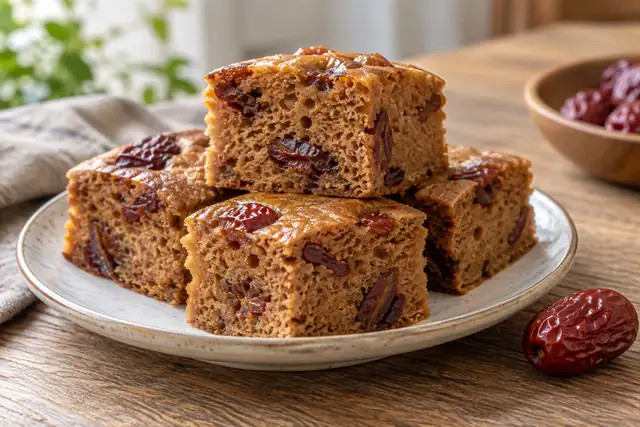
Wuxiang Jujube Millet Cake 武乡枣糕
Wuxiang Jujube Millet Cake is featured among the local specialties of Shanxi.
Wuxiang Jujube Millet Cake (武乡枣糕) is Wuxiang County's jujube cake, made from 黄米 — also called 软米 — and 大红枣. It is a soft, sweet cake from the Changzhi area of south-eastern Shanxi, and it is one of the county's own foods.
What it is made from
The county's food page names two things and stops there: 黄米, the millet whose Jin-dialect name 软米 describes its soft, sticky character, and 大红枣, the large jujubes that give the cake its name and its sweetness. That combination is the whole dish in outline.
In Shanxi, cakes of this family are made from 黄米粉, known locally as 糕面, and filled with bean or jujube paste. What the Wuxiang version does with proportion, steaming and cutting is not documented in the material read, so nothing further is fixed here.
How it eats
Expect 香甜、质软利口 — sweetly fragrant and soft on the tongue. Millet has its own faint sweetness, and the jujubes add a darker, slightly smoky fruit flavour, so the cake reads as a natural sweet rather than a sugared one.
It is dense food, in the way that steamed millet cakes and glutinous rice cakes are dense; a small piece is enough with tea, and a large one is a meal in itself.
Local roots
Wuxiang is a county of Changzhi, in the millet-and-jujube belt of south-eastern Shanxi, and the cake is listed among the area's own foods rather than among the province's famous noodle dishes. That is the right way to understand it: a county's sweet for festivals and gifts rather than a restaurant speciality.
Across the province the same instinct shows up in 年糕, which Shanxi makes from 黄米粉 糕面, fries or steams, and fills with bean or jujube paste. 武乡枣糕 is the county version of that habit, with the jujube doing more of the work than any filling.
Ingredients and dietary notes
Millet and jujube are the documented ingredients, with no dairy, egg or wheat necessarily involved — but recipes differ and some kitchens add a little wheat flour or sugar, so ask if either matters.
The cake is naturally sweet and dense rather than light. Anyone avoiding gluten should ask 加白面了吗 (is wheat flour added), and anyone watching sugar should treat it as a confection rather than a health food, whatever local tradition says about it.
How to buy it
Say 枣糕 or 武乡枣糕. It is bought by weight or by the piece from shops, markets and food counters, often wrapped as a gift, and it travels better than most local cakes because there is no cream or custard in it.
Ask 多少钱一斤 and 甜不甜 (how sweet is it), and ask whether it is 新做的 (freshly made) — the cake firms up as it cools and is at its best soon after it is cut.
How to eat it
Cut it into thick slices and eat it with plain tea, which balances the sweetness. In cold weather it can be warmed through a steamer, which brings the millet back to softness; in summer it is eaten as it comes.
It also works as a small gift, since it keeps without refrigeration for a while. If you are buying to carry home, ask for it wrapped tightly and keep it somewhere cool and dry rather than in a hot car.
More dishes to compare
Explore related local specialties and compare their names, preparation notes and ordering guidance.
Taigu sweet cakes 太谷饼 →
太谷饼 and 武乡枣糕 come from the same part of Shanxi and share a role — a sweet that keeps, is cut or broken into pieces, and is often bought as a gift rather than eaten at a table. The difference is the grain underneath: 太谷饼 is a baked wheat cake, dry and crumbly by design, while 武乡枣糕 is a soft millet cake whose sweetness comes from 大红枣. Buying one of each shows both textures at once, and it also shows how a province with a reputation for noodles finishes a meal.
Questions before you order
What is 武乡枣糕 made of?
黄米 — also called 软米 — and 大红枣. The Changzhi municipal page names those two ingredients and describes the cake as 香甜、质软利口, sweet and soft.
Is it a cake or a steamed snack?
It is a soft millet cake. Shanxi makes this family of cakes from 黄米粉 糕面, steamed or fried, often with jujube paste, and 武乡枣糕 belongs to that tradition rather than to the cream-cake shelf.
Source introduction: Wikipedia contributors: 年糕 · CC BY-SA 4.0. English guide adapted from the cited material, with additional preparation and ordering guidance.