

Tai'an cabbage-and-tofu soup 泰安三美
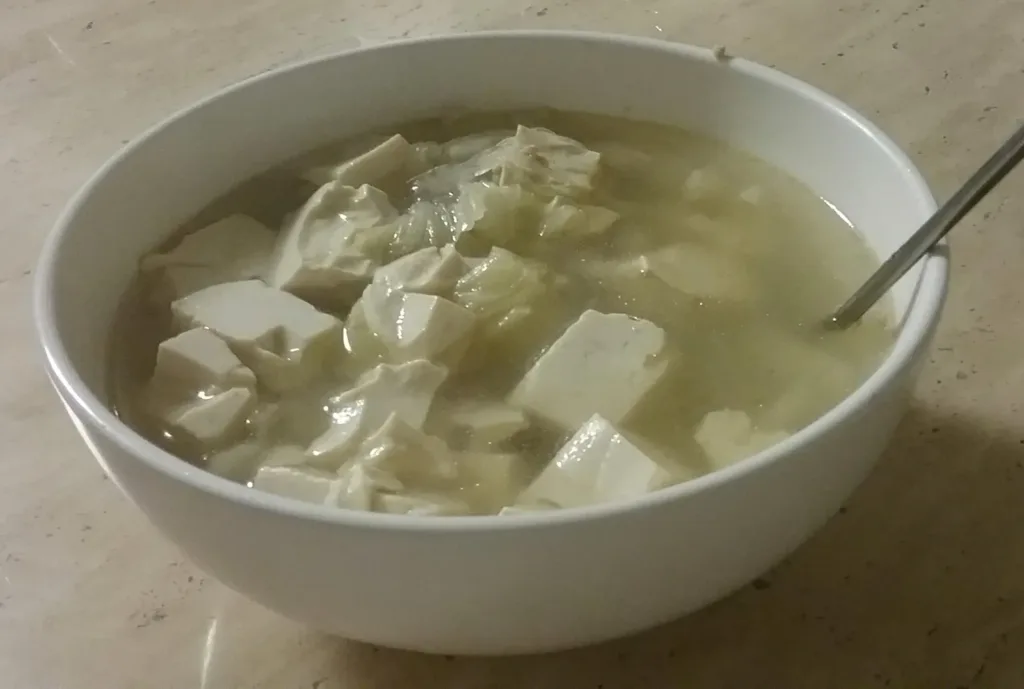
Tai'an Sanmei (泰安三美), also called Sanmei Tofu or Sanmei Soup, is a Tai'an local preparation built around three named local ingredients or resources: cabbage, tofu and water. Its appeal is the contrast between tender cabbage, soft bean curd and a pale, naturally sweet broth rather than a heavy sauce.
Tap any red Chinese text to hear it in Mandarin.
What “Sanmei” means
The name is not just a poetic label for any cabbage-and-tofu soup. A Taishan District government food guide defines the three elements as cabbage, tofu and water. It specifically highlights the local yellow-bud and green-bud cabbage varieties, with yellow-bud cabbage valued for cooking quickly, releasing relatively little water and helping produce a milky-looking, fresh-tasting soup.
The dish is associated with Tai’an and the foot of Mount Tai, but it is not a single protected recipe. In local food writing, you may see the names 泰安三美, 泰山三美汤, 三美汤 or 三美豆腐. They point to the same local food tradition, while the kitchen’s ingredients and stock can differ.
What to expect in the bowl
A detailed local account describes a traditional version using黄芽白菜, a soft northern-soybean tofu set with gypsum, and Taishan spring water. It reports that a restaurant version first turns the water into a clarified chicken stock, warms a little flour in oil, adds the stock and cabbage, and puts in the tofu later. The point of that account is the order and heat: the cabbage should soften and sweeten without losing all its freshness, while the tofu should stay tender instead of becoming rubbery.
That is a reported traditional method, not a rule for every restaurant. Other kitchens may use a different stock or a different balance of cabbage and tofu. Expect a pale to milky soup, tender cabbage and a smooth, mild bean-curd bite. The water is part of the dish’s identity, not merely a cooking detail; local and English-language descriptions present Taishan water as the third element of the combination.
How to order it
Show the name 泰安三美 Tài’ān Sān Měi or ask for 三美汤 Sān Měi Tāng. If you avoid meat, ask 这道三美汤的汤底是素汤吗? Zhè dào sān měi tāng de tāng dǐ shì sù tāng ma? (“Is the stock for this Sanmei soup vegetarian?”). One well-known preparation account uses chicken stock, so the pale appearance alone does not establish that the bowl is vegetarian. Also mention allergies or dietary restrictions before ordering; recipes and restaurant practice vary.
Where to eat it
You can find Tai'an Sanmei all over Shandong, so there is no need to seek out one particular restaurant. To find one near you, search for “泰安三美” in Meituan (美团) or Amap (高德地图) and check recent reviews, distance and opening hours.
More dishes to compare
Explore related local specialties and compare their names, preparation notes and ordering guidance.
Boshan stuffed tofu boxes 博山豆腐箱 →
Tofu is fried until it has a firm outer surface, then opened and partly hollowed. The filling goes inside before the boxes are steamed or otherwise finished, and sauce is added for serving. The exact stuffing is the kitchen's choice. The outer tofu is resilient, the inside softer and moist, and the filling adds small contrasting pieces. Sauce softens the fried surface, so a properly finished box need not stay crunchy like freshly fried bean curd.
Bazirou 把子肉 →
Thick pieces of pork belly are slowly braised in a soy-seasoned liquid until the meat is tender. They are served with the cooking sauce and often accompanied by other braised items. The meat is soft and full-flavored, with yielding fat and a salty, rounded sauce that suits plain rice.
Sources & reading
Recipes and servings vary between kitchens.
Image credits & notes (1)
- A regional illustrative photograph of napa cabbage and tofu soup (白菜豆腐湯), photographed in Clovis, California; it is not a photograph of Tai'an Sanmei in Tai'an. Photo: NeoBatfreakPhoto: CC BY-SA 4.0