

Steamed Pork Belly with Dried Mustard Greens 梅干扣肉
Steamed Pork Belly with Dried Mustard Greens is featured among the local specialties of Taiwan.
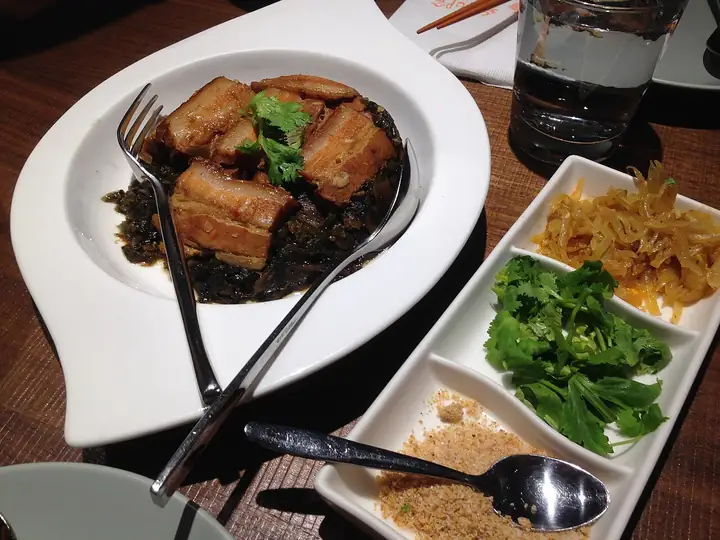

Photo adjustments
EXIF orientation normalized; resized without changing aspect ratio; converted to WebP. No subject edits.
Mei gan kou rou (梅干扣肉) is Hakka pork belly steamed over dried mustard greens: the greens soak up the fat, the meat turns soft enough to cut with a spoon, and the whole thing is served inverted.
How it is made
It begins in the field. Gongguan, in Miaoli County, plants mustard greens in September and October and pickles them the traditional way; the township calls itself the home of pickled mustard green and the whole village smells of it through the winter.
The green passes through three stages. Salted mustard green becomes 酸菜; wind and sun then turn it into 福菜; longer drying until it is completely dry makes 梅干菜. In the kitchen the dried green is laid under thick slices of pork belly and the dish is steamed long enough for the fat to run down into it.
Flavour & texture
Deeply savoury, salty and faintly sour, with a fermented tang that is closer to dried olive than to cabbage. The greens lose their sharpness in the steaming and take on the pork instead.
The pork is the texture story: skin gelatinous, fat translucent, lean part soft enough to pull apart. A well-made version is described locally as 不油膩, not greasy, which is exactly what the greens are there to achieve.
Local roots & traditions
Gongguan holds a mustard-green festival each December, with a display showing the three-step conversion from fresh mustard green to the dried forms, and a market of cheap Hakka dishes built on them.
In 2023 a Gongguan restaurant's 梅干扣肉 was picked for the 500 Pan awards, a Taiwanese restaurant list chosen by fifty judges. The county government treats the dish as one of its food landmarks and has promoted the pickled green into hotpot broths and restaurant menus.
Ingredients & dietary needs
Pork belly, dried mustard green, soy sauce, sugar, garlic and often rice wine, with the greens rehydrated before cooking. Nothing contains wheat or dairy, and no offal is involved.
The dish is built on pork fat, so it is not vegetarian and not halal; a vegetarian version with mushrooms exists but is a different dish. Soy sauce brings the gluten and soy risk. Ask about rice wine if you avoid alcohol, and expect a high salt level from the preserved greens.
How to order it
Show the name in Chinese. Ask whether it comes as a small plate or a clay pot, because portions vary a lot between snack stalls and restaurants. Ask for 少油 if you want the kitchen to skim the fat.
It is rich, so one plate is enough for three or four people alongside other dishes. In Gongguan it is often served with a red-date steamed bun, which is the local way to mop up the sauce.
How to eat it & plan a meal
Take a piece of pork and a spoonful of greens in the same bite; eaten separately the meat is heavy and the greens too salty. Spoon the sauce over plain rice rather than drinking it.
Order it with a plain vegetable and a clear soup to balance the fat. If you are eating at a Hakka table, put it in the middle and share — it is not designed as one person's main course.
More dishes to compare
Explore related local specialties and compare their names, preparation notes and ordering guidance.
Red Rice Wine Lees Pork 紅棗肉 →
Red-date pork is sweet and fruity, built on the township's dates; 梅干扣肉 is salty and fermented, built on its mustard greens. Restaurants in Gongguan often serve both on the same table.
Questions before you order
What exactly is 梅干菜?
It is mustard green that has been salted, then wind-dried and sun-dried until completely dry. The same green at earlier stages is 酸菜 and then 福菜; 梅干菜 is the fully dried end of the process and the strongest tasting.
Is the dish very fatty?
It uses pork belly, so yes, but the dried greens are layered underneath specifically to absorb the fat, and the local description of a good version is 不油膩, not greasy. Ask for 少油 if you want it skimmed.
Sources & reading
The supplied food list supports this name and regional association. The culinary terms below are explained as menu vocabulary; a local recipe, origin story and venue availability have not been independently verified.