

Thin Wheat Noodles 面线
Thin Wheat Noodles is featured among the local specialties of Taiwan.
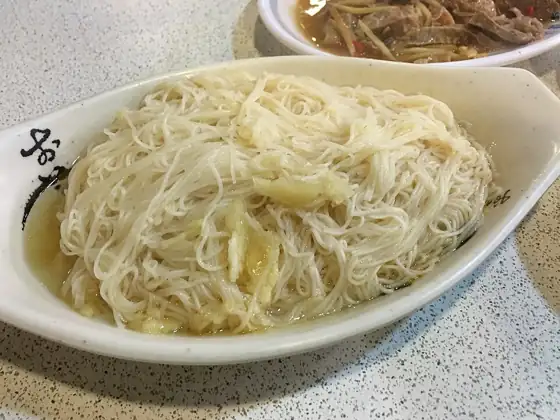
Thin Wheat Noodles (面线), also written 线面, is the thin wheat noodle of the Min-speaking and Hakka regions; in Taiwan it is set down for Taipei City, and thickened into soup it becomes 面线糊.
One noodle, several names
The source is less about a recipe than about a family of names. 线面 is the form used in the Min-speaking areas, with romanisations recorded in several regional systems; 面线 is the Minnan and Taiwan name; and 面线糊 is the thickened soup version. The same word covers the noodle and the bowl it arrives in, and the source stresses that the methods differ across the communities that eat it.
How the noodle eats
These are fine, slightly salted wheat strands, which is what makes them behave so differently from a thick noodle: they cook in a very short time, they soften quickly, and in a soup they release starch that thickens the broth around them. The result is a bowl that is silky rather than chewy, and the salt already in the noodle is part of the seasoning.
A noodle of the Min and Hakka regions
The source places 面线 across the Min-speaking and Hakka-speaking areas and lists the communities among which it is popular: the Minhai, Chaozhou, Hainan and Hakka. That spread explains the naming variation, because each community has its own form of the word and its own way of cooking the strands. In the assigned catalogue the name is listed for Taiwan, under Taipei City.
Ingredients and dietary questions
The noodle itself is wheat and is normally made with salt, so it is not gluten-free and it is not a low-salt food on its own. What arrives with it decides the rest: a bowl may be finished with oysters, pork, offal or a plain broth, and the thick version often carries a starch-thickened soup. Ask about the stock base and about what is on top if you avoid meat, seafood or shellfish.
Ordering a bowl
Say 面线 for the noodle and 面线糊 if you want the thickened soup style, then ask what goes in it – the answer changes the bowl entirely. Because the strands are delicate, they are served as soon as they are ready, and a bowl that sits before it reaches the table goes soft; ordering at a busy hour is therefore worth the wait.
How it is eaten
The bowl is eaten with a spoon as much as with chopsticks, because the fine strands and the thickened broth do not lift cleanly. It works as a light meal, or as one course among several at a snack table, and the source's point that the noodle is popular across several communities is the clue to its role: a plain, quick bowl rather than a dish reserved for occasions.
More dishes to compare
Explore related local specialties and compare their names, preparation notes and ordering guidance.
Oyster thin-noodle soup 蚵仔麵線 →
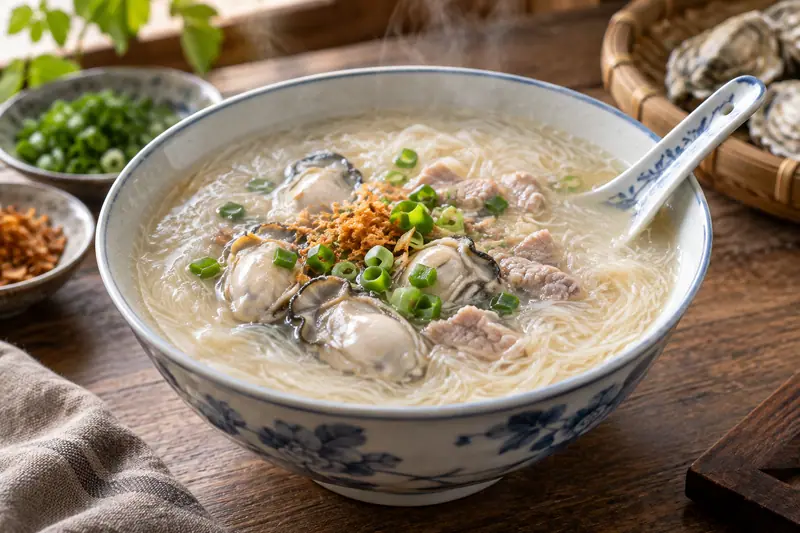
Oyster thin-noodle soup (蚵仔麵線) is a Taiwanese bowl in which thin wheat noodles meet a thickened broth and small oysters, served as a street snack. 面线 is the noodle at the centre of that family of dishes – the same fine strand under different names across the Min and Hakka regions, served plain as well as in soup. One is a specific bowl; the other is the ingredient that makes many bowls possible.
Questions before you order
Are 线面 and 面线 the same noodle?
Yes. The source treats 线面 as the form of the name used in the Min-speaking areas and 面线 as the Minnan and Taiwan form, with 面线糊 naming the thickened soup version. What changes between regions is the name and the cooking, not the basic product.
Why is it served in so many different ways?
Because it belongs to several communities at once. The source lists the Minhai, Chaozhou, Hainan and Hakka among the groups among which the noodle is popular, and notes that the ways of making it differ from one to another – which is why a bowl in one place is not the same dish as a bowl in the next.
Source introduction: Wikipedia contributors: 线面 · CC BY-SA 4.0. English translation and adaptation of the cited introduction, with additional preparation and ordering guidance.
Sources & reading
Named culinary source added during the audit. Source origin and local variants remain distinct; this is not a claim that all preparations have been individually verified.
Image credits & notes (1)
- Serving example. 拌麻油麵線, 岡山羊肉爐, 遼寧街, 台北Photo: bryan... from Taipei, Taiwan · CC BY-SA 2.0Resized for the web; the photo itself has not been edited.
.jpg)