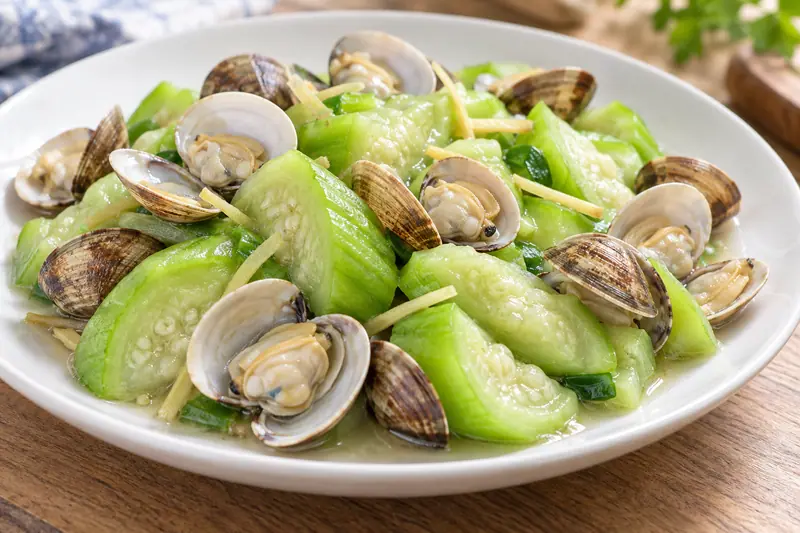
Penghu Stir-Fried Luffa with Clams 澎湖丝瓜炒蛤蜊
Penghu Stir-Fried Luffa with Clams is featured among the local specialties of Taiwan.
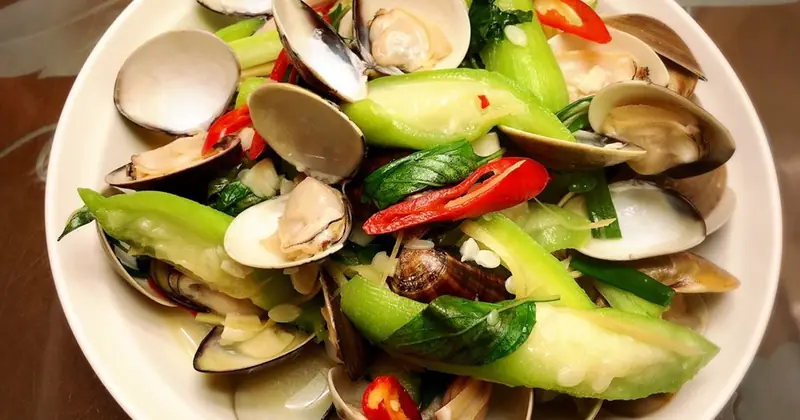
Image notes
Resized for the web; the photo itself has not been edited.
Penghu Stir-Fried Luffa with Clams (澎湖丝瓜炒蛤蜊) is Penghu's stir-fry of ridged luffa and clams: a dish built on the island group's own vegetable and its shellfish.
How it is cooked
The method is fixed by the name. 炒 is stir-frying, and the two ingredients are the vegetable and the shellfish, so this is a quick pan dish rather than a soup or a braise: the luffa is cut and turned in the pan while the clams open and release their liquid.
The vegetable is the part that needs explaining. 澎湖絲瓜 is a local name for 稜角絲瓜, the ridged luffa, whose fruit carries ten raised edges. Its flesh is thinner than that of the common round luffa, the fibres are finer and less numerous, and the reference rates the flavour above the round type.
What it tastes like
Ridged luffa is described as crisp and fine-grained rather than watery and coarse, which is why it holds up in a fast stir-fry. Clams add salt and sweetness through their own liquor, so the dish ends up light and clean: a vegetable that stays slightly firm with a shellfish broth at the bottom of the plate.
Why the name says Penghu twice
The luffa carries the county's name in everyday speech: the reference lists 澎湖絲瓜 and 金門絲瓜 among the plant's common names and adds that the ridged type is grown more in Guangdong, Guangxi and Taiwan than elsewhere. Its centre of origin is the Indian subcontinent, and it is now planted across tropical Asia.
Penghu is the island county in the middle of the Taiwan Strait, made up of the Penghu archipelago and administered from Magong as one city and five townships. The county's reference notes that its early economy was fishing, that it now leans on tourism, and that its small land area carries 69 fishing harbours — which is where the second half of the dish comes from.
Ingredients and dietary questions
In Taiwan, 蛤蜊 is a general term: the reference says edible bivalves such as 文蛤, 花蛤, 粉蛤 and 竹蛤 are all called by it, which is why the dish has no single fixed clam. Shellfish allergies and dietary rules should therefore be raised explicitly, and anyone avoiding soy or oyster sauce should ask how the pan is seasoned, since the sources do not document one standard set of seasonings.
Ordering it
Ask for 澎湖丝瓜炒蛤蜊, or shorten it to 絲瓜炒蛤蜊 on a Penghu menu — in the islands the word 絲瓜 normally means the ridged kind. Because the clams vary, 用什麼蛤蜊 is a fair question, and 不要放醬油 or 清炒 are the useful words if you want the dish kept simple.
How it is eaten
It is a shared vegetable plate in a home-style or seafood-restaurant meal, eaten with rice and alongside other dishes rather than on its own. The clam liquor collects at the bottom of the plate and is usually spooned over rice, which is also the practical test of whether the luffa was cooked long enough to soften without collapsing.
More dishes to compare
Explore related local specialties and compare their names, preparation notes and ordering guidance.
Oyster omelet 蚵仔煎 →
Oyster omelet (蚵仔煎) is the coastal shellfish dish bound in a starch batter and cooked on a griddle; Penghu's luffa and clam stir-fry keeps the vegetables and shellfish loose in the pan. Comparing them shows the same resource treated two ways — shellfish as the body of a chewy snack, or as seasoning and liquor for a green vegetable.
Questions before you order
What is 澎湖絲瓜?
It is 稜角絲瓜, the ridged luffa with ten prominent edges, called Penghu luffa in Taiwan; its flesh is thinner, finer and better flavoured than the round luffa.
Which clams are used?
There is no single answer: in Taiwan 蛤蜊 covers edible bivalves such as 文蛤, 花蛤, 粉蛤 and 竹蛤, so the species depends on the kitchen.
Source introduction: Wikipedia contributors: 稜角絲瓜 · CC BY-SA 4.0 (https://creativecommons.org/licenses/by-sa/4.0/). English guide adapted from the cited material, with additional preparation and ordering guidance.
Source introduction: Wikipedia contributors: 蛤蜊 · CC BY-SA 4.0 (https://creativecommons.org/licenses/by-sa/4.0/). English guide adapted from the cited material, with additional preparation and ordering guidance.
Source introduction: Wikipedia contributors: 澎湖縣 · CC BY-SA 4.0 (https://creativecommons.org/licenses/by-sa/4.0/). English guide adapted from the cited material, with additional preparation and ordering guidance.