

Crispy Fried Tofu-Skin Pork Rolls 酥炸鸡卷
Crispy Fried Tofu-Skin Pork Rolls is featured among the local specialties of Taiwan.
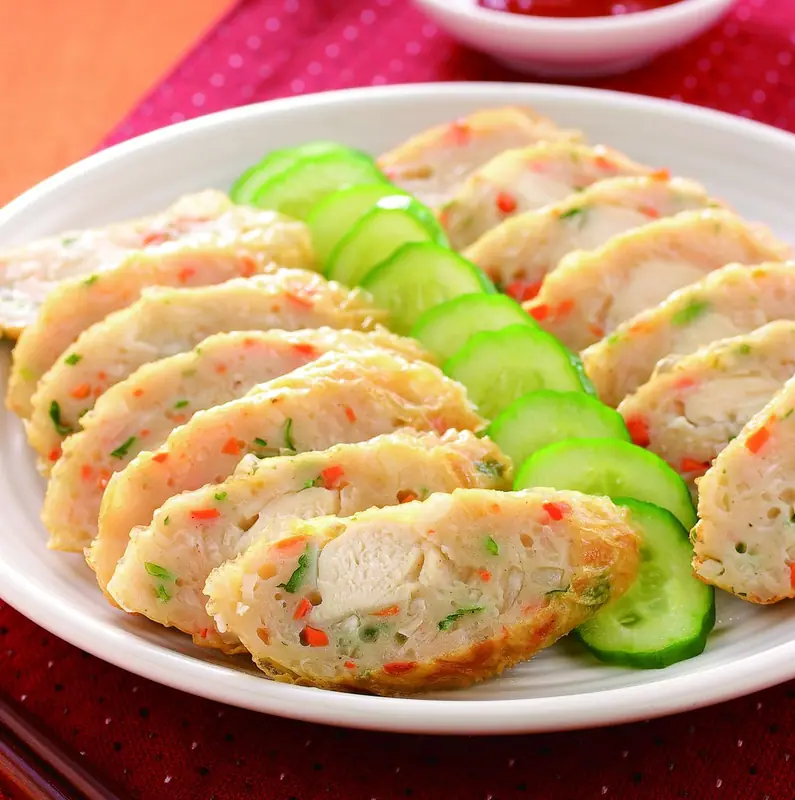
Image notes
Resized for the web; the photo itself has not been edited.
Crispy Fried Tofu-Skin Pork Rolls (酥炸鸡卷) are Taiwan's ji juan, ke-kńg in Taiwanese Hokkien: a deep-fried roll with a pork filling, wrapped to look like a chicken's neck. Chinese Wikipedia traces it to the Shima (石码) area of Zhangzhou (漳州) in southern Fujian, from where Hokkien migrants brought it to Taiwan. It is now one of the island's well-known snacks, and in northern Taiwan it is a common offering at ritual sacrifices.
How it is made
Most rolls today are tofu skin wrapped around fish paste and pork. Shops mostly use pork from the front leg, fry each roll at a weight of about four Taiwanese taels (台两), and cut it into several pieces once it comes out of the oil. It is served with side dishes such as salted pork with chopped spring onion, and pickled cucumber.
Older versions were different. Two Taiwanese publications of 1902 and 1912 record a dish named shao ji guan (烧鸡管), made from chicken and pork in a two-to-one ratio with onion, shiitake and caul fat. The Taiwanese-Japanese Dictionary (台日大辞典) of 1931 defines the fried dish as pork cut fine, mixed with shiitake, spring onion, bamboo shoot, pepper and flour, wrapped into a long roll in caul fat and deep-fried.
Where it comes from
Today's ji juan contains no chicken, which can catch diners out: in 2021 ETtoday reported a Taiwanese shop owner who refunded a customer angry that the roll held fish paste rather than chicken. The explanation now common in Taiwan is that the first syllable is really the Hokkien word for 'extra' (加), because it began as a frugal farm dish of leftovers rolled in tofu skin and fried. Chinese Wikipedia calls this a folk etymology, noting that only Quanzhou (泉州) and Taiwan call the dish ji juan, and that 'chicken' and 'extra' sound alike in Zhangzhou speech but not in Quanzhou speech. Elsewhere the roll goes by other names, such as rou juan (肉卷, 'meat roll') in Zhangzhou and Chaozhou (潮州) and wuxiang (五香, 'five spice') in Zhangzhou and Xiamen (厦门).
Sources & reading
Written from the linked sources and fact-checked against them on 2026-09-25. Recipes and servings vary between kitchens.