

Hsinchu Rice Vermicelli 新竹米粉
Hsinchu Rice Vermicelli is featured among the local specialties of Taiwan.


Photo adjustments
Full frame retained; EXIF orientation normalized, proportionally resized to at most 800 pixels and converted to WebP. No generated pixels or subject changes. Cards may crop the display.
Hsinchu Rice Vermicelli (新竹米粉) is a well-known noodle of the Hsinchu (新竹) area of Taiwan. Chinese Wikipedia credits Hsinchu's strong winds, which blow for much of the year, with making the area well suited to making the noodles, and says the craft came from Fujian (福建). The noodles were once made mainly from rice; corn starch is now the main ingredient, a change the article puts down to texture.
Where it comes from
Noodle-making was brought to Hsinchu between the Daoguang and Xianfeng reigns of the Qing dynasty by four brothers from Hui'an (惠安) in Fujian, among them Guo Quan (郭泉). The best-known production area, and the earliest, is Da'nanshi (大南勢), the strip between the south side of Yanping Road (延平路) and the Keya River (客雅溪). Before the 1960s the area was thick with paddy fields and grew plenty of rice, which made it a centre of noodle production; that is why Da'nanshi is often called Mifenliao (米粉寮), 'the rice-noodle sheds'.
How it is made
Hsinchu makes two kinds. Shuifen (水粉), also called coarse vermicelli, is short and thick and is the original form. Chuifen (炊粉), the fine kind now more popular, is pressed into thin strands, cooked in steamer baskets and then dried in the wind so that it keeps. The best noodles come from October to December, after the rice harvest, when the northeast monsoon blows hard and little rain falls.
How it is eaten
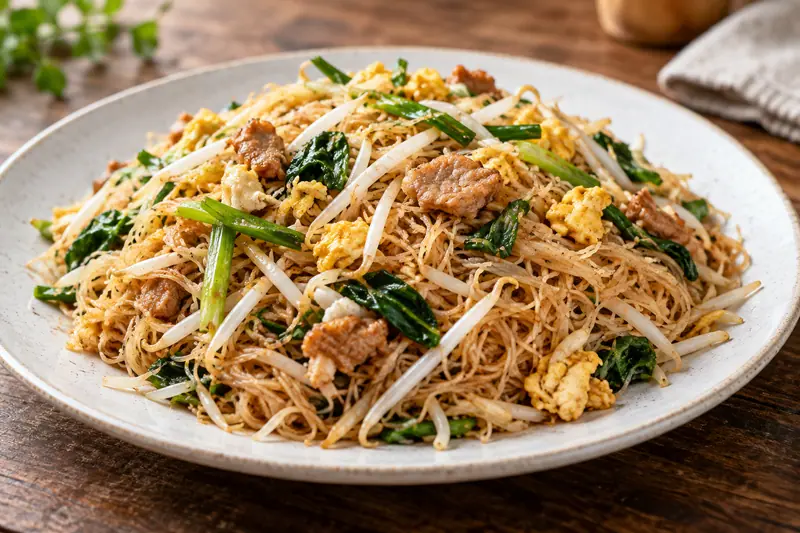
The coarse kind is most often simmered with meat into a noodle soup. The fine kind goes into soups such as pork-ball vermicelli soup (貢丸米粉湯), or is stir-fried and then served with soy-sauce meat gravy poured over it, a common Taiwanese way of eating it. The added corn starch is what makes Hsinchu's noodles suited to frying.
Ingredients
Because most Hsinchu noodles contain less than half rice, Taiwan's Ministry of Health and Welfare (衛生福利部) rules that took effect on 1 July 2014 meant they could no longer be sold simply as mifen. The Hsinchu City rice-noodle makers' association renamed the boiled kind 'Hsinchu shuifen' and the steamed kind, most of the output, 'Hsinchu chuifen'. The Central News Agency (中央社) reported the Food and Drug Administration's deputy director-general saying that Hsinchu mifen would not disappear. In 2016 the administration agreed with the Hsinchu city government and the makers' association that the word mifen could be used again.
Sources & reading
Written from the linked sources and checked sentence by sentence against quoted extracts by a separate reviewer on 2026-09-25. Recipes and servings vary between kitchens.