

Oysters with Fermented Black Beans 荫豉蚵仔
Oysters with Fermented Black Beans is featured among the local specialties of Taiwan.
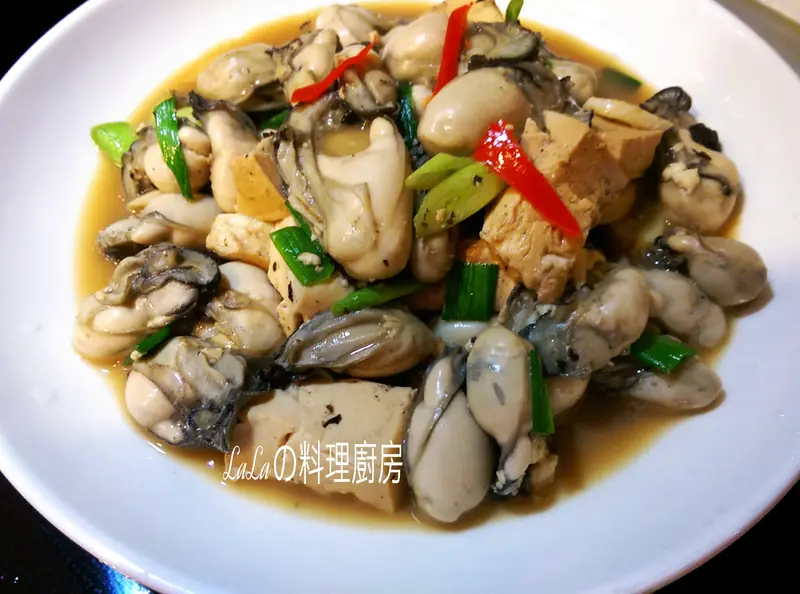
Photo adjustments
EXIF orientation normalized; resized without changing aspect ratio; converted to WebP. No subject edits.
Oysters with Fermented Black Beans (荫豉蚵仔) is oysters cooked with fermented black beans. The name is the recipe in two words: 蔭豉 is the Taiwanese and Minnan term for salted, fermented black beans, and 蚵仔 is the oyster.
The seasoning does the work
Fermented black beans are among the oldest seasonings in Chinese cooking. The word 豉 does not appear in pre-Qin texts but shows up in the Han dynasty: it is mentioned in the Shiji, the Hanshu records two merchants who made their fortunes trading it, and jars of it were found in the Mawangdui tomb. Through the Han and the Three Kingdoms it was an everyday condiment that could also be used medicinally, and the Qimin Yaoshu and Bencao Gangmu both record methods for salted and unsalted versions.
In Minnan and Taiwanese usage the same product is called 蔭豉. What it brings to a pan is salt and deep, savoury fermentation rather than heat, so the cook's job is to balance that against the sweetness of the shellfish and to keep the oysters in the pan only long enough to firm them up.
What it tastes like
This is a briny, savoury dish with almost no sweetness in the seasoning. The oysters supply a soft, mineral flavour and a little sweetness of their own; the beans sit over the top with salt and the particular funk of fermented soy. Together they taste stronger than either would alone.
Heat is a variable rather than a fixture. Some kitchens keep it plain, others add chilli or garlic, so ask before ordering if you want the dish mild — the name itself does not promise a spice level.
Where the oysters come from
蚵仔 is simply the Taiwanese word for oyster, and the shellfish it names has a long farming history on the island. Records place oyster cultivation near Dongshi as early as 1717, using scattered stones and shells; around 1890 villagers at Wengang began planting reed stems on the tidal flats so that seed oysters would settle on them, which started investment in farmed oysters.
Bamboo strips replaced the reeds, then bamboo split to hold oyster shells, and by the 1930s the stake method dominated around Budai and Dongshi in Chiayi County. Rack culture was promoted in 1960, and from 1968 growers there moved to fixed hanging culture; nylon strings, which resist rot, sun and strain, made that shift possible. After 1982, offshore floating-rack zones were set up outside the Tainan coast, with the result that a large share of Taiwan's oysters now comes from open-water racks rather than the tidal flats the industry began on.
Ingredients and dietary questions
The dish needs shucked oysters and fermented black beans, with salt and oil; garlic, chilli, ginger and spring onion appear in the wider family of bean-seasoned seafood dishes, so ask what went into yours.
Oysters are shellfish and the main allergen risk in the bowl. Because the dish is cooked, ask whether yours has been heated through if you are not comfortable eating them barely done, and ask for the sauce to be left off if you are limiting salt — the beans are the saltiest thing in the pan.
Ordering it
Say 蔭豉蚵仔, or the closely related 蔭豉鮮蚵, and expect a hot dish rather than a soup. It is usually part of a shared table and is eaten with plain rice, so order it alongside something blander.
If the kitchen plates it simply, ask for the sauce separately on the side; the beans are strong enough that a dish can be ruined by a heavy hand, and the person eating can manage the balance.
How it is eaten
It comes from the wok straight to the table and is eaten while hot, spooned over rice. The beans are not a garnish to be picked out: the sauce they make is the point of the dish rather than a by-product.
The same bean seasoning moves across Taiwanese seafood: the local dish list includes 蔭豉鮮蚵 beside oyster omelette and five-willow fish.
More dishes to compare
Explore related local specialties and compare their names, preparation notes and ordering guidance.
Oyster thin-noodle soup 蚵仔麵線 →
Oyster thin-noodle soup (蚵仔麵線) uses the oyster as the body of a thick, savoury soup with very fine noodles, while 荫豉蚵仔 treats the whole dish as a seasoning exercise: shellfish and fermented black beans, no noodles, eaten over rice. Comparing them shows how differently one Taiwanese oyster can be used.
Questions before you order
What exactly is 蔭豉?
It is the Minnan and Taiwanese name for 豆豉 — salted, fermented black beans, a soybean product used across Chinese cooking as a seasoning rather than as a vegetable.
Is 荫豉蚵仔 spicy?
Not by definition. The name names the beans and the oysters only, and chilli or garlic are additions a kitchen chooses. Ask if you want it mild.
Source introduction: Wikipedia contributors: 豆豉 · CC BY-SA 4.0 (https://creativecommons.org/licenses/by-sa/4.0/). English guide adapted from the cited material, with additional preparation and ordering guidance.
Source introduction: Wikipedia contributors: 牡蠣 · CC BY-SA 4.0 (https://creativecommons.org/licenses/by-sa/4.0/). English guide adapted from the cited material, with additional preparation and ordering guidance.
Source introduction: Wikipedia contributors: 臺灣料理 · CC BY-SA 4.0 (https://creativecommons.org/licenses/by-sa/4.0/). English guide adapted from the cited material, with additional preparation and ordering guidance.
Sources & reading
The supplied food list supports this name and regional association. The culinary terms below are explained as menu vocabulary; a local recipe, origin story and venue availability have not been independently verified.